
The Indonesian Ministry of Finance has won the Grand Prize in the Ministry/Agency category at the “Indonesia SDGs Action Awards 2026.” This achievement is backed by its diversified mobilization of funds for SDG-related projects using thematic bonds and sustainability bonds, as well as its track record of highly transparent fund management.
- Key Points and Background of the Grand Prize Awarded to the Ministry of Finance
- Sustainable Financing Model via Thematic Bonds
- Diverse Issuance Track Record of Green Sukuk and SDG Bonds
- Clarification of Fund Use and Implementation of ESG Frameworks
- Limitations of the APBN and Incentive Design for the Private Sector
- Future Developments and Key Focus Areas for Sustainable Growth
Key Points and Background of the Grand Prize Awarded to the Ministry of Finance
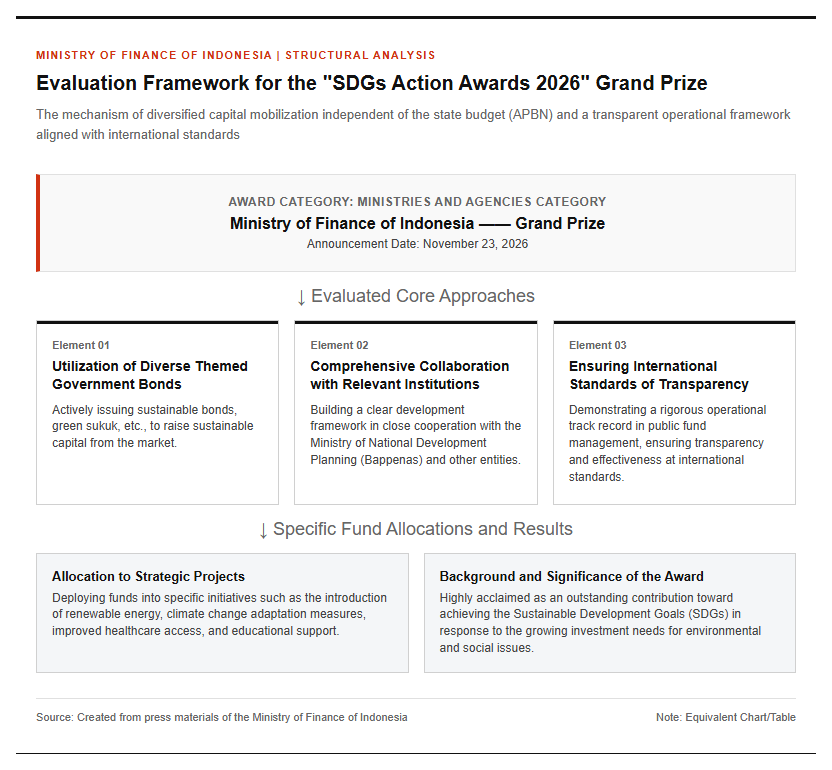
On November 23, 2026, the Indonesian Ministry of Finance announced that it had received the Grand Prize in the Ministry/Agency category at the “Indonesia SDGs Action Awards 2026.” This award recognizes institutions demonstrating excellence in efforts toward achieving the Sustainable Development Goals (SDGs). The primary factor in the Ministry’s evaluation was its proactive approach to raising and utilizing the funds necessary for sustainable projects by issuing thematic bonds (such as sustainability bonds and green sukuk) rather than relying solely on the state budget (APBN). In Indonesia, the demand for investment in environmental protection and social issue resolution is rising rapidly, leading to the development of a comprehensive framework in collaboration with relevant agencies such as the National Development Planning Agency (Bappenas). The Ministry of Finance has established a system to allocate capital obtained through bond issuances to specific projects, such as the introduction of renewable energy, climate change adaptation measures, improvement of healthcare access, and educational support. Ensuring transparency and effectiveness in the management of public funds in accordance with international standards led to this award. The following figures show the SDGs Award ceremony and a conceptual diagram of fund management.
Sustainable Financing Model via Thematic Bonds
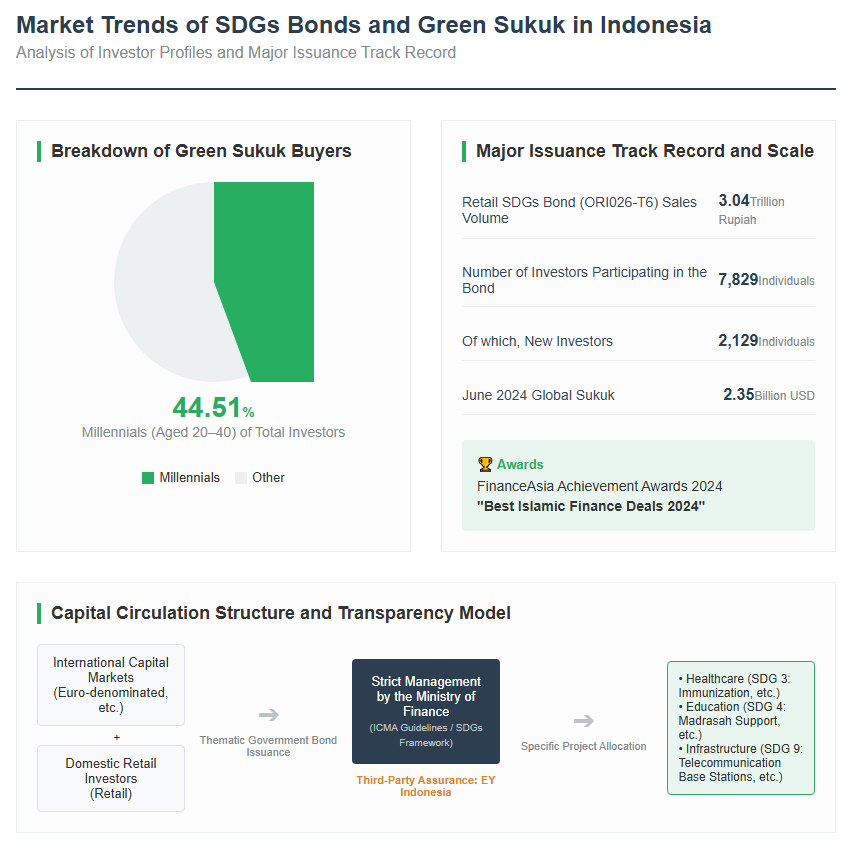
The thematic bond issuance model promoted by the Indonesian Ministry of Finance is highly regarded internationally as a groundbreaking mechanism that balances the resolution of environmental and social issues with the revitalization of financial markets. For example, in September 2021, the Ministry issued a 500 million Euro SDG bond (12-year tenor) in Euro denominations, raising sustainable development funds from international capital markets. The raised funds are strictly managed based on the International Capital Market Association (ICMA) guidelines and the country’s SDG framework. Specifically, the funds were allocated to projects such as basic immunization and the distribution of HPV/PCV vaccines by the Ministry of Health (SDG 3), development and education support programs for madrasas and primary schools through the Ministry of Religious Affairs and the Ministry of Education, Culture, Research, and Technology (SDG 4), and the installation of telecommunications base stations (BTS/Last Mile) in un-electrified and information-disparity areas by the Ministry of Communication and Informatics (SDG 9). The Ministry ensures thorough transparency in the use of funds and visibility of results by publishing impact reports and undergoing limited assurance reviews by a third-party institution, Ernst & Young (EY) Indonesia. This highly transparent management structure is considered a model for sustainable financing.
Development of SDG Bonds and Green Sukuk in Indonesia
Diverse Issuance Track Record of Green Sukuk and SDG Bonds
Indonesia is a world-leading pioneer in the field of “Green Sukuk,” which fuses Islamic financial instruments (Sukuk) with environmental investment. Since its full-scale rollout as an environmentally conscious investment in November 2019, the country has seen a succession of issuances not only through large-scale offerings for overseas institutional investors but also through retail products (such as the ST series) targeting domestic individual investors. In particular, it functions as a tool to attract the environmental awareness and investment appetite of the younger generation, with millennials aged 20–40 accounting for 44.51% of the total investor base. Furthermore, in the retail thematic bond “SDG Bond Retail (ORI026-T6)” offered from September 30 to October 24, 2024, sales reached 3.04 trillion Rupiah as of the settlement on October 30, with a total of 7,829 investors (including 2,129 new investors) participating. In international markets, the Ministry issued 2.35 billion USD in global sukuk in June 2024 and has won numerous international awards, including “Best Islamic Finance Deals 2024” at the FinanceAsia Achievement Awards 2024. The following figure shows the breakdown of the Green Sukuk purchaser demographic and its growth trends.
Clarification of Fund Use and Implementation of ESG Frameworks
The Directorate General of Budget and Risk Management (DJPPR) of the Ministry of Finance formulated the “ESG Framework and Manual,” which mandates Environmental, Social, and Governance (ESG) considerations in infrastructure development, and formally announced its introduction at a side event of the G20 Bali Summit in November 2022. This ESG policy aims to reduce climate change risks and maximize social value in Public-Private Partnership (PPP) infrastructure projects. In selecting the use of funds, the DJPPR has established a system for “budget tagging” eligible projects that contribute to national targets (NDCs) and the SDGs roadmap by utilizing “KRISNA,” an integrated planning and budgeting management system operated in cooperation with Bappenas and the Ministry of Environment and Forestry. It has received high evaluations from Norway’s climate and environmental assessment organization, CICERO Shades of Green: “Good” for its governance structure and “Medium Green” for its green bond framework. As a result, project management that balances the prevention of environmental destruction risks (through the application of environmental impact assessments such as AMDAL) with the ensuring of social justice has been realized.
Development Financing Needs, Future Outlook, and Key Focus Areas
Limitations of the APBN and Incentive Design for the Private Sector
According to estimates by the Indonesian Ministry of National Development Planning (Bappenas), the total investment required for national construction and infrastructure development over the five-year period from 2025 to 2029 will reach 47,000 trillion rupiah. However, the reality is that the proportion that the state budget (APBN) can directly bear is limited to only about 7% to 8% of the total needs. To bridge this massive funding gap, mobilizing capital from private funds, domestic and foreign institutional investors, and individual investors is indispensable. To address this challenge, the Ministry of Finance is strengthening the design of diverse incentives to promote the participation of private operators, such as providing tax expenditures, government guarantees, and utilizing blended finance. Furthermore, the ministry has deployed innovative financial products such as “Cash Waqf Linked Sukuk (CWLS)” linked to religious donations, successfully establishing mechanisms to attract small-scale and social funds into infrastructure and social development. By lowering the hurdles to infrastructure investment, the foundation for sustainable economic growth is being solidified.
Future Developments and Key Focus Areas for Sustainable Growth
The first key focus area for sustainable growth is the expansion of thematic bond issuances aimed at realizing the new National Medium-Term Development Plan (RPJMN 2025-2029), which kicks off in earnest in 2025, and “Golden Indonesia 2045 (Indonesia Emas 2045).” Even under the new Prabowo administration, the promotion of decarbonization through the Energy Transition Mechanism (ETM) and further funding allocation to climate change adaptation projects are required. The second focus area is the diversification of thematic government bonds in new areas—such as sustainability-linked sukuk and blue bonds (for marine conservation and fisheries resource management)—and the further expansion of the domestic investor base. Third, the thorough enforcement of biodiversity and forest conservation standards during project selection, alongside the continuous and timely publication of post-issuance quantitative impact evaluation reports, will be key to maintaining investor confidence. The pioneering efforts of the Indonesian Ministry of Finance in harmonizing public funds and private capital at a high level will continue to be closely watched worldwide as a model case for sustainable finance in emerging countries.
References
- 【Kementerian Keuangan Republik Indonesia】https://www.kemenkeu.go.id
- 【Direktorat Jenderal Pengelolaan Pembiayaan dan Risiko (DJPPR)】https://www.djppr.kemenkeu.go.id
- 【KPBU Kementerian Keuangan – ESG Manual】https://kpbu.kemenkeu.go.id
【#IndonesianMinistryOfFinance #SDGs #ThematicGovernmentBonds #GreenSukuk #SustainableFinance #EconomyBusiness】

コメント