
Korea’s POSCO International has completed the acquisition of U.S. shale gas field assets for $550 million. The move is driven by the group’s strategic transformation to expand from a steel-centric business structure into energy resources, as well as the need to capture soaring U.S. LNG demand.
- Acquiring Premium Gas Fields in Pennsylvania with a 0 Million Investment
- Immediate Cash Generation and Profit Structure Brought by Operating Assets
- A Major Overhaul of the Business Structure Aiming to Break Away from Steel Dependency
- U.S. LNG Demand Expansion and Asian Companies’ Competition for Resources
- Synergies of an Integrated System from Production to Liquefaction and Trading
- Risk Factors and Medium- to Long-Term Points to Watch in the North American Business
Acquiring Premium Gas Fields in Pennsylvania with a 0 Million Investment
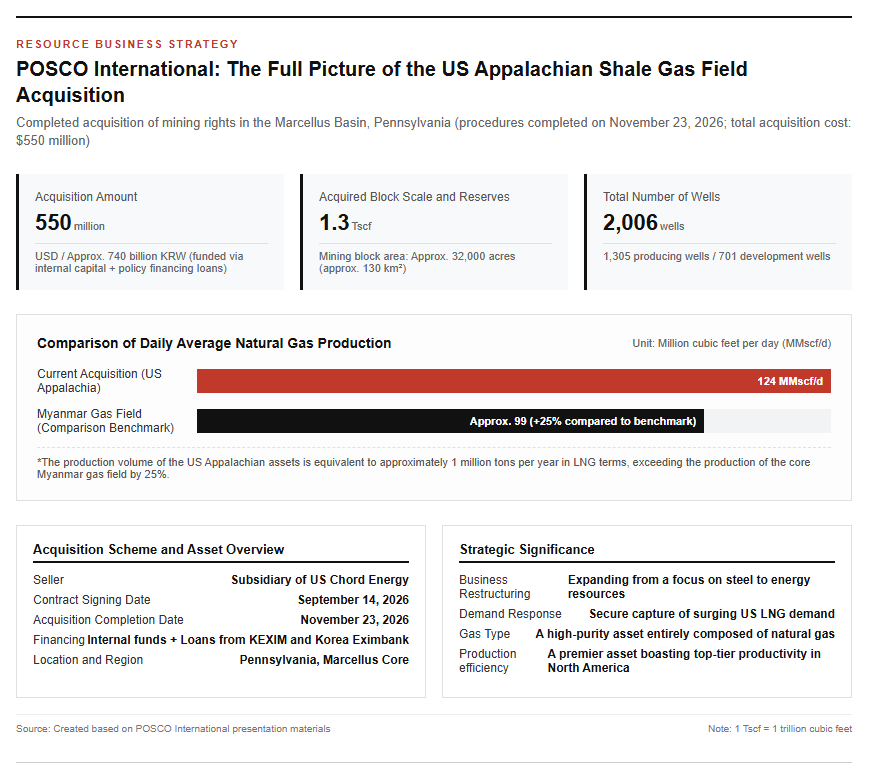
On November 23, 2026 (local time) in Houston, USA, POSCO International completed the procedures to acquire 100% of the rights to shale gas field assets in the Appalachian (Marcellus) Basin of Pennsylvania, held by a subsidiary of the U.S. company Chord Energy, for $550 million (approximately 740 billion won). The transaction was concluded in about two months following the signing of the definitive agreement on September 14, 2026. The acquisition funds were raised using internal capital alongside loans from the Korea Development Bank and the Export-Import Bank of Korea. The target assets consist of approximately 32,000 acres (about 130 square kilometers) of mineral leases located in the Marcellus Core region, which boasts some of the highest productivity in North America, comprising a total of 2,006 wells (1,305 producing wells and 701 development wells). Reserves reach 1.3 Tscf (trillion cubic feet), entirely consisting of natural gas. The daily average production is approximately 124 million cubic feet (124 MMscf/d), which is equivalent to an annual scale of about 1 million tons in liquefied natural gas (LNG) terms—surpassing the production volume of the company’s mainstay Myanmar gas field by 25%. Please refer to the map below for the positional relationship of the mineral leases and the pipeline network in the Appalachian Basin.
Immediate Cash Generation and Profit Structure Brought by Operating Assets
The defining feature of this acquisition is that, rather than targeting assets in the exploration or early development stages, the company directly acquired producing wells that are already operational and generating revenue. Consequently, without having to wait for large-scale initial capital expenditure (CAPEX), the structure enables the company to immediately enjoy revenues and cash flows from direct gas sales starting right after the acquisition is completed. These assets generated an annual average of approximately $50 million in EBITDA (earnings before interest, taxes, depreciation, and amortization) from 2023 to 2025, recording about $80 million in 2025 performance and approximately $70 million in the first quarter of 2026. While local operators manage operational controls such as production, drilling, and permitting, POSCO International directly trades the allocated gas through its own sales network. Because production costs are extremely low at under $2.0 per MMBtu relative to the Henry Hub (HH) price, the assets can maintain strong price competitiveness even during periods of sluggish gas prices. The company expects to secure operating profits averaging about 100 billion won (approximately 12 billion yen) annually from these assets between 2028 and 2040.
POSCO Group’s “Triple Core” Strategy and Background
A Major Overhaul of the Business Structure Aiming to Break Away from Steel Dependency
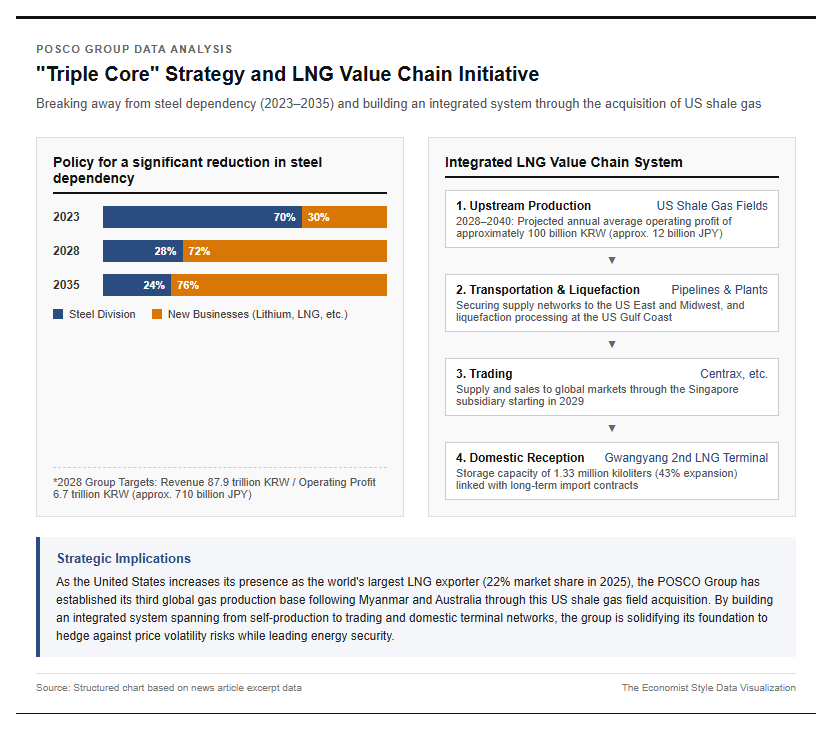
In July 2026, the POSCO Group announced its “Triple Core” strategy, shifting away from the traditional steel-centered business structure to establish “Steel,” “Lithium,” and “LNG (Energy)” as its three main pillars. In response to oversupply originating from China and sluggish steel market conditions, the company plans to reduce the sales revenue ratio of the steel division—which accounted for about 70% as of 2023—down to 28% in 2028 and 24% by 2035. As an overall group, it has set goals to achieve 87.9 trillion won in sales revenue and 6.7 trillion won (approximately 710 billion yen) in operating profit by 2028, while intensively investing 16.6 trillion won of its 29.1 trillion won investment plan into growth areas over the next three years. This acquisition of U.S. shale gas fields marks the first specific instance of securing overseas energy resources independently since the announcement of the Triple Core strategy. By establishing its third global gas production base following Myanmar and Australia (Senex Energy), the company has solidified a foundation to lead energy security beyond simply being a general trading company.
U.S. LNG Demand Expansion and Asian Companies’ Competition for Resources
The United States is a global energy supply hub boasting the world’s number one ranking in natural gas production and LNG export volume (accounting for 22% of the global share in 2025, or about 800 million tons). In recent years, due to the explosive surge in power demand driven by AI and data centers, alongside a global shift toward decarbonization, natural gas demand within the U.S. and LNG demand for the international market have been rising rapidly. LNG-related gas demand is projected to increase by about 90% by 2030 compared to 2025 levels, reaching a scale of 250 million tons, raising long-term concerns over upward trends in Henry Hub benchmark prices. Under these circumstances, major Asian companies such as those in Japan are also accelerating acquisitions of U.S. shale mineral leases to enhance energy self-sufficiency and diversify cost volatility risks. In 2025, Mitsubishi Corporation and JERA successively carried out large-scale acquisitions of upstream interests in North America, and the POSCO Group’s full-scale acquisition of interests this time is positioned as a strategic move to solidify stable North American upstream interests and the LNG value chain.
Building the LNG Value Chain and Future Outlook
Synergies of an Integrated System from Production to Liquefaction and Trading
POSCO International is not only selling produced gas locally but is also driving LNG value chain integration synergies across the entire group. Specifically, while securing pipeline transportation contracts to deliver gas to consumers in the US East and Midwest such as Ohio and New York, it also supplies a portion of the gas to liquefaction plants on the US Gulf Coast. Starting in 2029, the company plans to supply and sell liquefied gas to the global market through its Singapore-based trading subsidiary, Centrus. Furthermore, this will be linked with a long-term LNG supply contract of 400,000 tons per year with major US company Cheniere (with shipments starting in October 2026), as well as the completion of the 2nd LNG Terminal in Gwangyang, Jeollanam-do (expanding storage capacity by 43% to 1.33 million kiloliters). Through an integrated system covering self-produced gas, long-term procurement, terminals, and dedicated vessels, the company aims to maximize trading profits while hedging against price volatility. Please refer to the figure below for the value chain concept promoted by the POSCO Group, extending from upstream production to LNG trading and domestic terminals.
Risk Factors and Medium- to Long-Term Points to Watch in the North American Business
To secure medium- to long-term profitability as aimed by POSCO International, it is essential to closely monitor future changes in the market environment and operational risks. The company’s operating profit outlook of an annual average of 100 billion won through 2040 assumes the smooth progress of phased additional drilling and development plans for its 701 development wells. The US natural gas market is susceptible to market price fluctuations of Henry Hub, increases in drilling and completion costs due to inflation, and permitting environments such as regulations and environmental protection policies. Additionally, challenges include maintaining good cooperative relationships with local operators while ensuring improved production efficiency and stable operation of transportation pipelines. By linking group-wide gas demand with trading functions to offset the impacts of market fluctuations, POSCO International is expected to grow its North American business into a new pillar of revenue to compensate for the anticipated production decline phase of the Myanmar gas field in the mid-2030s.
Reference Pages
- [POSCO International Investor Presentation Materials] https://www.poscointl.com/
- [Chord Energy Press Release (IR Information)] https://ir.chordenergy.com/2026-09-16-Chord-Energy-Announces-Divestiture-of-Non-Operated-Marcellus-Assets
[#POSCO #ShaleGas #Energy #MandA #LNG #POSCOInternational]


コメント