Zendesk LLC has announced “Zendesk Unlimited,” a outcome-based pricing model tied to the number of AI-resolved issues, along with the “Outcome AI Platform,” moving away from the traditional per-seat licensing model. This shift is driven by structural changes in the industry where the autonomy of AI agents makes traditional per-seat billing models obsolete, creating a demand for pricing aligned directly with true business outcomes.
- Key Takeaways from the Announcement of the Outcome-Based AI Infrastructure “Outcome AI”
- Structural Shift from Per-Seat Billing to an “Outcome Budget”
- “Zendesk Bridge” for Integrating External AI and Open Infrastructure
- Dual Verification and Governance Design by AI Self-Assessment
- The “Seat Compression” Challenge in the SaaS Market and the Background of Outcome-Based Pricing
- Future Outlook and Key Points for Adopting Companies
Key Takeaways from the Announcement of the Outcome-Based AI Infrastructure “Outcome AI”
On November 24, 2026, Zendesk LLC announced the “Outcome AI Platform,” a new platform strategy centered on driving business outcomes, alongside “Zendesk Unlimited,” a new outcome-based pricing model. While the company has previously promoted centralized inquiry management through omnichannel integration and AI automation, Taro Mori, Representative Director and President of Zendesk, stated that the company is now advancing to a stage that supports true business outcomes such as customer retention and conversions. The company has clearly established an attitude that emphasizes results—such as customer contract renewals and employees returning to work immediately—rather than stopping at mere task completion like processing refunds or resetting passwords. The Outcome AI Platform accurately understands customer intent using customer support data accumulated over the past 20 years and more than 18 billion interactions. It features a structure that completes tasks as a seamless process across multiple applications—such as billing systems and communication tools—allowing the entire system to continuously learn and evolve from every outcome.
Structural Shift from Per-Seat Billing to an “Outcome Budget”
The defining feature of the new Zendesk Unlimited pricing structure is that it completely abolishes traditional billing models based on the number of seats or users, instead charging fees according to a pre-configured “Outcome Budget.” Since access limits within the organization are removed, additional seat fees are never incurred due to seasonal staffing fluctuations or business expansion. The billable outcomes are categorized into two types: “Conversational Outcomes,” where AI solves issues within a conversation, and “Operational AI Outcomes,” which complete automated workflows across systems. Zendesk objectively evaluates the quality and completion level of each outcome, counting only those that meet established criteria. Please refer to the figure below.
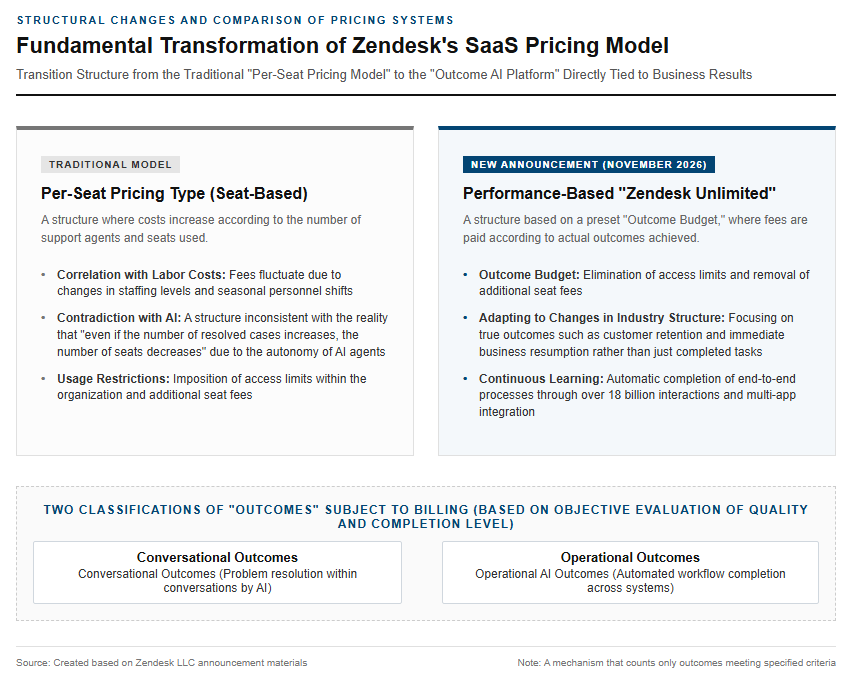
By introducing this platform, the company aims to automate over 80%—up to 84%—of support requests, reducing the time required to resolve inquiries from several hours to just a few minutes.
“Zendesk Bridge” for Integrating External AI and Open Infrastructure
In addition to the pricing changes, the announcement also unveiled “Zendesk Bridge” and the “Open Service Directory,” an integration infrastructure for external AI and applications. According to Masaki Mitsuhashi, Senior AI Sales Specialist at Zendesk, Zendesk Bridge serves to safely connect external AI agents that enterprises have already implemented in their operations with Zendesk’s data and AI tools. MCP (Model Context Protocol) and A2A (Agent-to-Agent) protocols—common standards for AI-to-AI communication and collaboration—have been adopted as connection protocols. This enables advanced integrations, such as an external AI reading product feedback within a support ticket via MCP and automatically registering it in a development management tool. Administrators can centrally manage access permissions for external AI through the agent registry. Additionally, the “Open Service Directory,” a public directory that allows personal AI assistants to correctly recognize and connect to official corporate support channels, has been launched as an early access program.
The Software Market in the AI Era and Future Outlook
Dual Verification and Governance Design by AI Self-Assessment
In performance-based models, a subject of debate within the industry is the verification transparency of “who determines the outcome.” In Zendesk’s design, in addition to the first-stage condition that a conversation has ended without human intervention, a second-stage automated determination is interposed where the AI itself reviews the conversation content to verify whether it was truly resolved. Because a single outcome is only counted after passing this dual verification, a more rigorous accuracy guarantee is achieved compared to conventional determination criteria. To enable client companies to verify expenditures and quality, the company provides usage reports including quality scores, agentic analytics, and audit trails on Zendesk Bridge. In AI governance for customer service, while retaining human involvement in high-risk decisions such as refunds and account closures, it is essential to document and visualize routing logic and the AI’s reasoning process. The Zendesk Resolution Platform uses QA functions to score AI and human interactions equally, supporting the realization of safe and reliable autonomous operations.
The “Seat Compression” Challenge in the SaaS Market and the Background of Outcome-Based Pricing
The background behind Zendesk’s transition to a performance-based model lies in a structural shift across the entire software industry. While traditional SaaS businesses have grown on a per-seat, monthly head-count pricing model, the widespread adoption of AI agents drives labor savings, leading them to face a revenue reduction risk known as “seat compression.” According to research reports, the generative AI market size for customer support automation and conversational agents is projected to expand from 7.82 billion USD in 2025 to 9.86 billion USD in 2026, and 34.12 billion USD in 2031, growing rapidly at a compound annual growth rate (CAGR) of 28.18%. Along with market expansion, client companies have come to demand concrete productivity improvements and a return on investment (ROI) rather than mere usage licenses. Please refer to the figure below.
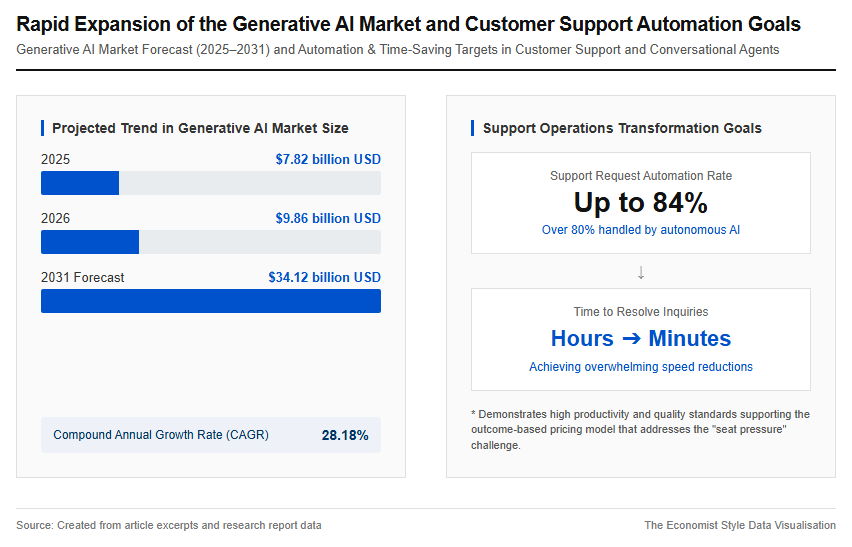
Outcome-based pricing—which defines value not by headcount, but by the number of resolved tasks—has become an inevitable choice for major software vendors to seize leadership in the AI era and reconstruct their revenue models.
Future Outlook and Key Points for Adopting Companies
Zendesk’s performance-based model, the “Outcome AI Platform Plan,” is scheduled for an official release in February 2027 following a global trial implementation spanning the past two years. This advanced performance-based initiative also influences competing major SaaS vendors such as Salesforce and Intercom, accelerating the hybridization of pricing structures across the entire industry. Meanwhile, for companies considering adoption, it is important to clearly understand contract terms such as the definition of what constitutes a “resolution,” pricing structures for overages, and dispute resolution processes. In an era where AI agents autonomously execute tasks, companies are required to shift from managing the number of licenses to outcome-based budget management centered on “how many outcomes are consumed at what unit price.” Zendesk’s transparent governance features and open integration platform will serve as an important touchstone for companies to reliably reap the fruits of their AI investments and evolve customer experience into the next generation.
Reference Pages
[#Zendesk #AIAgents #PerformanceBased #SaaS #CustomerSupport #GenerativeAI #ITTechnology]
コメント