
Oxide Computer, a provider of cloud infrastructure for on-premises environments, has raised $445 million in a Series D funding round. Behind this is a surging demand for computing resources accompanying the adoption of agentic AI and an accelerating return to on-premises infrastructure driven by the soaring costs of public clouds.
- Overview of the 5 Million Funding Announced in October 2026
- Achieving Profitability as a Hardware Company and Expanding Manufacturing Capacity
- Vertical integration design of hardware and open-source software
- Proprietary Rack Architecture and Power-Saving, High-Density Implementation
- The Wave of Agentic AI and Strategic Partnership with AMD
- Repatriation from the Public Cloud and the Future of the Enterprise
Overview of the 5 Million Funding Announced in October 2026
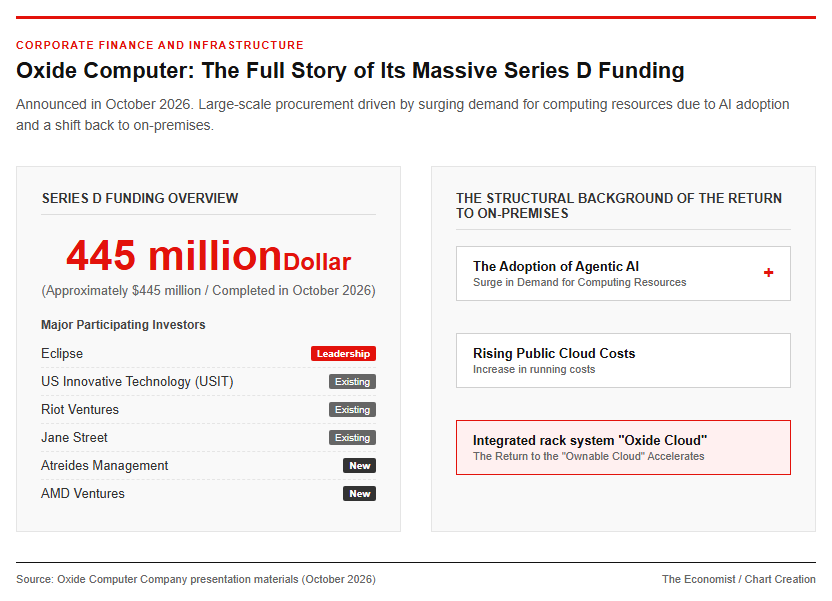
On October 9, 2026, Oxide Computer Company (hereinafter “Oxide”), headquartered in Emeryville, California, announced that it has closed a massive $445 million Series D funding round. The round was led by venture capital firm Eclipse, with participation from existing investors such as the US Innovative Technology Fund (USIT), Riot Ventures, and Jane Street. In addition, new investors Atreides Management and AMD Ventures, the investment arm of semiconductor giant AMD, joined the round.
Oxide is a hardware and software integration infrastructure company founded in 2019 by Bryan Cantrill and Steve Tuck. The company offers the “Oxide Cloud Computer,” an integrated rack system that enables enterprises to own and operate the same level of advanced automation and flexibility that hyperscale cloud providers use in their own data centers. This massive funding round proves that the “cloud you can own” concept advocated by the company is receiving strong market support in the capital-intensive hardware business. The figure below shows the company’s growth and funding trajectory.
Achieving Profitability as a Hardware Company and Expanding Manufacturing Capacity
In an exceptional achievement for a rapidly scaling hardware startup, Oxide achieved profitability in the first half of 2026. Because hardware businesses incur massive component procurement costs prior to product shipment, securing working capital is a perpetual challenge. According to Oxide CEO Steve Tuck, while the company’s manufacturing capacity has expanded 20-fold over the past 12 months, customer demand continues to outpace supply capacity.
The newly raised $445 million will be used to procure parts, expand manufacturing lines, and strengthen the supply chain in order to meet a rapidly growing backlog of orders. Rather than simply securing funds to maintain operations, the primary objective is to scale up manufacturing capacity to rapidly respond to surging demand. With customers including the Idaho National Laboratory, major financial institutions, and government agencies, the company is establishing a long-term supply system to create an environment where corporate clients can formulate decades-long infrastructure plans with confidence.
Technical Innovations in Cloud Computing
Vertical integration design of hardware and open-source software
The defining feature of Oxide Cloud Computer is that it co-designs hardware and software as an integrated whole. In traditional enterprise data centers, servers from Dell or HPE, third-party switches, and virtualization software like VMware had to be procured and configured individually, making complexity and operational costs major challenges. In contrast, Oxide provides its system as a single, integrated rack.
The software stack employs fully open-source technologies, such as the illumos-based host OS “Helios,” the Rust-written hypervisor “Propolis,” and the network control engine “OPTE.” Users can instantly provision virtual machines, block storage, and virtual networks (VPCs) via a web console, API, or SDK with the same self-service capability as a public cloud. By eliminating individual licensing costs and complex setup tasks, it combines the convenience of the cloud with on-premises security.
Proprietary Rack Architecture and Power-Saving, High-Density Implementation
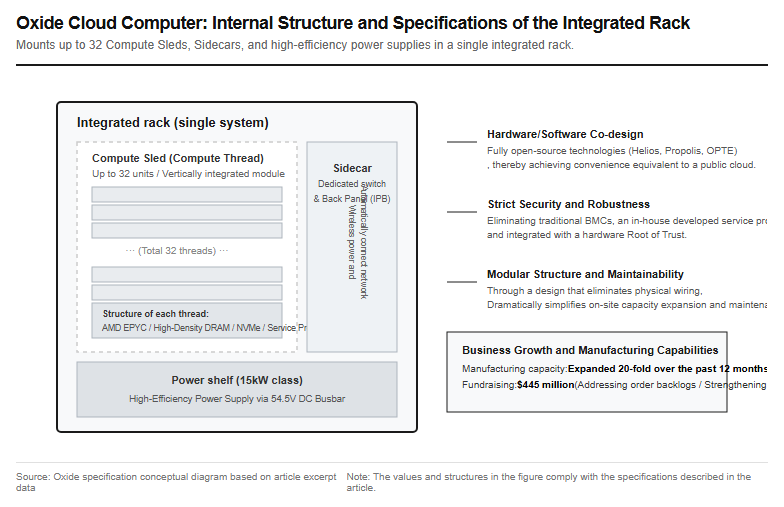
In terms of hardware configuration, Oxide adopts an architecture capable of housing up to 32 “Compute Sleds” in a single integrated rack. Each sled is equipped with an AMD EPYC processor, along with high-density DRAM and NVMe storage. Additionally, by eliminating the conventional BMC (Baseboard Management Controller) and incorporating a custom-developed service processor (SP) and a hardware Root of Trust, it achieves extremely fast boot times and robust security.
Inside the rack, a dedicated switch called “Sidecar” and a proprietary backplane (IPB: Identity and Presence Backplane) are integrated, creating a mechanism where power and network connections are established simply by inserting each sled, without the need for cabling. Furthermore, it is equipped with a 15kW-class power shelf using a 54.5V direct current (DC) busbar to provide highly efficient power delivery. The elimination of wiring work and the modular structure dramatically simplify on-site maintenance and capacity expansion. The conceptual diagram below shows the internal structure of the rack.
Infrastructure Demand in the AI Era and Future Outlook
The Wave of Agentic AI and Strategic Partnership with AMD
In recent years, the spread of “agentic AI,” which autonomously makes decisions and executes tasks, has been changing the requirements for enterprise infrastructure. In the process of integrating generative AI into practical operations—such as inference processing, data retrieval and preprocessing, and database operations—not only GPUs, but also high-bandwidth memory and powerful general-purpose CPU computing resources are essential. Oxide’s systems are capable of handling such data engineering, Spark, Ray, and CPU-based AI inference workloads with exceptional efficiency.
Against the backdrop of this technical affinity, AMD Ventures, the investment arm of semiconductor giant AMD, made a strategic investment in this Series D round. Oxide’s compute sleds employ the latest AMD EPYC processors (featuring up to 192 cores and 1.5TiB memory configurations), and the two companies are closely collaborating on both the hardware and software fronts. Going beyond the bounds of mere general-purpose servers, it is expected to evolve into a comprehensive system platform that supports AI workloads.
Repatriation from the Public Cloud and the Future of the Enterprise
While the use of public clouds continues to expand, many companies are facing unexpected cost spikes, data governance issues, and regulatory compliance problems. As data transfer fees and ongoing GPU usage costs balloon, the trend of “cloud repatriation”—moving a portion of workloads back to on-premises environments—is accelerating. In sectors such as finance, healthcare, government agencies, and national laboratories where data sovereignty and low latency are prioritized, the importance of self-owned infrastructure continues to grow.
Bryan Cantrill, CTO of Oxide, emphasizes that the company’s goal is not to be acquired, but to build an autonomous infrastructure company that will endure for generations. By achieving a high-level fusion of cloud operability with on-premises cost predictability and transparency, the Oxide Cloud Computer serves as a powerful option for companies struggling with excessive public cloud dependence. Bolstered by the $445 million in funding secured in this round, the company will further accelerate its steps toward redefining data center infrastructure.
Reference page
- [Oxide Press Release] https://www.prnewswire.com/news-releases/oxide-raises-445m-series-d-as-the-company-proves-vision-of-full-stack-cloud-infrastructure-enterprises-can-own-302903159.html
- Oxide Documentation
- 【Oxide FAQ Friday】https://oxide.computer/faq-friday/why-did-oxide-raise-445m
【#OxideComputer #CloudInfrastructure #DataCenter #Funding #Hardware #PrivateCloud #AMD】

コメント