On October 22, 2026, the Hokuriku Technology Exchange Techno Fair opened in Fukui Prefecture, featuring numerous physical AI technologies designed to address severe labor shortages. This exhibition is driven by regional challenges—specifically having the highest job-to-applicant ratio in the country—coupled with the rapid evolution of cutting-edge technologies that enable AI to autonomously make decisions and take action in the physical world.
- Hokuriku Technology Exchange Techno Fair 2026 Event Overview
- Current Situation and Challenges of the Labor Shortage Faced by Fukui Prefecture
- Demonstration exhibition ranging from autonomous transport to precise picking
- Technological Leap and Structure from Conventional Robots
- The Non-Technical Barriers of Safety, Legal Liability, and Operational Suitability
- Future Outlook and Key Points for Sustainable Social Implementation
Hokuriku Technology Exchange Techno Fair 2026 Event Overview
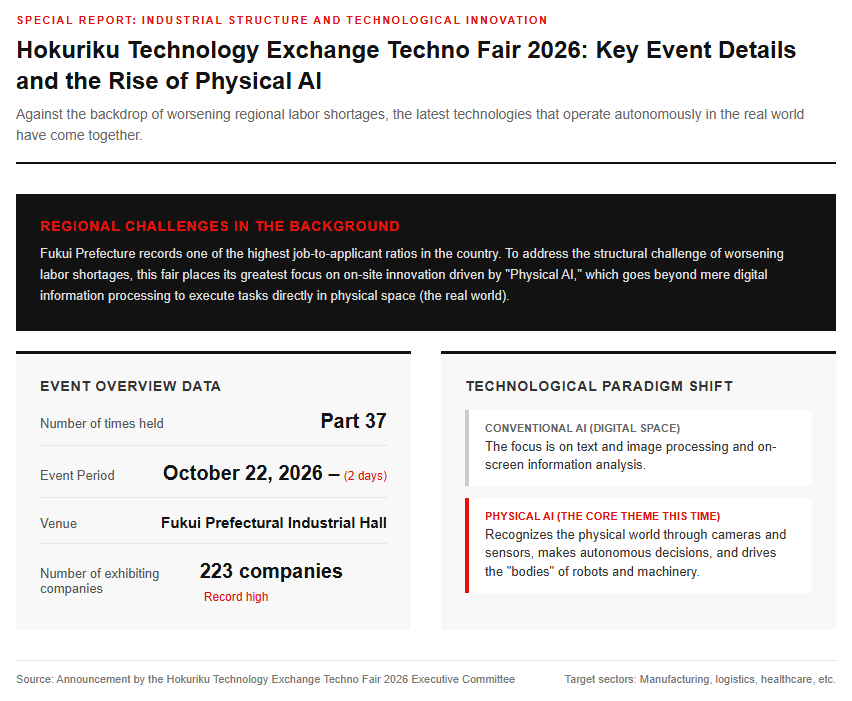
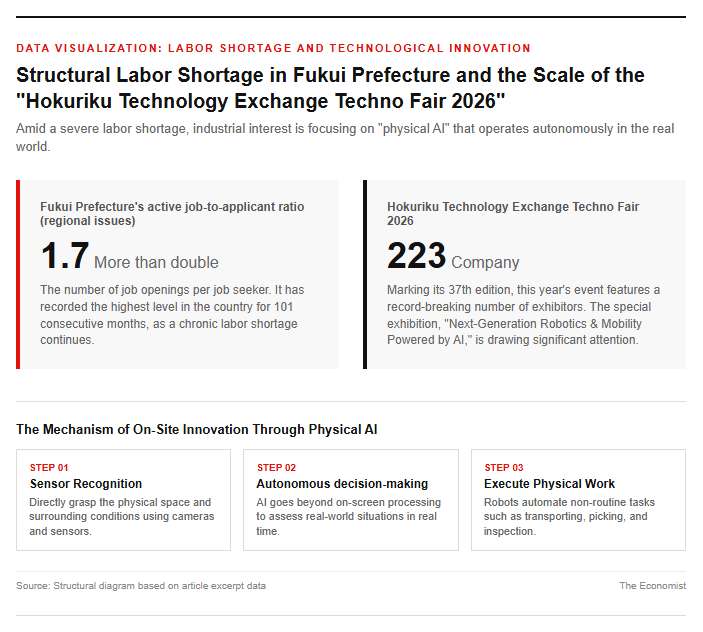
On October 22, 2026, the “Hokuriku Technology Exchange Techno Fair 2026” kicked off for a two-day run at the Fukui Prefectural Industrial Hall in Fukui City, Fukui Prefecture. Marking its 37th edition, the fair features a record-breaking 223 companies setting up exhibition booths, fostering technology exchanges that transcend industry and regional boundaries. Front and center as the primary theme of this comprehensive technology exhibition is physical AI, showcased largely through the special exhibition “Next-Generation Robotics & Mobility Exhibition Powered by AI.” Physical AI refers to a technological domain that goes beyond conventional AI processing text and images in digital spaces; it directly recognizes the real world (physical space) through cameras and various sensors, autonomously assesses situations, and operates the “bodies” of robots and machinery. As the role of AI evolves from on-screen information processing to executing tasks in the physical world, the fair brings together cutting-edge technologies aimed at innovating operations in fields such as manufacturing, logistics, and healthcare.
Current Situation and Challenges of the Labor Shortage Faced by Fukui Prefecture
The strong attention on physical AI at the Hokuriku Technology Exchange Techno Fair is driven by the severe structural labor shortage facing its host prefecture, Fukui. While Fukui Prefecture is a hub for manufacturing industries such as precision machinery parts, textiles, and electronic components, its active job-opening-to-applicant ratio—which indicates how many job openings exist per job seeker—has recorded the highest level in the country for 101 consecutive months. With more than 1.7 job openings per person looking for work, the chronic labor shortage has become the biggest concern for maintaining regional industries and plant operations. Amid advancing declining birthrates, aging populations, and depopulation, demand is surging to replace tasks that previously relied on human labor—such as transport, picking, and equipment inspection—with robots. As a result, expectations for physical AI are growing as a workforce capable of collaborating with humans or automating on-site operations.
Latest Technologies in Physical AI Operating in the Field
Demonstration exhibition ranging from autonomous transport to precise picking
At the techno fair venue, live demonstrations were conducted by physical AI robots in various forms. GARobotics unveiled a robot that recognizes voice commands, autonomously navigates while avoiding surrounding obstacles using a camera, and transports cargo to its destination. Additionally, Thinker Co., Ltd. exhibited the bin-picking robot “Thinker Model A” equipped with the “Think Hand F” robot hand, showcasing automated packaging operations linked with a tabletop packaging machine and high-precision demonstrations of blindly mating connectors. Furthermore, Akatsuki AI Technologies displayed a bipedal walking humanoid aimed at collaboration in construction and nursing care sites, as well as a quadrupedal dog-shaped robot utilized for inspecting hazardous areas where humans cannot enter. These exhibits demonstrate adaptability to non-routine tasks that was impossible with conventional rigid automation equipment.
Technological Leap and Structure from Conventional Robots
What makes physical AI significantly different from conventional industrial robots is its flexibility to autonomously adjust its movements in response to environmental fluctuations, rather than simply repeating predetermined procedures. Supporting this leap forward is the VLA (Vision-Language-Action) model, which integrates and batch-processes visual information, natural language instructions, and action generation. Furthermore, with the introduction of world models—where AI understands physical laws and simulates the outcomes of its actions—a structure is being established to prevent unpredictable accidents and enhance the reliability of operations. According to the “AI Robotics Strategy” formulated by the Ministry of Economy, Trade and Industry in March 2026, Japan is promoting integrated technological development with the aim of capturing a 20 trillion yen share of the versatile robot market, which is projected to grow to a global scale of approximately 60 trillion yen by 2040.
Challenges Toward Societal Implementation and Future Outlook
The Non-Technical Barriers of Safety, Legal Liability, and Operational Suitability
While the technical performance of physical AI is improving, structural bottlenecks other than technical aspects are becoming apparent in its social implementation in the field. Unlike generative AI, whose errors are confined to on-screen outputs, misjudgments by physical AI operating in physical space directly lead to physical damage, such as personal injury, equipment destruction, and misdelivery. Because software updates after shipment (OTA) alter a product’s behavior and safety, legal clarification is needed regarding the timing for determining defects under the Product Liability Act (PL Act) and the duration of liability pursuit. In the guidelines published by the Ministry of Economy, Trade and Industry in April 2026, applications are classified into “auxiliary/support types,” which involve human final judgment, and “reliance/substitution types,” where AI substitutes for judgment. It is required to clarify the recording of operation logs, update authority, and liability demarcation for damages in contracts between implementing companies and manufacturers.
Future Outlook and Key Points for Sustainable Social Implementation
The success or failure of future social implementation depends on how well we can avoid excessive, customized tuning for individual sites and instead build a common infrastructure that can be deployed horizontally. While Japan boasts strengths such as an industrial robot manufacturing base holding a global market share of approximately 38% and a wealth of on-site data, a shortage of robot SIer capabilities responsible for deployment is considered a challenge. Moving forward, integrated support measures combining industrial structure and policy are drawing attention, such as the establishment of joint ventures (JVs) between AI vendors and user companies, and the introduction of subsidies for the demand side conditioned on domestic data management (data sovereignty). Building systems that achieve both reliability and safety through the accumulation of learning in simulation environments and demonstration experiments during normal times will be the key to supporting the sustainable growth of industries facing labor shortages.
Reference page
- 【National Institute of Advanced Industrial Science and Technology (AIST)】 Hokuriku Digital Manufacturing Center Event Exhibition Information https://www.aist.go.jp/hokuriku/ja/news/event/event_20261022.html
- [Ministry of Economy, Trade and Industry (METI)] Guidelines on the Interpretation and Application of Civil Liability in the Utilization of AI https://www.meti.go.jp/press/2026/04/20260409001/20260409001.html
【#PhysicalAI #HokurikuTechnologyExchangeTechnoFair #Robotics #LaborShortageResolution #SocialImplementation #AutomationTechnology #FukuiPrefecture】

コメント