
Miroku Information Service Co., Ltd. has announced that it will launch “Edge Tracker Expense Claim II” in December 2026 as the successor to its cloud-based expense management service, “Edge Tracker Expense Claim.” Against the backdrop of recent severe labor shortages, the new service aims to reduce the burden on the entire back office—ranging from applications and approvals to accounting and payment operations—and improve productivity.
- Section 1-1: Key Points of the Announcement and the Positioning of the Successor Service “Edge Tracker Expense Claim II”
- Section 1-2: Labor Shortages and Challenges in Back-Office Operations
- Section 2-1: Revision of Screen Design and Multi-Device Support
- Section 2-2: Evolution of AI-OCR Functions Compatible with the Invoice System
- Section 1-1 [Note: Section 3-1 translated accurately]: Data Integration with MJS Financial and Accounting Systems and Duplicate Application Detection
- Section 3-2: Streamlining Payments via Bank Transfer Data Output and Rakutasu Transfer Integration
- Section 4-1: Electronic Bookkeeping Act Option Scheduled for March 2027 and Future Prospects
Section 1-1: Key Points of the Announcement and the Positioning of the Successor Service “Edge Tracker Expense Claim II”
Miroku Information Service Co., Ltd. (hereinafter MJS), a provider of financial accounting systems and business information services, announced on November 24, 2026, that it will begin offering the cloud-based expense management service “Edge Tracker Expense Claim II” in December 2026. Positioned as the successor to the previously offered “Edge Tracker Expense Claim,” this service features a comprehensively redesigned function incorporating the latest cloud technology and user experience. Designed to support multi-device environments, it enables users to quickly access and operate the system not only from personal computers but also from smartphones and other devices. Implementation is progressing as an integrated solution that not only reduces the hassle of daily expense applications for employees but also significantly lowers management costs for approvers and the accounting department.
Section 1-2: Labor Shortages and Challenges in Back-Office Operations
In recent years, labor shortages have been growing across many companies, making the promotion of operational efficiency and digitalization an extremely important management challenge. In expense management operations in particular, a wide range of tasks relies heavily on manual labor—ranging from application work by employees and approval procedures by supervisors to payment processing, journal entry generation, and transcription into core systems by accounting personnel—which has been a factor increasing the burden on the front lines. The growing need to standardize this series of complex processes and promote automation while mitigating risks such as input errors and duplicate applications serves as a strong background for the development of the new service.
Chapter 2: Improving On-Site Operability through AI-OCR and UI/UX Renewal
Section 2-1: Revision of Screen Design and Multi-Device Support
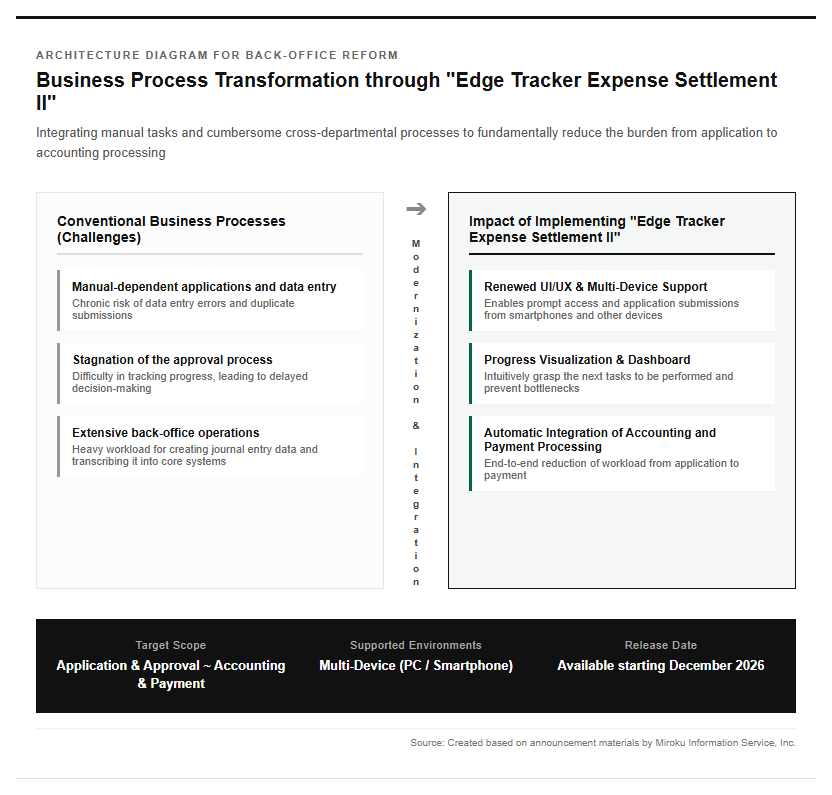
In “Edge Tracker Expense Claim II,” a comprehensive overhaul of the screen design and operational flow was carried out from the perspectives of applicants and approvers. On the home screen, tasks that need to be performed next and the progress status of approvals are displayed in an easily understandable organization, allowing users to intuitively determine what actions they need to take right now. A design has been adopted that utilizes a progress visualization function to prevent stagnation in the approval process and support prompt decision-making. The multi-device design, which is independent of terminals, makes it possible to complete application and approval work without delay even while on the go or in a remote work environment. Please refer to the screen image below.
Section 2-2: Evolution of AI-OCR Functions Compatible with the Invoice System
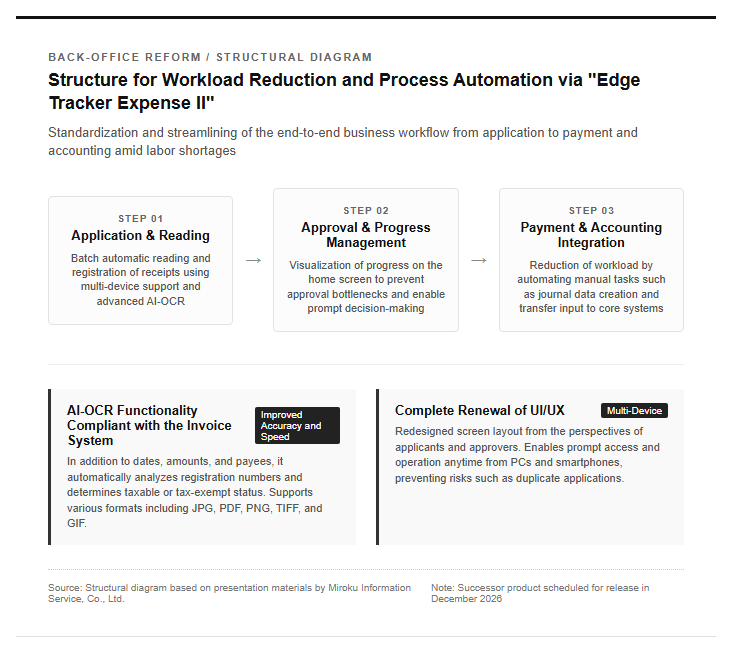
To significantly save labor in employee data entry work, the latest AI-OCR (Optical Character Recognition) function comes as a standard feature. Along with the renewal of the recognition engine, the image reading speed and recognition accuracy for receipts have been dramatically improved compared to previous products. It is equipped with a function that automatically analyzes and extracts the registration number, which is crucial under the invoice system, in addition to the date, amount, and payee listed on the receipt. Based on the acquired registration number, the system is designed to automatically determine whether the vendor is a taxable or tax-exempt business operator. Supported file formats cover standard JPG and PDF, as well as major image formats such as PNG, TIFF, and GIF. On the web version screen, users can proceed with batch registration work while comparing multiple receipt images and input fields side by side. The detailed confirmation screen is as follows.
Chapter 3: Seamless Integration with Accounting Systems and Payment Operations
Section 1-1 [Note: Section 3-1 translated accurately]: Data Integration with MJS Financial and Accounting Systems and Duplicate Application Detection
As a measure to enhance the practical efficiency of accounting personnel, advanced data integration functions with various financial and accounting systems deployed by MJS have been established. Major target systems for integration include “Galileopt DX Financial General,” “MJSLINK DX Financial General,” “ACELINK NX-Pro Accounting General,” and “ACELINK NX-CE Accounting.” Expense data for which application and approval have been completed are smoothly integrated as journal data and master information, preventing manual journal entry and transcription work. Furthermore, automatic cross-checking within the system detects expenses that have been applied for in duplicate in the past, thereby improving internal controls and operational quality. Even when utilizing accounting software from other companies, flexible data integration is possible via CSV formats.
Section 3-2: Streamlining Payments via Bank Transfer Data Output and Rakutasu Transfer Integration
Based on approved expense information, a function to create and export bank transfer data (FB data) compliant with the Zengin Data Code (All Banks Association format) is built-in as a standard feature. Furthermore, by utilizing API integration with “Rakutasu Furikomi,” a transfer agency service provided by MJS, the automation of transfer operations and overall payment operations, as well as seamless operation, is achieved. Regarding service usage fees, the initial registration fee is 50,000 yen (excluding tax), and the monthly usage fee applies a structure according to the scale of use. Specific monthly fees (excluding tax) are set at 14,000 yen for 20 users, 27,000 yen for 50 users, 37,000 yen for 100 users, and 80,000 yen for 300 users, making it easy to adopt according to the scale of mid-sized and small-to-medium enterprises.
Chapter 4: Compliance with the Electronic Bookkeeping Act, Future Developments, and Key Points
Section 4-1: Electronic Bookkeeping Act Option Scheduled for March 2027 and Future Prospects
As part of future feature expansion plans, an optional feature compliant with the “Electronic Bookkeeping Act” is scheduled for release in March 2027. By introducing this option and linking it with “MJS e-Document Cloud,” proof data such as approved receipts are automatically saved to the cloud, enabling automatic time-stamping and tamper-detection functions based on legal requirements. Unified management combined with other evidentiary documents such as invoices becomes possible, achieving future paperless operations and enhanced governance. Additionally, accompanying the launch, an online seminar is scheduled to be held on January 20, 2027, from 10:00 to 11:00 AM, where operational demonstrations using actual screens will be showcased. Market expansion is anticipated going forward as a highly注目 (noteworthy) service aimed at promoting back-office DX.
Reference Page
- [Cloud-Based New Expense Reimbursement Service “Edge Tracker Expense Reimbursement II” to Launch in December 2026 | News Release | Miroku Information Service Co., Ltd.] https://www.mjs.co.jp/products/edgetracker/keihi/
[#MirokuInformationService #EdgeTrackerExpenseReimbursementII #CloudExpenseReimbursement #AIOCR #InvoiceSystem #BackOfficeDX #AccountingEfficiency]

コメント