Stronger-than-expected figures for the US Personal Consumption Expenditures (PCE) price index and revised Q3 GDP for October 2026 have made a further rate hike by the Fed in December all but certain. This is driven by persistent inflation fueled by high crude oil prices and AI demand, alongside robust US economic growth.
- Core PCE Up 3.3% and GDP Upwardly Revised to 4.3%
- Probability of Additional Rate Hike at December FOMC Surges to 98%
- Financial Markets Hit Hard by Tech Sell-off and Rising Interest Rates
- Structural Factors Intertwined: High Oil Prices, New Tariffs, and AI Investment
- The Equilibrium Point Between Nominal GDP Growth and Prolonged High Interest Rates
- Focus of the Next FOMC and Global Economic Outlook
Core PCE Up 3.3% and GDP Upwardly Revised to 4.3%
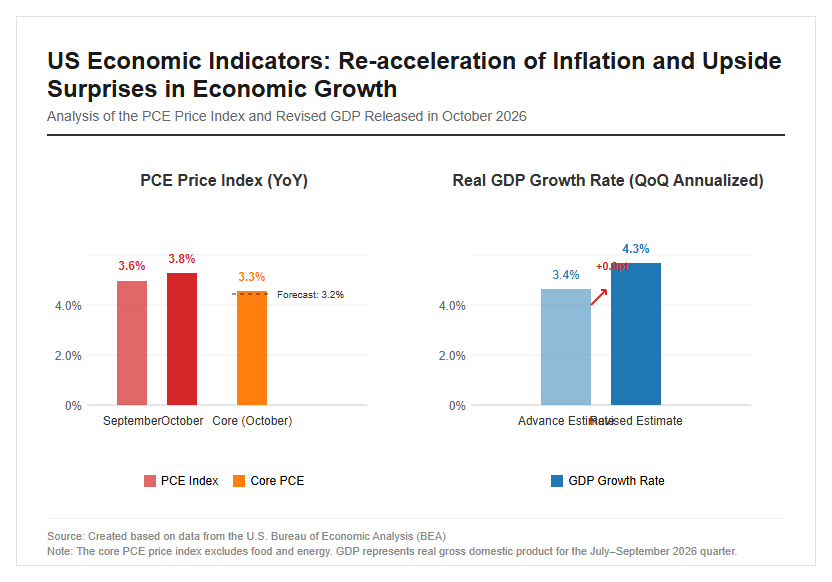
The Personal Consumption Expenditures (PCE) price index for October 2026, released by the US Bureau of Economic Analysis, rose by 3.8% year-over-year, accelerating from 3.6% in September. Notably, the core PCE price index—which excludes food and energy and is most closely watched by the Federal Reserve as an underlying inflation trend—recorded a 3.3% increase compared to the same month last year. This exceeded the market consensus of 3.2% by 0.1 percentage points, marking the largest growth rate since November 2023. On a month-over-month basis, it also rose by 0.3% for the third consecutive month, indicating a prolonged period of sticky inflation. Meanwhile, the revised real Gross Domestic Product (GDP) growth rate for the July–September 2026 quarter was significantly upwardly revised to an annualized rate of 4.3% from the preliminary figure of 3.4%. This was driven by capital expenditures, intellectual property investments, and personal consumption significantly outperforming by shaking off downward pressures. Please refer to the figure below.
Initial jobless claims, released concurrently, also remained at a historically low level of 189,000, once again confirming the robustness of the US labor market and general economic overheating.
Probability of Additional Rate Hike at December FOMC Surges to 98%
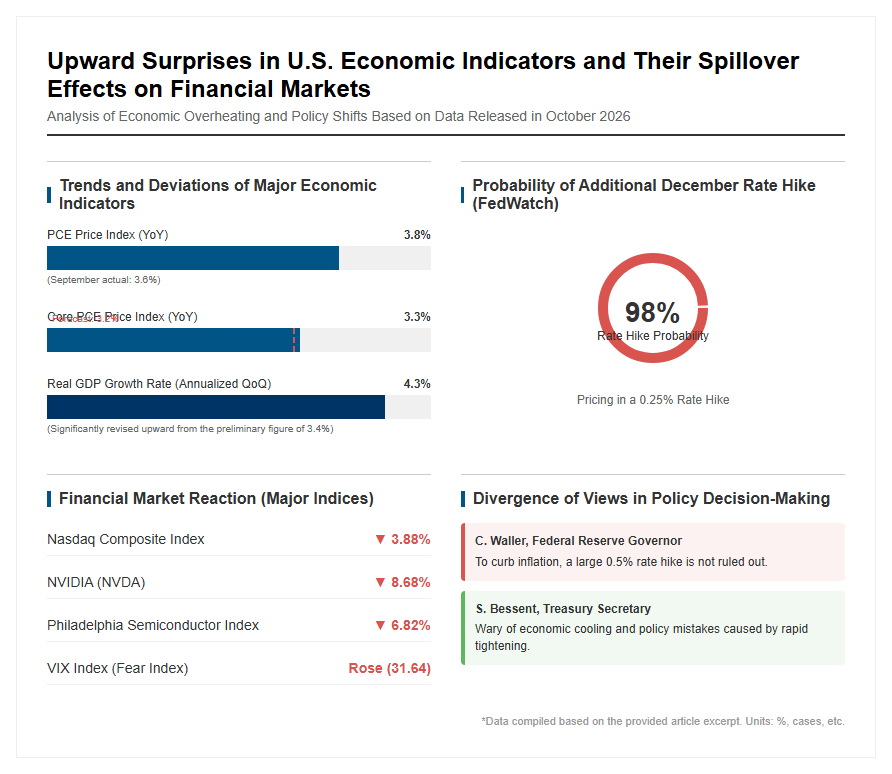
Following the string of upside surprises in economic indicators, expectations in financial markets for an additional rate hike by the Fed at the upcoming Federal Open Market Committee (FOMC) meeting on December 8–9 have become definitive. According to the CME FedWatch Tool, the probability of a 0.25% rate hike in December priced in by the market briefly reached 97.8% to 98%, virtually eliminating the scenario of a pause. The Fed implemented its first rate hike in 3 years and 2 months in September 2026, raising the federal funds rate target range to 3.75%–4.00%, and is now expected to resume its tightening cycle following a pause at the October meeting. Market interest has already moved beyond the December rate hike to focus on whether consecutive rate hikes will occur at the January 2027 meeting, with opinions divided among Fed officials and experts.
– Federal Reserve Governor Christopher Waller has hinted at the possibility of not ruling out a larger 0.5% rate hike to curb prices.
– On the other hand, Treasury Secretary Scott Bessent and others have expressed caution regarding the risks of economic cooling and excessive policy mistakes stemming from rapid monetary tightening.
Spillover to Markets and Financial Conditions, and Structural Inflation Factors
Financial Markets Hit Hard by Tech Sell-off and Rising Interest Rates
Hit directly by strong inflation statistics and expectations of accelerating rate hikes, US financial markets were forced into a broad-based sell-off. Selling orders flooded in, particularly for high-P/E (price-to-earnings) technology stocks that are sensitive to rising interest rates. The Nasdaq Composite Index briefly fell by 3.88%, and the S&P 500 Index also fell below the key 7,100-point milestone. Nvidia, which has led the AI and semiconductor market, plunged 8.68%, while the Philadelphia Semiconductor Index recorded a 6.82% decline. The VIX index, which measures market fear, surged to 31.64. Please refer to the figure below.
In the bond market, the yield on the US 10-year Treasury note fluctuated upward to briefly touch the 4.85% level, and the persistence of high long-term interest rates is diminishing the relative attractiveness of equities. Furthermore, spot gold prices—considered a safe-haven asset that yields no interest—also faced selling pressure, plunging over 2% to drop below $3,470 per ounce. In the foreign exchange market, dollar buying progressed against the backdrop of persistently high US interest rates, with the USD/JPY exchange rate moving in the low 159 yen range and approaching the 160 yen mark, a level that triggers vigilance for potential intervention by Japanese currency authorities.
Structural Factors Intertwined: High Oil Prices, New Tariffs, and AI Investment
The background of this re-acceleration of inflation involves a complex interplay of multiple structural factors that go beyond mere demand overheating. First, the escalation of tensions in the Middle East, triggered by attacks on Iran by the United States and Israel, has caused significant increases in energy prices, including crude oil, driving up transportation and raw material costs. Second, the United States Trade Representative (USTR) has announced a new proposal for Section 301 tariffs targeting 14 economies, including China, the European Union (EU), and Taiwan, based on an eight-month investigation into excess production capacity. Concerns over the introduction of these new tariffs are being factored in as a driver for increased supply chain costs. Third, there is the massive demand for data center construction and capital expenditure driven by the rapid proliferation of generative AI. Large tech companies (hyperscalers) are issuing massive amounts of corporate bonds, which is absorbing long-term funds and causing a “reverse crowding out” phenomenon that pushes up government bond yields. Furthermore, labor supply constraints and upward pressure on wages resulting from the retirement of the senior population since the COVID-19 pandemic are supporting the persistence of high service prices.
Macroeconomic Challenges and Key Points to Watch
The Equilibrium Point Between Nominal GDP Growth and Prolonged High Interest Rates
With long-term interest rates reaching high levels around 5%, discussions regarding the long-term impact on the stock market and the real economy are intensifying. According to historical data, during periods when the U.S. nominal GDP growth rate exceeds the 10-year Treasury yield, corporate earnings tend to maintain an expansionary trend even if interest rate levels themselves are high. When nominal GDP growth is robust, moderate interest rate increases are often absorbed by the stock market as “good rate hikes” reflecting the strength of economic activity. However, if rapid interest rate increases continue or if real personal consumption growth remains sluggish after inflation adjustments, negative impacts on corporate earnings and households will be unavoidable. Although nominal personal consumption increased by 0.3% in October, it remained flat on a real basis. Concerns for the future include the compression of real disposable income due to high inflation and declining consumer sentiment among low- and middle-income groups who do not hold stocks. Prolonged high interest rates will act as a significant weight for housing investment and startups that are highly dependent on borrowing.
Focus of the Next FOMC and Global Economic Outlook
In forecasting the future course of the global economy and financial markets, the FOMC policy meeting to be held on December 8–9, along with the policy interest rate outlook (dot chart) to be released simultaneously, will be the primary point of interest. The focus will be on what terminal rate the median interest rate forecast of FRB members indicates toward 2027. There is a persistent concern in the market that high interest rates will be maintained until early spring 2027 due to delays in inflation convergence. Careful attention must also be paid to policy synchronization with the central banks of other major nations.
– The European Central Bank (ECB) is also wary of soaring energy prices during the winter and has suggested additional rate hikes at its December meeting.
– The Bank of Japan is also widely expected to implement a 0.25% rate hike at its December meeting against the backdrop of an upward trend in underlying inflation, raising the risk that simultaneous monetary tightening by the U.S. and Japan could lead to a global tightening of liquidity.
Amid the determination of major central banks to curb inflation and the complex intersection of AI demand and geopolitical risks, investors must carefully monitor trends in macroeconomic indicators.
Reference Pages
- 【Global Market Outlook as Discussed by J.P. Morgan Asset Management Strategists】https://am.jpmorgan.com/jp/ja/asset-management/per/insights/market-insights/on-the-minds-of-investors/strategist-views-2026q4-03/
【#USEconomy #FRB #Inflation #PCEPriceIndex #StockMarket #InterestRateTrends #FOMC】

コメント