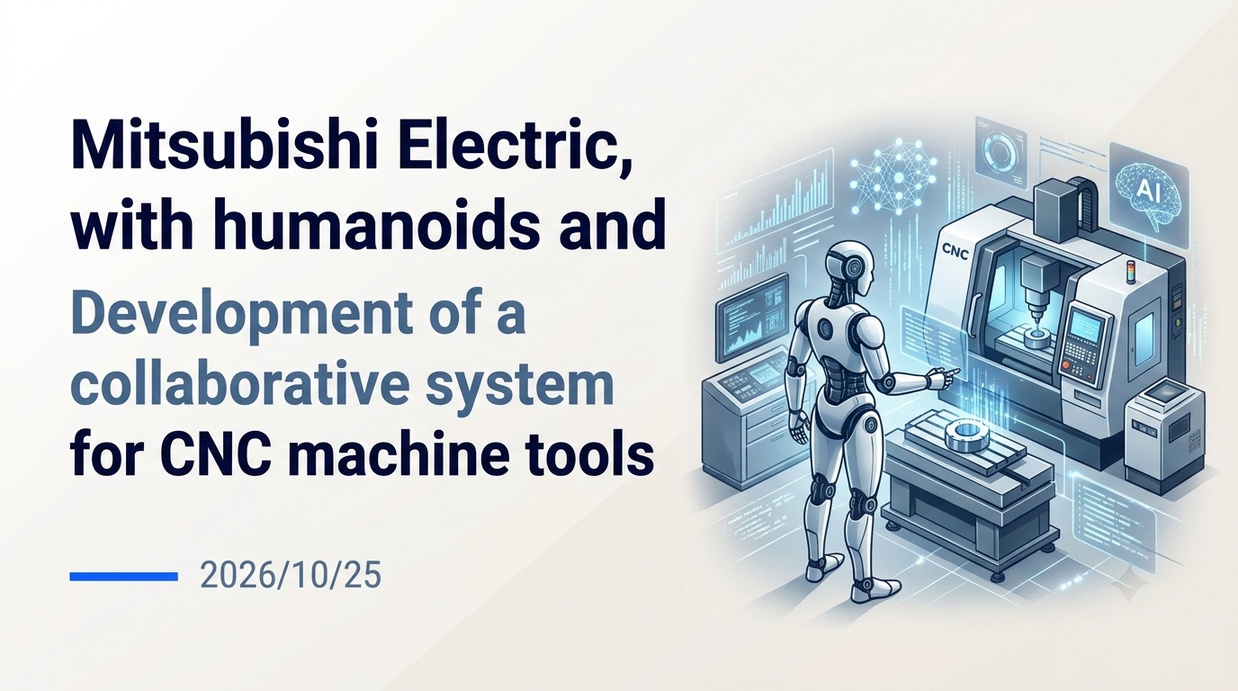
Mitsubishi Electric Corporation has developed a machining system that utilizes physical AI to seamlessly coordinate humanoid robots and CNC machine tools. Behind this development are challenges such as severe labor shortages at manufacturing sites, as well as the implementation costs and setup complexity associated with conventional industrial robots.
- Key event: Announcement of a collaborative system between humanoids and CNC machine tools
- Three System Components Supporting Physical AI
- The Intensifying Labor Shortage and Barriers to Adopting Conventional Industrial Robots
- The Advantages of Humanoids That Leverage Human-Designed Work Environments As-Is
- Redesigning the Division of Roles Between Humans and Machines with the Introduction of Physical AI
- Future Developments and Key Focus Areas: Exhibition Demos and Challenges Toward 2030 Practical Application
Key event: Announcement of a collaborative system between humanoids and CNC machine tools
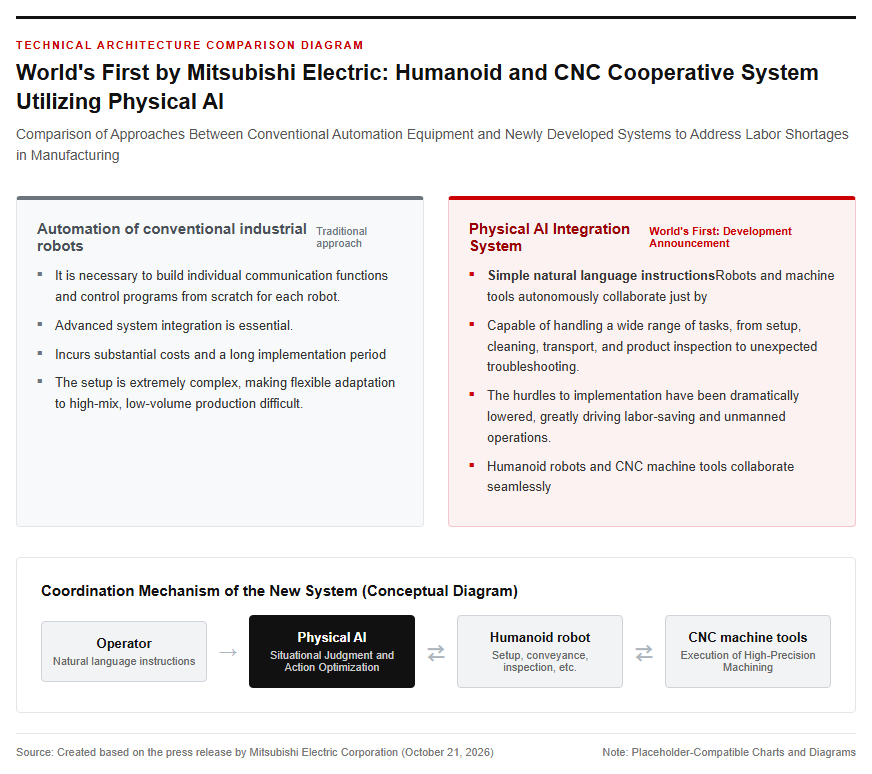
On October 21, 2026, Mitsubishi Electric Corporation announced the development of the industry’s first “machining system in which humanoid robots and CNC (Computer Numerical Control) machine tools seamlessly collaborate via physical AI.” According to the company’s research, this is the world’s first initiative for an NC system designed on the premise of integration with humanoid robots. This system makes it easy to replace a wide range of tasks with humanoid robots—tasks that were previously performed manually by operators on the machining floor, ranging from setup work such as placing workpieces into machine tools, post-machining cleanup, removing finished products, and inter-process transport to product inspection and even response to unexpected troubles. With conventional automation equipment, advanced system integration was essential to build individual communication functions and control programs from scratch for each robot, requiring enormous costs and time. In this new development, robots and machine tools operate autonomously in cooperation and coordination based simply on natural language instructions, dramatically lowering the hurdle for implementation and attracting attention as a major breakthrough toward realizing labor savings and unmanned operations in manufacturing sites. Please refer to the figure below.
Three System Components Supporting Physical AI
The machining system announced this time consists mainly of three key elements to achieve autonomous cooperative operation. The first element is the AI machining task planner, which receives natural language instructions from the operator, automatically generates a series of tasks required for the machining process, and optimally allocates and manages the work between the machine tools and humanoid robots. The second element is a CNC machine tool equipped with physical AI, which executes high-precision machining while exchanging operational information and work status with each other in natural language. The third element is a general-purpose humanoid robot not limited to any specific manufacturer. Among these, newly developed physical AI based on Maisart (Mitsubishi Electric’s AI creates the State-of-the-ART in technology)—Mitsubishi Electric’s AI technology brand—is incorporated into the AI machining task planner and CNC machine tools. Physical AI is a technology that highly recognizes, controls, and optimizes sensory data and movements in the physical world. This completes a system that allows operators to autonomously perform advanced collaborative machining simply by giving instructions in an interactive format without the need for specialized programming.
Challenges in Manufacturing and the Inevitability of Automation
The Intensifying Labor Shortage and Barriers to Adopting Conventional Industrial Robots
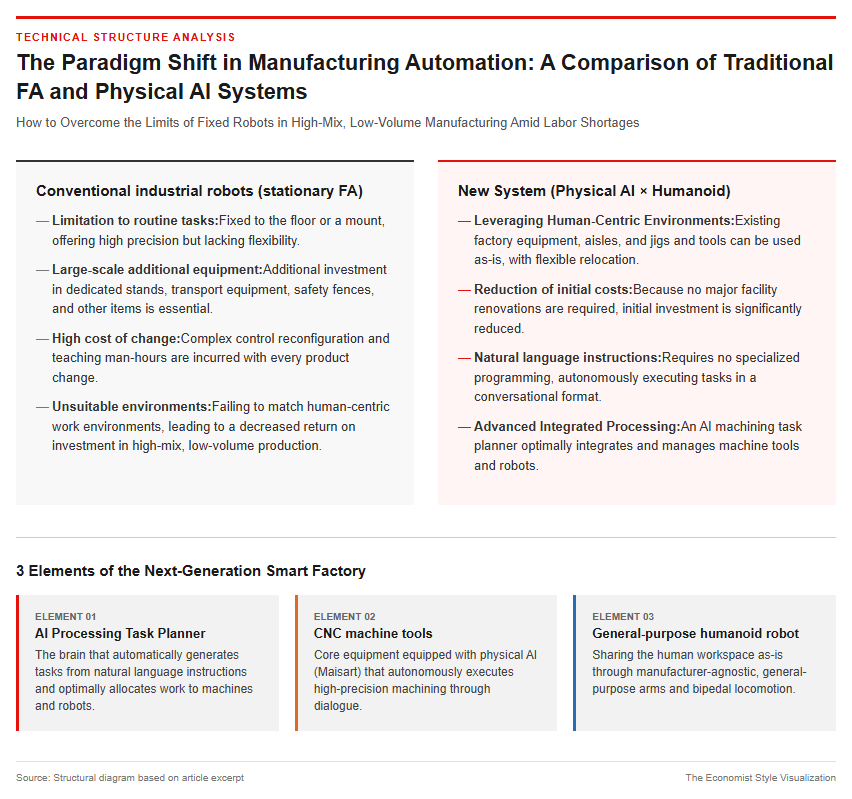
In modern manufacturing, the shortage of skilled operators due to the declining birthrate, aging population, and shrinking labor force has become a critical management issue, and the demand for labor-saving and unmanned production lines is higher than ever before. However, industrial robots used in conventional factory automation (FA) are fixed to floors or mounts and excel at “routine tasks” that involve repeating prescribed movements with high precision and high speed, but they have tended to lack flexibility. In particular, setup tasks such as accurately placing workpieces like metal materials inside machine tools and cleaning up cutting chips are performed in work environments designed around human physical characteristics and decision-making capabilities. Therefore, attempting to substitute them with fixed industrial robots requires large-scale additional capital investments in dedicated mounts, transfer devices, and safety fences. Furthermore, every time the product shape or process changes, complex control sequence reconstruction and teaching man-hours arise, and in high-mix, low-volume production sites, there are many cases where the return on investment cannot be justified. These limitations of conventional, fixed equipment have been a major barrier preventing the progress of comprehensive automation on the manufacturing floor.
The Advantages of Humanoids That Leverage Human-Designed Work Environments As-Is
As a way to overcome the limitations of stationary robots, expectations for humanoid robots equipped with bipedal walking and multi-jointed arms are growing worldwide. The greatest strength of humanoids lies in their versatility and relocation flexibility, allowing them to directly utilize existing factory equipment, pathways, and jigs and tools designed for humans. Because they can be placed directly into existing workspaces without conventional equipment modifications, it is possible to significantly reduce initial capital investment costs. However, to link humanoids with machine tools, communication protocols and control algorithms—which vary by robot model—must be connected and adjusted, making the difficulty of technical integration a newly emerging challenge. The system developed by Mitsubishi Electric solves this by absorbing the interoperability of this communication and control through physical AI and a natural language interface. This creates an environment where, while preserving the advantages of existing work environments, even on-site workers without advanced knowledge can safely and smoothly integrate humanoids, paving the way for the realization of flexible, next-generation smart factories. Please refer to the figure below.
Perspectives on Management and Organizational Transformation toward Practical Application
Redesigning the Division of Roles Between Humans and Machines with the Introduction of Physical AI
The introduction of physical AI and humanoids to manufacturing floors goes far beyond simply deploying the latest equipment, bringing about changes that force a redesign of management and organizational structures within the manufacturing industry itself. In conventional automation systems, humans primarily performed equipment setup, operation, and constant monitoring, while also being responsible for emergency stops and manual recovery when anomalies occurred. In contrast, in systems where physical AI autonomously makes decisions and actions, the execution of work itself is entrusted to machines, shifting the human role to advanced management functions such as “setting overall objectives,” “designing decision-making authority,” “supervising the AI,” and “taking responsibility for outcomes.” Misjudgments by AI in manufacturing environments do not stop at mere system errors; they are directly linked to severe risks involving degraded product quality, sudden line shutdowns, damage to expensive machine tools, and even worker safety. Consequently, corporate management must clearly define recovery procedures and governance frameworks in advance for anomaly scenarios while transferring routine operations to machines. Correctly designing the decision-making boundaries between humans and machines, and building the organizational capability to translate and accumulate on-site expertise into AI data, will be the very source of sustainable competitiveness for the manufacturing industry going forward.
Future Developments and Key Focus Areas: Exhibition Demos and Challenges Toward 2030 Practical Application
This announcement represents a significant milestone in the research and development stage, drawing attention to the concrete processes toward future practical application. The next major turning point will be a demonstration exhibition at “JIMTOF 2026 (The 33rd Japan International Machine Tool Fair),” to be held at Tokyo Big Sight from October 26 to October 31, 2026. At this exhibition, the system—having received natural language instructions from an operator—is scheduled to showcase how it generates machining tasks in real time and how a humanoid robot and a CNC machine tool operate in coordination, serving as a valuable opportunity to evaluate the specific accuracy and responsiveness required for on-site application. Mitsubishi Electric aims to further evolve this technology and achieve practical implementation by 2030 as a foundation for realizing autonomous unmanned factories. However, in actual market deployment, there are still challenges that must be cleared, such as long-term stable operation, battery life, compliance with safety standards like ISO, and the optimization of implementation costs. Toward the 2030 commercialization, all eyes will be on future industry trends to see what kind of demonstration experiments the company will accumulate and how it will proceed with productization and the development of peripheral solutions.
Reference Page
- 【Industry First: Developed a Machining System Where Humanoids and CNC Machine Tools Collaborate】https://www.mitsubishielectric.co.jp/ja/pr/2026/1021_rd/
【#MitsubishiElectric #Humanoid #CNCMachineTools #PhysicalAI #SmartFactory #ManufacturingDX】

コメント