Itochu Techno-Solutions has added and expanded two new menus to its “C-Native” suite of cloud-native technology support services to support AI-driven development. This comes against the backdrop of the rapid expansion of AI utilization in infrastructure construction, which has brought to light governance challenges such as the fragmentation of development environments and the erosion of authority and security controls.
- Two New Menus Supporting AI-Driven Development and Their Delivery Formats
- Challenges in Infrastructure Construction Automation and Governance Unification
- C-Native Harness: Controlling Configuration and Security
- C-Native CodeSpire: Accelerating Common Development Environments
- Consistent Support System with A-Native and D-Native
- Business Expansion Aiming for 1 Billion Yen in 3 Years and Impact on Society
Two New Menus Supporting AI-Driven Development and Their Delivery Formats
Itochu Techno-Solutions Limited announced on November 25, 2026, that it has added two new menus to its “C-Native” suite of cloud-native technology support services, aimed at AI-driven development that utilizes generative AI and other technologies for system construction. The expanded lineup consists of two types: “C-Native Harness,” which controls infrastructure construction and operational rules, and “C-Native CodeSpire,” which provides a common development environment applying standard rules. Pricing starts at 7 million yen (excluding tax), and the service will be rolled out primarily to companies working to strengthen governance in AI-driven development. The company has set a goal to achieve 1 billion yen in sales through these menus over the next three years.
The following diagram shows the overall picture and scope of the newly expanded C-Native.
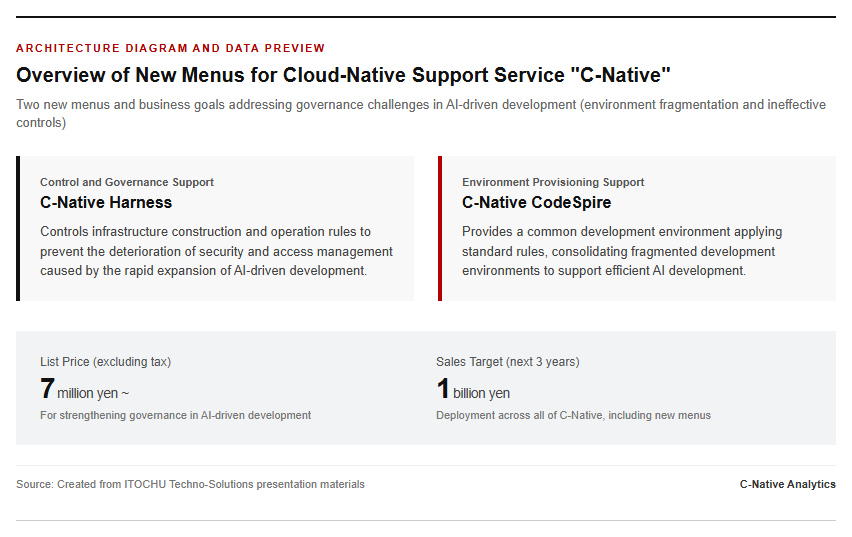
As the adoption of AI in development sites accelerates, this service standardizes infrastructure configuration and permission management, supporting the creation of enterprise-wide AI utilization foundations.
Specific support formats include the following measures:
– Establishment of automated control rules for cloud infrastructure configuration management and permission settings
– Significant reduction in development environment construction man-hours through the use of common templates
– Hands-on consulting covering everything from implementation and operation to security measures
Through this support, the company aims to realize robust development structures that go beyond mere trial and error.
Challenges in Infrastructure Construction Automation and Governance Unification
In recent years, the fusion of Infrastructure as Code (IaC) technology—which automates management by turning configurations into code—and AI-driven development has been rapidly progressing in IT infrastructure construction sites such as cloud and network environments. By integrating AI into program creation and various testing tasks, unprecedented development speed and efficiency are being achieved. On the other hand, as individual departments and teams within companies adopt AI tools and development methods independently, expertise and environments are becoming fragmented, leading to serious security and governance issues.
The following elements are identified as particularly serious challenges:
– Risks of misconfiguration or information leakage caused by code generated or modified by AI
– Inconsistent management where access permissions and operational rules vary by developer
– Lack of auditing frameworks for vulnerabilities and security risks introduced by generative AI code
In development sites as of 2026, there is a strong demand to address the trade-off between increasing development speed via AI and maintaining secure corporate control. As companies need to flexibly expand their environments in line with the rapid evolution of AI technology, building governance mechanisms that unify the configuration and permissions of the entire infrastructure has become an urgent priority.
Key Functions and Technical Features Provided by C-Native
C-Native Harness: Controlling Configuration and Security
C-Native Harness, a pillar of the new menus, is a mechanism that automatically applies strict rules for configuration, permissions, and security when managing and constructing cloud environments and execution platforms through code. In AI-driven development, scenarios where AI agents or assistants automatically generate or modify code are increasing; however, there are concerns that changes made without human intervention could lead to inappropriate permission settings or the introduction of security holes. This function performs automatic checks and controls based on predefined safe governance rules, even for code modified by AI.
The main roles and control functions are as follows:
– Automation of guardrail settings and context management in specification-driven development
– Maintenance of system deliverable quality and functions for acquiring audit logs from a third-party perspective
– Access control based on the principle of least privilege and reduction of information leakage risks
The following diagram shows an innovation image of secure infrastructure construction with applied governance.
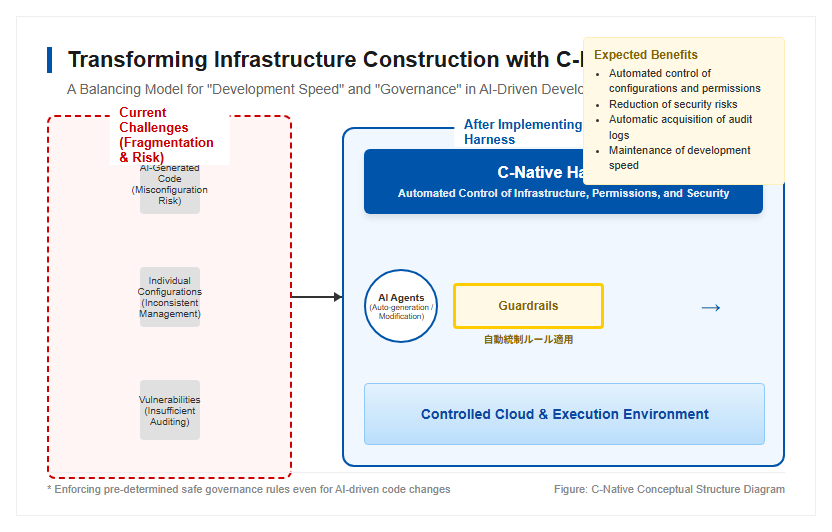
By systematizing rule compliance in this way, the service prevents human error and provides an environment where companies can scale AI development with confidence.
C-Native CodeSpire: Accelerating Common Development Environments
Another new menu, C-Native CodeSpire, provides a standard development environment to rapidly deploy company-wide AI-driven development. Traditionally, individual project teams independently prepared templates and CI/CD pipelines for AI development, which consumed a significant amount of man-hours and time in environment setup. C-Native CodeSpire collectively distributes common templates and tools pre-integrated with standard rules and security settings established by C-Native Harness.
The specific benefits brought by C-Native CodeSpire are as follows:
– Significant reduction in initial setup man-hours through the distribution of harnesses for local development environments
– Integration of automated inspection and approval processes into CI/CD pipelines
– Application of the same level of security and quality standards across the entire company
As a result, developers are freed from non-essential tasks such as environment setup, allowing them to concentrate on core system design and value creation. By standardizing development environments that tend to fall into localized optimization, it strongly backs the company-wide cross-functional promotion of AI utilization.
Integration with Other Services and Future Market Outlook
Consistent Support System with A-Native and D-Native
ITOCHU Techno-Solutions does not stop at supporting C-Native on a standalone basis, but deploys integrated solutions linked with its other advanced service groups. In October 2026, through a collaboration with IBM Japan, the company launched “A-Native,” an AI-driven application development and modernization service leveraging IBM Bob. A-Native uses AI to streamline application development processes from requirements organization to design, programming, and testing, powerfully supporting the modernization of existing core systems.
The integration framework with the major services provided by the company is as follows:
– C-Native: Handles AI-driven development and governance control of infrastructure and execution platforms
– A-Native: Supports development efficiency in the application layer and phased modernization of existing systems
– D-Native: Supports the construction of data utilization foundations and their lifecycle, serving as the base for AI utilization and analysis
By cross-functionally combining these three service groups, companies can achieve phased cloud migration and secure AI transformation covering the entire system, from infrastructure to applications and data platforms.
Business Expansion Aiming for 1 Billion Yen in 3 Years and Impact on Society
Centering on the two newly expanded C-Native menus, ITOCHU Techno-Solutions aims to actively pursue sales expansion targeting enterprise companies working to strengthen governance in AI-driven development, setting a sales target of 1 billion yen over three years. Building upon the knowledge of C-Native cultivated since 2020 and the know-how gained from in-house implementations and client projects, the company has established a system to provide consistent, hands-on support ranging from consulting and environment setup to operations and security.
Future technological prospects and market impact can be summarized in the following points:
– Resolution of insufficient governance in infrastructure automation and reduction of incident risks
– Acceleration of overall development through synergies with other AI tools such as the upstream process support system Acsim
– Supplementing the shortage of corporate IT human resources and promoting the cloud migration of mission-critical systems
As pointed out in the White Paper on Information and Communications and elsewhere, the shift to AI-centric development methodologies in the IT infrastructure of domestic Japanese companies has become inevitable. This initiative, which balances control and speed, is expected to serve as an important foundation for boosting the digital competitiveness of Japanese companies.
Reference Pages
- [Expanding Cloud-Native Technology Support Services “C-Native” for AI-Driven Development – ITOCHU Techno-Solutions] (https://www.ctc-g.co.jp/news/release/20261125-02167.html)
- [CTC and IBM Japan Collaborate on AI-Driven Development Service “A-Native” Utilizing IBM Bob] (https://jp.newsroom.ibm.com/announcements?item=122709)
[#AIDrivenDevelopment #CNative #CTC #CloudNative #ITGovernance #IaC #Security]


コメント