In November 2026, NVIDIA released the open weights of “Nemotron-Labs-Image-30B-A3B,” a new image generation AI model adopting a large language model approach, free of charge. The background behind this move is the aim to attract the developer community through an open model strategy and seize leadership in next-generation AI foundational technology.
- Key Points of the Event and Background of the Announcement
- The Mechanism of Image Generation Adopting an Autoregressive Approach
- Efficiency through 30B Parameters and MoE Design
- Performance Comparison Across Various Benchmarks
- License Restrictions and Commercial Use Treatment
- Operating Environment Requirements and Future Outlook/Key Points
Key Points of the Event and Background of the Announcement
By November 25, 2026, U.S. semiconductor giant NVIDIA published the open weights (model weight data) of its new image generation AI model, “Nemotron-Labs-Image-30B-A3B,” on Hugging Face, an AI model-sharing platform. This model is made available for download free of charge by anyone for research and evaluation purposes.
This release marks a significant shift in the design philosophy of image generation models. In the conventional image generation AI market, as typified by Stable Diffusion, diffusion models—which start from noise and remove it in stages—have been mainstream. However, this model employs an autoregressive approach, generating images through the exact same process that large language models (LLMs) use to output text.
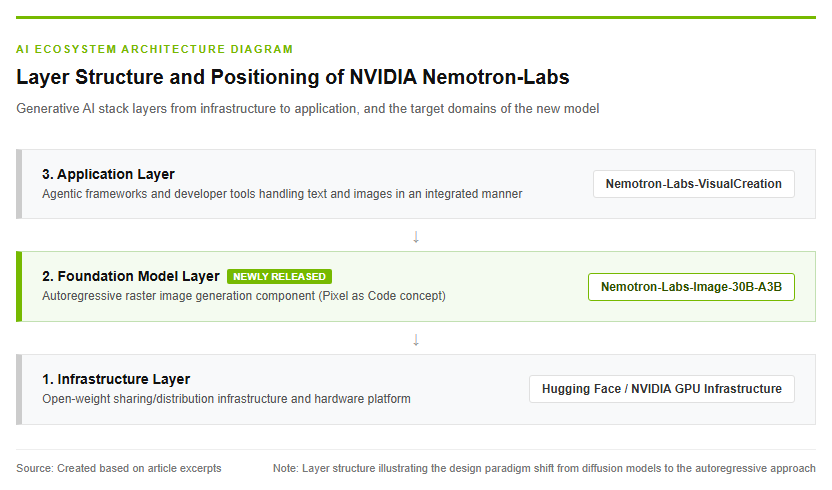
NVIDIA promotes a concept called “Pixel as Code,” which treats image generation not as pixel data, but as visual code. As part of this initiative, the company is developing “Nemotron-Labs-VisualCreation,” an agent-based framework that handles text and images in an integrated manner, and the newly released model is positioned as a component responsible for its raster image generation function. There is a strategic background of aiming to expand the ecosystem by allowing developers to directly verify innovative model structures in an open environment.
The following figure is an image showing the layer structure in generative AI, ranging from infrastructure to models and applications.
The Mechanism of Image Generation Adopting an Autoregressive Approach
The defining feature of “Nemotron-Labs-Image-30B-A3B,” released this time, is that it applies the technical structure of a language model that outputs text directly to image generation. The base model is “Nemotron 3 Nano,” a text language model independently developed by NVIDIA.
NVIDIA’s development team newly added and expanded 196,560 visual tokens to the existing text vocabulary. In response to the input prompt text, the model autoregressively writes out a sequence of visual tokens one after another, much like writing while predicting the next word in a sentence. The written token sequence is then restored into a pixel image by passing through an attached dedicated conversion model (tokenizer).
Furthermore, this model adopts a hybrid design combining Mamba-2 state space layers and a traditional attention mechanism to enhance computational efficiency. The context length reaches 262,144 tokens, making it possible to process extremely long contexts and complex instructions simultaneously. The resolution of the generated images is set to multiples of 16 pixels on each side, with four sizes presented as recommended presets, including 1024×1024 pixels.
Efficiency through 30B Parameters and MoE Design
The parameter structure of “Nemotron-Labs-Image-30B-A3B” incorporates computational efficiency technologies from modern AI design. While the total number of parameters across the entire model boasts a large scale of 30 billion (30B), the active parameters that activate and operate during actual generation processing are kept to just 3 billion (3B).
Achieving this significant weight reduction is a network structure called Mixture-of-Experts (MoE). MoE is a method that divides the inside of a model into multiple expert sub-networks specialized for specific processing, and dynamically selects and calculates only the optimal experts for each input token. This successfully and dramatically reduces computational costs and power consumption during inference while maintaining an expressiveness equivalent to 30 billion parameters.
Conventional denoising models required repeating dozens of steps of iteration to complete an image, resulting in a heavy computational load on the GPU. In contrast, combining an autoregressive model with MoE allows existing high-speed inference libraries and batch processing technologies for LLMs to be utilized as-is. A practical model configuration that improves the efficiency of computational resources during inference while maintaining cutting-edge image generation quality has been realized.
Performance Evaluation and Limitations/Challenges in Implementation
Performance Comparison Across Various Benchmarks
According to performance data published by NVIDIA, the framework including “Nemotron-Labs-Image-30B-A3B” has recorded exceptional figures equal to or exceeding existing leading models across multiple major image generation benchmark tests.
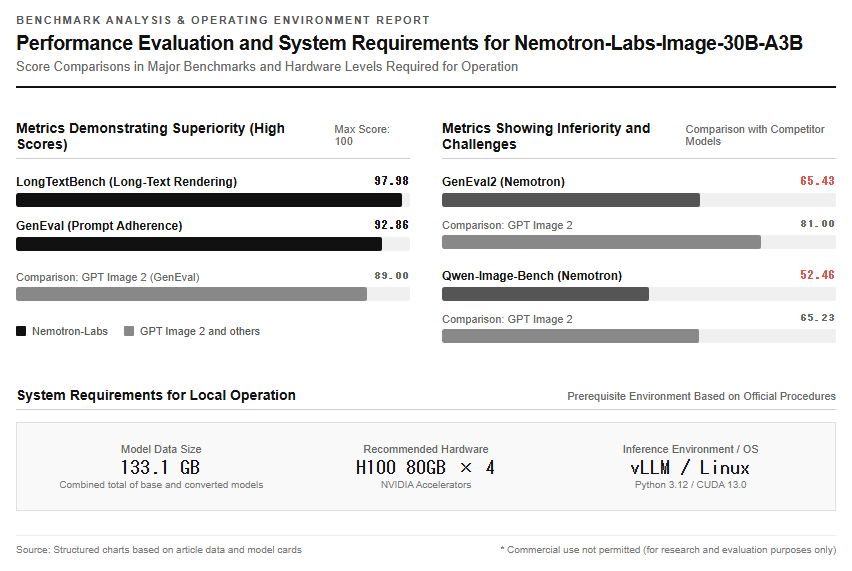
In “BizGenEval,” which evaluates image generation accuracy in the business domain, it scored 86.0 points, outperforming competing models such as OpenAI’s “GPT Image 2” at 83.2 points and Google’s “Nano Banana Pro (Gemini 3 Pro Image)” at 76.7 points. Additionally, it recorded 97.98 points in “LongTextBench,” which measures the rendering accuracy of long text contained within images, surpassing GPT Image 2’s 96.00 points and Nano Banana Pro’s 97.60 points. It also scored 92.86 points in “GenEval,” which measures prompt adherence, demonstrating an advantage over GPT Image 2’s 89.00 points.
On the other hand, it does not overwhelm competitor models across all metrics. Its score in “GenEval2” remained at 65.43 points, putting it at a disadvantage compared to GPT Image 2’s 81.00 points, and it reached only 52.46 points in “Qwen-Image-Bench,” falling short of GPT Image 2’s 65.23 points. The results show that each model’s areas of strength vary depending on the subject matter and the quality of the text structuring requirements.
License Restrictions and Commercial Use Treatment
While the model data (weights) for “Nemotron-Labs-Image-30B-A3B” can be downloaded for free by anyone from Hugging Face at zero cost, strict license conditions are imposed on its use.
According to the terms of the “NVIDIA License” (LICENSE 3.3) applied to this model, permitted use is strictly limited to non-commercial research and evaluation. It is highly likely to constitute a copyright or license violation if a company incorporates the model into its own services or commercial products to generate direct revenue, or uses generated images for sales activities such as advertisements or paid proposals. Commercial use is exclusively permitted only for NVIDIA itself and its affiliates.
Furthermore, it is important to note that secondary models created by independently fine-tuning the original weights inherit these same non-commercial restrictions. It is dangerous for AI personnel within companies to immediately adopt the model for business automation or in-house services based solely on the phrase “free release,” and the model must be treated strictly as a research tool for evaluating and verifying the latest model structures and rendering algorithms.
Operating Environment Requirements and Future Outlook/Key Points
The hurdle for actually running “Nemotron-Labs-Image-30B-A3B” in an in-house or local environment is extremely high. The total data volume of the model, combining the main file and the converted model, reaches a massive 133.1 GB.
The official operating procedure example shown in the model card assumes an ultra-high-spec computing environment equipped with Linux (Python 3.12) as the OS, a CUDA 13.0-compatible driver, and four NVIDIA H100 80GB accelerators. Moreover, because the inference environment is built on vLLM rather than the widely used Diffusers library, it cannot be loaded and used directly into existing image generation pipelines, necessitating system configuration modifications.
Future points of interest include the release timing of the remaining elements of the ecosystem that were left unreleased this time, namely the execution harness and “Nemotron-Labs-VisionCode,” which outputs editable SVG or HTML code. Furthermore, whether autoregressive image generation models provided in an open-weight format can replace traditional diffusion models while incorporating LLM optimization techniques and batch processing environments is a matter of great interest to the entire AI industry.
The conceptual diagram below shows the connection configuration between dedicated software and third-party models in an on-premises environment.
Reference Pages
- [Hugging Face – Nemotron-Labs-Image-30B-A3B Repository] https://huggingface.co/nvidia/Nemotron-Labs-Image-30B-A3B
- [NVIDIA Developer Blog] https://developer.nvidia.com/blog/ai-model-co-design-hardware-friendly-llm-design/
[#NVIDIA #GenerativeAI #Nemotron #OpenWeights #AutoregressiveModel #GenAI]

コメント