The national average price of regular gasoline has fallen to 169.9 yen per liter, edging down by 0.1 yen from the previous week and turning into a modest decline. This recent price trend is driven by crude oil futures prices falling below key psychological thresholds due to oversupply concerns in the international crude oil market, as well as the government’s continued support through fuel oil subsidies.
- Key Event: Average regular gasoline price edges down to 169.9 yen
- Sharp drop in oil prices driven by improving supply-demand conditions and oversupply concerns
- Mechanism of the fuel oil price spike mitigation subsidies and the policy for their phased reduction
- The reality of energy costs putting pressure on corporate management and household budgets
- Vulnerability of the Crude Oil Procurement Structure and Enhancement of Security through Legislation
- Future Outlook and Points to Watch: Subsidy Exit Strategy and Next-Generation Energy Supply Systems
Key Event: Average regular gasoline price edges down to 169.9 yen
According to the Petroleum Product Price Survey (as of November 24) released by the Agency for Natural Resources and Energy on November 26, 2026, the average retail price of regular gasoline at service stations nationwide dropped by 0.1 yen from the previous week to 169.9 yen per liter. In the preceding survey as of November 16, the price was 170.0 yen, marking an increase for the first time in four weeks, but the latest survey showed a return to a modest decline, falling for the second week in two weeks. The major factor halting the rise in retail prices is the ongoing provision of the government’s fuel oil price spike mitigation subsidies. The gasoline subsidy amount reached 36.7 yen per liter from November 12 to 18, 2026, keeping retail prices suppressed around the 170-yen mark even though market prices would significantly exceed 200 yen without the subsidies. In addition to gasoline, equivalent subsidies are applied to diesel, kerosene, and fuel oil, playing a role in temporarily easing the burden of rising fuel costs for households and industries entering the winter heating demand season.
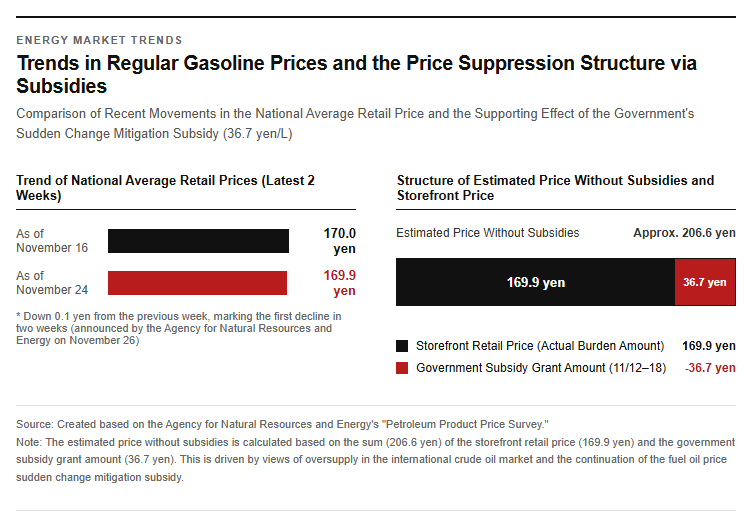
However, the current price stability relies on policy suppression through massive public fund injections and does not accurately reflect the market’s intrinsic supply-demand balance. Moving forward, both fluctuations in the international crude oil market and changes in government policy will have a major impact on retail prices.
Sharp drop in oil prices driven by improving supply-demand conditions and oversupply concerns
Downward pressure on domestic gasoline prices is being driven by oversupply concerns in the international crude oil market and the accompanying downward trend in prices. NYMEX WTI crude oil futures on the New York market fell below the 80-dollar threshold to $79.2 per barrel, and North Sea Brent crude oil futures also dropped to $85.7, updating to lows not seen since September of this year. In addition to a temporary easing of supply disruption concerns caused by geopolitical risks, a rapid recovery in crude oil exports from the Middle East has led to worsening market sentiment. Specifically, the restart of Saudi Arabia’s East-West pipeline and an increase in ship-to-ship transfer operations off the coast of Oman have expanded crude oil supply from the Gulf region. In response, the three major agencies—the U.S. Energy Information Administration (EIA), the Organization of the Petroleum Exporting Countries (OPEC), and the International Energy Agency (IEA)—have successively shifted their market assessments from previous supply shortages to pricing in oversupply. The EIA forecasts an oversupply of about 4 million barrels per day in the supply-demand balance for the following year, and this slack in supply-demand fundamentals is solidifying the medium-term downward trend in crude oil prices.
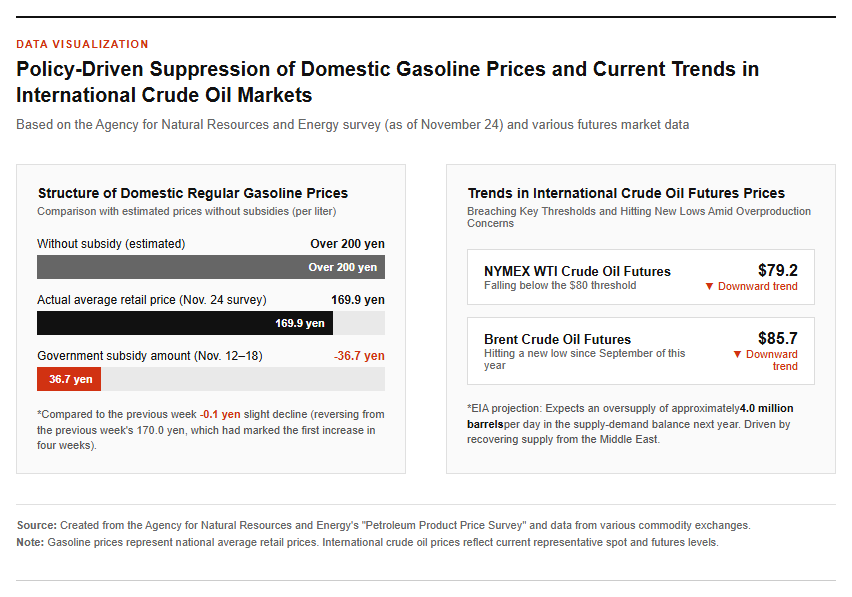
The decline in international crude oil prices lowers the import unit prices of petroleum products and the procurement costs of domestic primary distributors, directly acting as a factor that eases upward pressure on gasoline retail prices.
Evolution of policy support and its economic impact on businesses and households
Mechanism of the fuel oil price spike mitigation subsidies and the policy for their phased reduction
The “Fuel Oil Price Spike Mitigation Project,” introduced to prevent sudden surges in gasoline prices, has been in operation through continuous revisions since its launch in January 2022. Rather than directly distributing cash to general consumers, this system involves the Agency for Natural Resources and Energy of the Ministry of Economy, Trade and Industry directly providing subsidies to petroleum primary distributors and importers. The subsidy payouts lower the actual wholesale prices of the primary distributors, and service stations nationwide set their storefront retail prices based on these cheaper procurement costs, allowing consumers to automatically purchase fuel at reduced prices at the pump. Since March 2026, an “Emergency Steep Price Mitigation Measure” has been implemented to keep the national average price around 170 yen, but at the end of October 2026, the government outlined a policy to gradually reduce these subsidies starting in December. Proposals from the Liberal Democratic Party suggest reducing the subsidy unit price at a pace of about 5 yen per month from December onward.
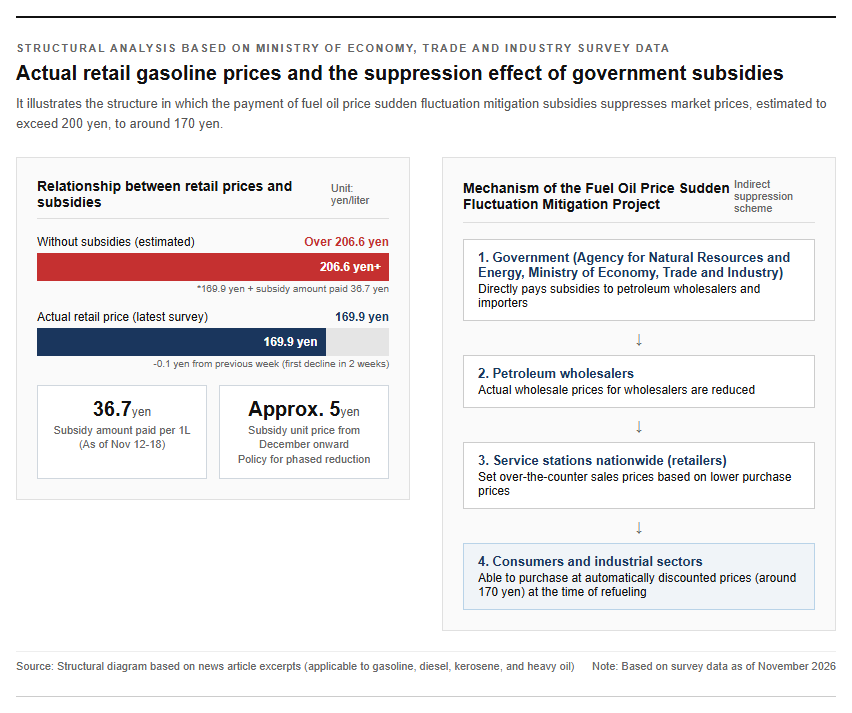
Estimates indicate that if crude oil prices remain at a certain level while the subsidy unit price decreases by 5 yen every month, retail prices will be pushed up by about 15 yen in three months, rising to around 185 yen. As the exit strategy for subsidies that have suppressed price increases for a long period becomes a reality, practical vigilance regarding future price hikes is mounting.
The reality of energy costs putting pressure on corporate management and household budgets
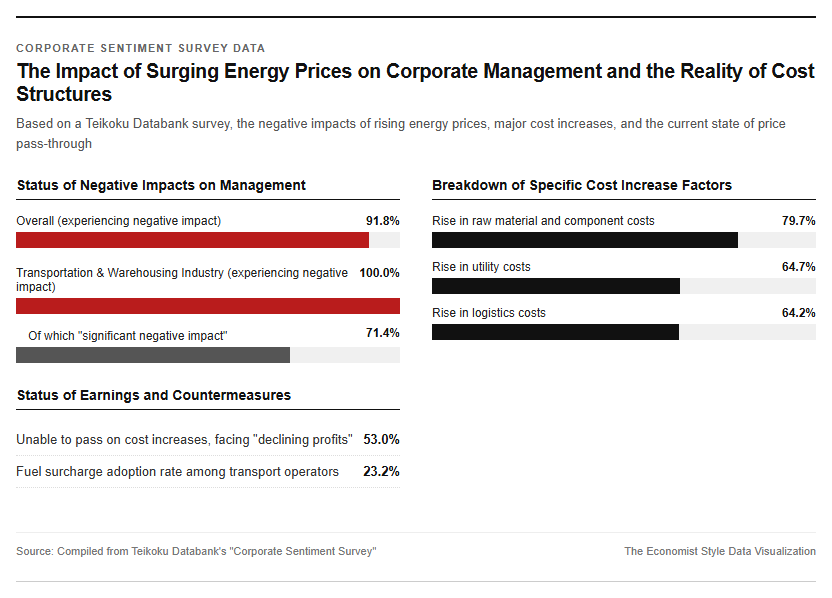
High and fluctuating energy prices are having a massive impact on corporate management and regional economies. According to a corporate sentiment survey conducted by Teikoku Databank, 91.8% of companies reported that rising energy prices are having a “negative impact” on their business operations. Notably, in the “transportation and warehousing” industry, where fuel costs account for a direct expense, 100% of companies reported negative impacts, with 71.4% describing them as “significant negative impacts.” Specific examples include “rising raw material and resource costs” (79.7%), “rising utility bills” (64.7%), and “rising logistics costs” (64.2%), while 53.0% of companies face “declining profits” as they are unable to pass on the increased costs to their selling prices. Furthermore, the adoption rate of fuel surcharge systems among transport operators remains limited to 23.2%, placing many companies in a severe revenue structure where they are forced to absorb the increased costs internally.
Meanwhile, economic concerns have also been pointed out regarding the gasoline subsidy program. According to an analysis by the Japan Research Institute, the support lacks fairness because only about 60% of households purchase gasoline. Additionally, the fiscal burden is swelling with cumulative subsidy budgets exceeding 8.2 trillion yen, and price suppression has become a factor in dampening willingness to save energy and undertake decarbonization (GX) efforts.
Mid-to-Long-Term Energy Security and the Transformation of Gas Station Structures
Vulnerability of the Crude Oil Procurement Structure and Enhancement of Security through Legislation
Japan depends on overseas imports for almost all of the crude oil it consumes, and import data for fiscal 2025 shows that reliance on the Middle East region exceeds 90%. Because much of Middle Eastern crude oil is transported via the Strait of Hormuz, Japan has a vulnerable structure that faces a dual crisis of declining domestic supply volumes and soaring import unit prices if navigational disruptions or geopolitical tensions arise in the strait. On October 23, 2026, the Cabinet approved the “White Paper on Energy 2026,” which explicitly articulates a sense of crisis regarding these structural issues. In conjunction with this, three bills related to energy security were submitted to the Diet, aiming to equalize costs between peacetime and emergencies, diversify procurement sources, and build resilient supply chains. Under these bills, a framework is scheduled to be established to provide government supplementation, investment, and financing support during emergencies against the risk of rising transportation costs and insurance premiums associated with long-distance procurement.
While there is a possibility that this could act as a factor driving up prices in the short term due to the introduction of levies on petroleum products, over the medium to long term it is expected to have the effect of mitigating price surges and supply disruption risks during crises, thereby curbing the blow to corporate earnings and public livelihoods.
Future Outlook and Points to Watch: Subsidy Exit Strategy and Next-Generation Energy Supply Systems
The biggest point to watch regarding future gasoline price trends is the government’s gradual reduction process for subsidies and its accompanying impact on retail prices. As the reduction of subsidy unit prices scheduled for and after December begins, an increase in the fuel cost burden for corporations and a strengthening of consumers’ frugality-oriented mindset are expected. Therefore, it is essential for companies to grasp their fuel costs on a weekly basis and advance fuel surcharge negotiations. In addition, the number of service stations (SS) nationwide continues to decline against the backdrop of shrinking demand, the rise of self-service gas stations, and a shortage of successors, making structural business reforms an urgent task. While securing service stations in depopulated areas and ensuring appropriate profits remain challenges, breaking away from traditional dependence on gasoline sales is required.
Against this backdrop, momentum is growing to transform service stations into “green stations” and comprehensive energy supply hubs equipped with rapid electric vehicle (EV) charging facilities, hydrogen refueling equipment, and stationary fuel cells. Through government support for facility installation and the sharing of technical information, reconstruction not merely as fuel supply locations, but as disaster evacuation bases and community-oriented service hubs, will be the key determining factor for the future sustainability of the energy market.
Reference Pages
- [Agency for Natural Resources and Energy] Petroleum Product Price Survey and Energy Policy Information (Agency for Natural Resources and Energy, Ministry of Economy, Trade and Industry) https://www.enecho.meti.go.jp/
[#GasolinePrices #CrudeOilPrices #GasolineSubsidies #EnergyPolicy #EconomicTrends #InflationCountermeasures]


コメント