
Finance and central banking authorities from Japan, China, South Korea, and ASEAN have agreed to establish a dedicated working group aimed at strengthening cross-border digital payment cooperation. The move is driven by the rapid expansion of QR code payments within the Asian region and the demand for stabilizing regional financial systems through the promotion of local currency-denominated settlements.
- Agreement at the Kyoto Deputy Meeting and the Role of the Working Group
- Promotion of Local Currency Settlements and Reduction of US Dollar Dependency
- Interoperability of QR Code Payments and the Rise of Wide-Area Networks
- Regulatory Discrepancies and Ensuring Financial Autonomy and Security
- Stablecoin Regulations and the Progress of CBDCs and mBridge
- Future Roadmap and Outlook for the 2027 Nagoya Meeting
Agreement at the Kyoto Deputy Meeting and the Role of the Working Group
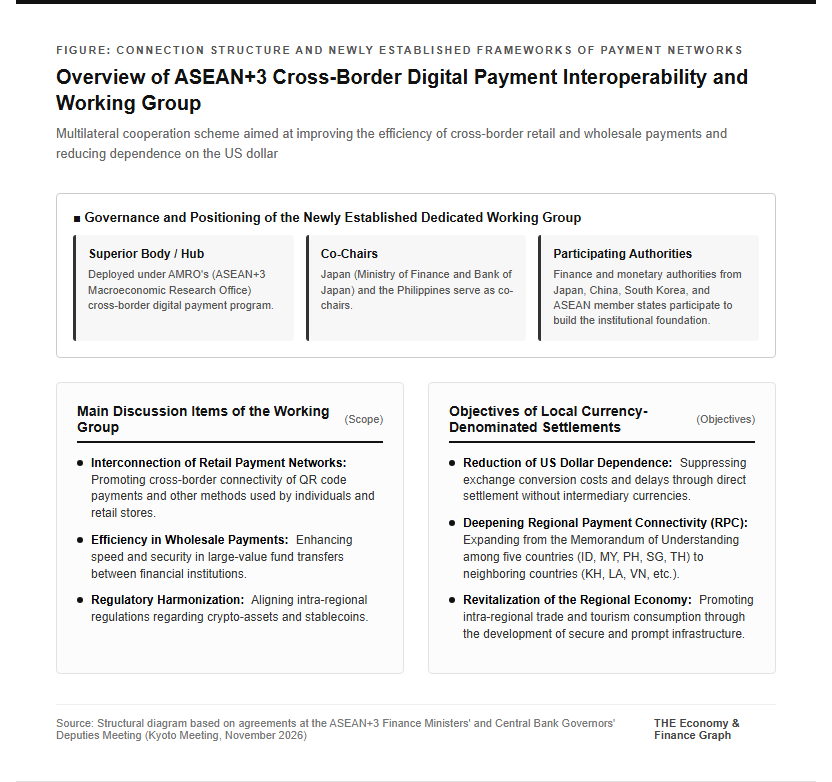
At the ASEAN+3 Deputy Finance Ministers and Central Bank Governors’ Meeting held in Kyoto, Kyoto Prefecture, from November 25 to 26, 2026, the three countries of Japan, China, and South Korea, along with the member states of the Association of Southeast Asian Nations (ASEAN), agreed to establish a dedicated working group to discuss cross-border digital payment cooperation. Representing Japan, Vice Minister of Finance for International Affairs Mimura attended the meeting and co-chaired it with the Philippines, alongside the Bank of Japan. This working group will be established under the cross-border digital payment program operated by the ASEAN+3 Macroeconomic Research Office (AMRO), a Singapore-based international organization. Its primary roles are outlined to include not only promoting the connection of retail payment networks used by individuals and retail stores, but also comprehensively discussing the streamlining of wholesale決済 (wholesale settlements) where financial institutions exchange funds, as well as harmonizing regulations concerning crypto assets and stablecoins. Materialized based on a ministerial-level agreement in May 2026, this framework serves as an important step toward building a foundation for digital payment rules within the region.
Promotion of Local Currency Settlements and Reduction of US Dollar Dependency
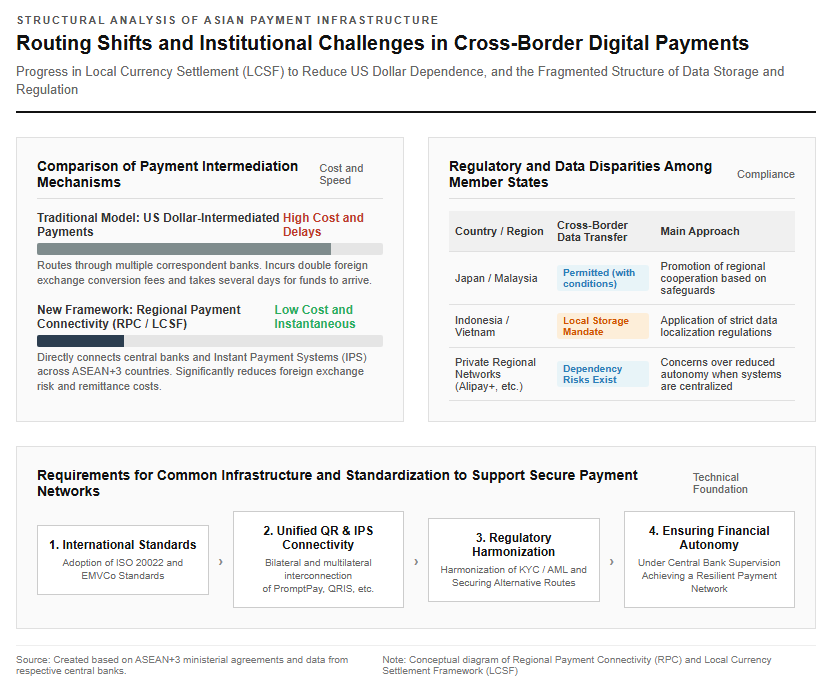
The strengthening of cross-border digital payment cooperation in the Asian region carries a strong objective to reduce excessive dependency on the US dollar, curb foreign exchange fluctuation risks, and lower international remittance costs. Traditional international remittances frequently use the US dollar as an intermediary currency, posing challenges such as currency conversion fee generation and settlement processing delays. In response, following the signing of a memorandum of understanding on Regional Payment Connectivity (RPC) by the central banks of five countries—Indonesia, Malaysia, the Philippines, Singapore, and Thailand—in November 2022, initiatives directly linking local currency settlement frameworks (LCSF) with each country’s instant payment systems (IPS) have progressed rapidly. Surrounding countries such as Cambodia, Laos, and Vietnam have also successively joined the cooperation, and a mutual settlement infrastructure within the region is steadily falling into place. The newly established working group is expected to enable the ASEAN+3 region, including Japan, China, and South Korea, to develop a safe and prompt payment network centered on local currencies, directly contributing to the revitalization of intra-regional trade and tourist consumption. The following figure illustrates the connection structure of payment networks in Asia.
Current State and Challenges of the Asian Payment Market
Interoperability of QR Code Payments and the Rise of Wide-Area Networks
In the Southeast and East Asian markets, accompanied by the widespread adoption of smartphones and the rise of fintech companies, unified domestic QR code payment standards are expanding rapidly. Domestic common QR standards linked with each country’s instant payment systems—such as Thailand’s PromptPay, Malaysia’s DuitNow, Indonesia’s QRIS, Singapore’s NETS/SGQR, and Cambodia’s Bakong—have been developed, achieving bilateral interoperability. Meanwhile, private sector-led wide-area networks such as Ant International’s Alipay+ and UnionPay operated by China are also expanding, enabling payments via payment apps from various Southeast Asian countries even at merchant stores like PayPay in Japan. As technologies supporting the interoperability of these payment networks, the introduction of ISO 20022 (the international standard for financial messaging) and EMVCo standards is progressing. While the diversification of connection methods dramatically enhances user convenience, the harmonization of these various standards remains a future technical challenge.
Regulatory Discrepancies and Ensuring Financial Autonomy and Security
With the expansion of digital payment networks across wide areas, how to achieve consistency among differing regulations and systems across countries has become a critical challenge. In particular, significant gaps exist among member states’ policies regarding immediate compliance checks for Anti-Money Laundering and Countering the Financing of Terrorism (AML/CFT), Know Your Customer (KYC) procedures, and cross-border data flow regulations. For instance, while Malaysia and Japan permit cross-border data transfer under certain protective measures, Indonesia and Vietnam impose strict data localization obligations requiring data to be stored domestically. Furthermore, if connections become excessively concentrated in specific private wide-area payment operators, there is a risk that dependence on external entities regarding system failure risks, fee and connection condition modifications, and data management will deepen, potentially undermining domestic financial autonomy and resilience. Therefore, securing alternative routes through public-private cooperation and formulating common rules that allow central banks to participate in oversight are required. The following figure depicts the concept of cross-border payment chains and international standards.
Medium- to Long-Term Outlook and Japan’s Strategic Role
Stablecoin Regulations and the Progress of CBDCs and mBridge
While the rise of private digital currencies and stablecoins brings greater efficiency to cross-border payments, it also generates new risks for financial market stability and exchange rate management. Stablecoins backed by fiat currencies such as the Japanese yen and US dollar are spreading rapidly due to their capability for 24/7 instant remittances, making the establishment of international regulatory frameworks to ensure consistency with individual countries’ capital controls and currency sovereignty an urgent task. Meanwhile, the “mBridge” project—a multi-country payment platform utilizing central bank digital currencies (CBDCs)—reached the minimum viable product (MVP) stage in June 2024, with validation for practical application progressing as the Central Bank of Saudi Arabia officially joined. The mechanism for conducting payment-versus-payment (PvP) settlement using wholesale CBDCs, which are direct liabilities of central banks, is attracting attention as a technology that guarantees the immediacy and irreversibility of settlements, and it has been positioned as a key focus of policy dialogue within the working group.
Future Roadmap and Outlook for the 2027 Nagoya Meeting
The consultation results and specific standardization proposals of the Working Group on Cross-Border Digital Payments agreed upon this time in Kyoto are scheduled to be reported to the “30th ASEAN+3 Finance Ministers’ and Central Bank Governors’ Meeting,” to be held in Nagoya City, Aichi Prefecture, in May 2027, with the aim of achieving a full-fledged policy agreement. Furthermore, it has been agreed that the Asian Bond Markets Initiative (ABMI), which has been promoted since 2003, will evolve and expand into the “Asian Bond and Financial Markets Initiative (ABFMI)” under a new roadmap starting in 2027, thereby boosting regional financial cooperation from both payment infrastructure and capital market perspectives. Japan is expected to provide high technical capabilities and institutional design know-how while advancing the verification of overseas interoperability for the Japanese Common QR Code Standard (JPQR) and its involvement in international standardization. Continuous, unified public-private efforts will be the key to completing a secure and resilient digital payment network in Asia.
Reference Pages
- [Ministry of Finance] Regarding the Holding of the ASEAN+3 Finance Ministers’ and Central Bank Governors’ Deputies Meeting, etc. (November 25–26, 2026)
 その他の国際会議等 : 財務省その他の国際会議等www.mof.go.jp
- [Ministry of Finance] Co-Chairs’ Statement (Provisional Translation) PDF
https://www.mof.go.jp/policy/international_policy/convention/other/kyodoseimsei1.pdf - [Institute for International Monetary Affairs] Public-Private Initiatives Linking QR Code Payments in Asia and Challenges for Japan
公益財団法人 国際通貨研究所www.iima.or.jp - [Asian Development Bank Institute (ADBI)] Evolution of ASEAN Financial Integration in the Comparative Perspective
Evolution of ASEAN Financial Integration in the Comparative PerspectiveASEAN could learn from the European Union’s experience, particularly under the current global challenges.www.adb.org


[#ASEANPlusThree #CrossBorderDigitalPayments #QRCodePayments #Stablecoins #InternationalFinance]


コメント