NVIDIA has announced that it will partner with six major supply chain companies to expand production capacity for AI package substrates 2.5-fold over the next three years. This move is driven by globally expanding demand for AI infrastructure and aims to eliminate production capacity bottlenecks across various semiconductor manufacturing processes.
- The Full Story of the Six-Company Partnership and Production Increase Plans Revealed at GTC Berlin
- Specific Measures to Increase Package Substrate Production Capacity 2.5-Fold in 3 Years
- Global Expansion Plan for Advanced Packaging and Inspection Systems
- 15-Fold Production Increase for Optical Engines for Co-Packaged Optics (CPO)
- The Structure of 9 Billion in Supply Commitments and Financial Risks
- Future Roadmap and Key Focus Areas for Realizing the AI Factory
The Full Story of the Six-Company Partnership and Production Increase Plans Revealed at GTC Berlin
At “GTC Berlin” held on October 21, 2026, U.S. semiconductor giant NVIDIA announced a large-scale manufacturing capacity expansion plan in collaboration with six supply chain partners to meet the explosive global surge in AI infrastructure demand. Founder and CEO Jensen Huang stated, “We are in the midst of the largest-scale infrastructure build-out in human history, and while demand is extraordinary, production capacity is the constraint,” making it clear that securing supply capacity is the highest priority issue.
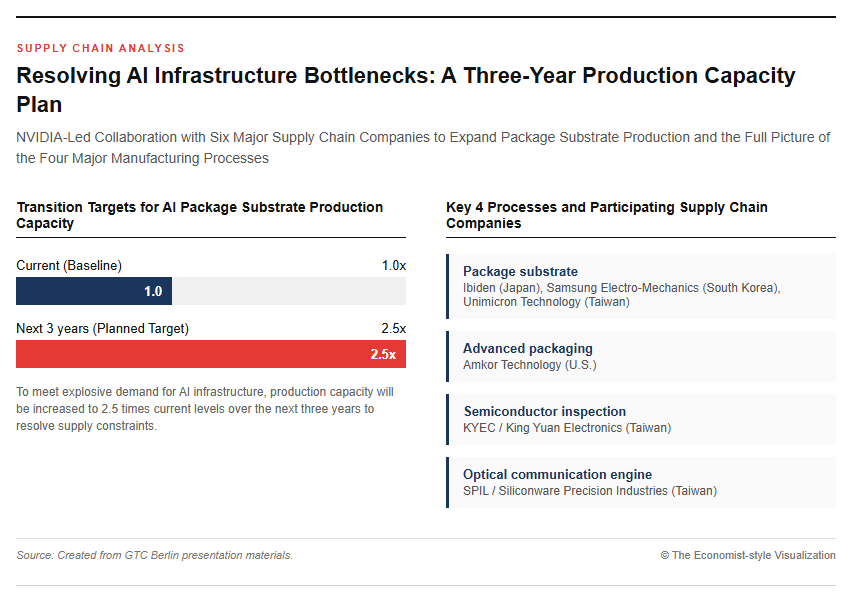
Six companies are participating in this partnership: Japan’s Ibiden, South Korea’s Samsung Electro-Mechanics, Taiwan’s Unimicron Technology, U.S.-based Amkor Technology, Taiwan’s KYEC, and Taiwan’s SPIL. The scope of expansion goes beyond single components, covering four major manufacturing processes: package substrates, advanced packaging, semiconductor testing, and optical communication engines. By enhancing the redundancy and strength of the supply chain, the initiative aims to ensure a stable supply for the entire system. Please refer to the overview below, which illustrates the key components of the supply chain.
Specific Measures to Increase Package Substrate Production Capacity 2.5-Fold in 3 Years
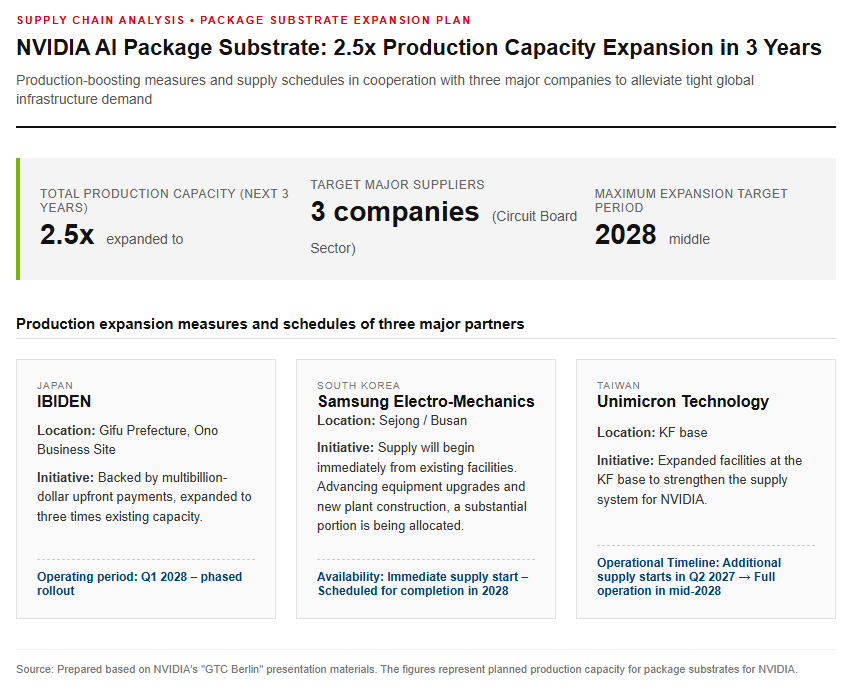
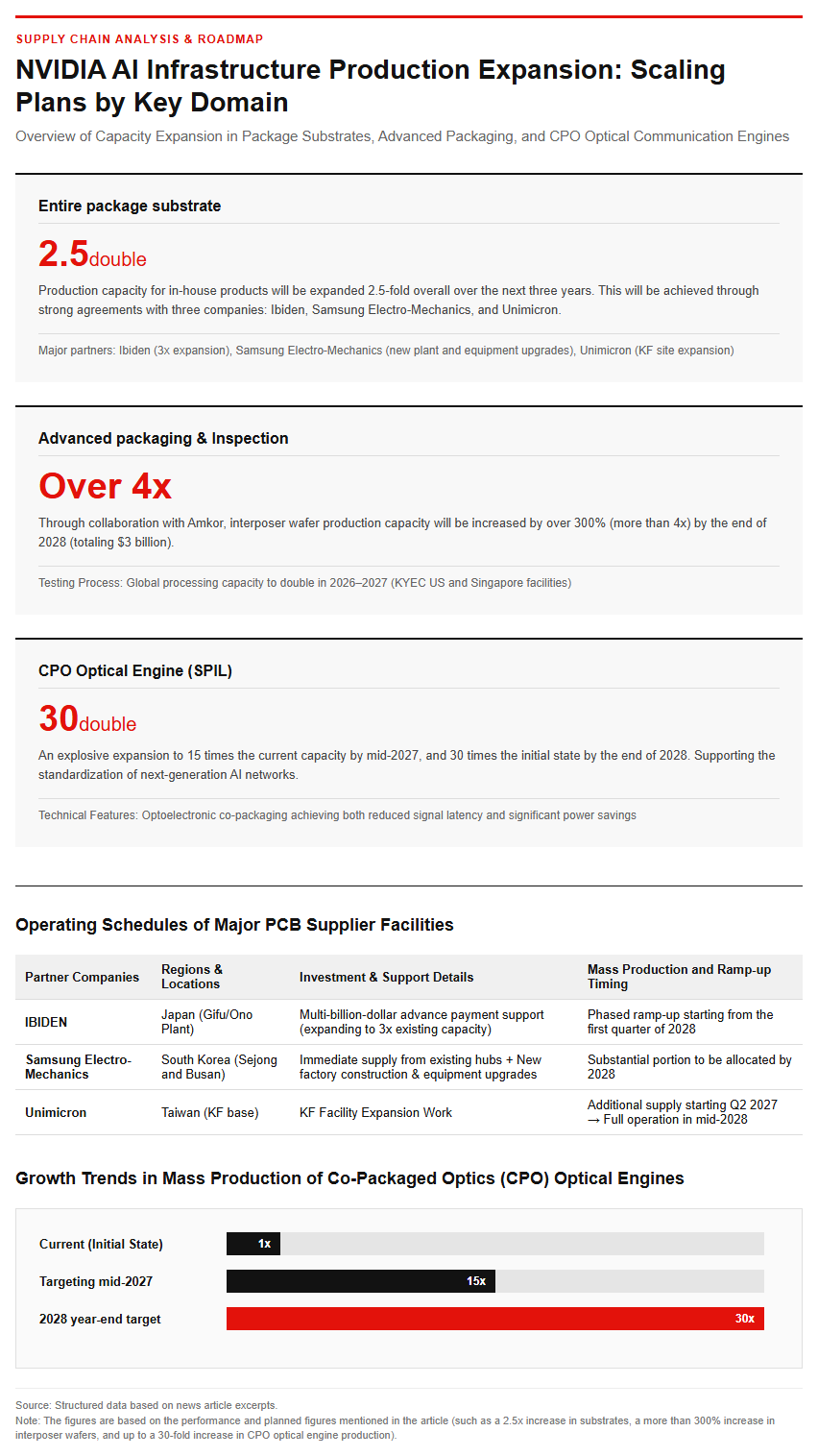
Regarding packaging substrates, which are facing a particularly severe supply crunch in AI chip manufacturing, NVIDIA has outlined a plan to expand its overall production capacity for its products 2.5-fold over the next three years. Supporting this massive production increase are robust agreements with three companies: Ibiden, Samsung Electro-Mechanics, and Unimicron.
For Japan’s Ibiden, multi-billion-dollar upfront payments will be provided to secure production capacity at the Ono plant in Gifu Prefecture, supporting an expansion to three times its existing capacity. Additional production capacity at the plant is expected to ramp up in phases starting from the first quarter of 2028. Samsung Electro-Mechanics of South Korea, newly participating in the supply chain, will begin supplies immediately from existing facilities while advancing equipment upgrades and new plant construction in Sejong and Busan, with plans to allocate a substantial portion of its substrate production capacity to NVIDIA by 2028. Furthermore, Taiwan’s Unimicron is projected to begin additional supplies from the second quarter of 2027 through expansions at its KF facility, reaching full capacity by mid-2028. Please refer to the roadmap for key facilities below.
Overcoming Bottlenecks in Advanced Packaging, Inspection, and Optical Communications
Global Expansion Plan for Advanced Packaging and Inspection Systems
In the field of advanced packaging, which connects semiconductor chips together with high precision, NVIDIA and U.S.-based Amkor Technology are significantly boosting their manufacturing capabilities in South Korea. The two companies have set a goal to increase interposer wafer production capacity by over 300% (more than four times the previous level) by the end of 2028, supporting the mass production of current and next-generation AI platforms alongside the opening of a new facility in South Korea. Amkor has signed a new $1.3 billion contract with NVIDIA, bringing the total value of related contracts to the scale of $3 billion.
Furthermore, regarding the testing process to guarantee the quality of finished semiconductors, there are plans to double worldwide processing capacity between 2026 and 2027. NVIDIA is providing $1.1 billion in upfront payments for capacity securing to Taiwan’s major testing firm KYEC, supporting the construction of a new testing facility and equipment in the United States with the aim of starting mass production in April 2027. In addition, the expansion of testing bases in Singapore is also underway, with mass production operations scheduled to begin in February 2027.
15-Fold Production Increase for Optical Engines for Co-Packaged Optics (CPO)
In large-scale AI supercomputing and AI factories, data transfer bandwidth and power consumption within systems have become critical challenges. To address this, NVIDIA is partnering with Taiwan’s SPIL (Siliconware Precision Industries) to dramatically expand manufacturing capacity in Taiwan for optical engines used in co-packaged optics (CPO: optoelectronic integration).
Specifically, the company aims to increase optical engine production capacity to 15 times the current level by mid-2027, and further double that (30 times the initial state) by the end of 2028. CPO technology is a next-generation technology that integrates semiconductor chips and optical communication components within the same package, thereby reducing signal delay and achieving significant power savings. As the shift from traditional copper wiring to optical connections progresses, this 15-fold production increase plan illustrates how optical engines are becoming a standard component of AI networks. Please refer to the technical overview diagram below.
A $279 Billion Massive Commitment and the Future of AI Infrastructure Building
The Structure of 9 Billion in Supply Commitments and Financial Risks
According to NVIDIA’s Form 10-Q filing for the second quarter of fiscal year 2027 submitted to the U.S. Securities and Exchange Commission (SEC), the company’s total commitments for supply and capacity obligations reached $279 billion (approximately 44.5 trillion yen) as of July 26, 2026. This is a sharp increase of $160 billion from the previous quarter’s $119 billion, driven primarily by the securing of long-term allocations for high-bandwidth memory (HBM) and manufacturing equipment.
The $1.1 billion for KYEC and the multi-billion-dollar prepayments for Ibiden in the recent six-company collaboration are also part of this massive supply-securing strategy. Prepaying billions of dollars in advance to lock in production capacity serves as a powerful weapon to avoid shortage risks during the explosive growth phase of AI demand. At the same time, however, if market demand falls short of expectations in the future or if customer adoption paces slow down, it also entails the risk that the massive locked-in purchase obligations and upfront costs will rebound as direct financial burdens or inventory write-downs.
Future Roadmap and Key Focus Areas for Realizing the AI Factory
This production expansion plan is a multi-stage roadmap with varying timelines for the start of mass production and full operation for each process. Starting with the operation of the Singapore inspection facility in February 2027 and the U.S. KYEC facility in April, SPIL is expected to achieve a 15-fold increase in optical engine production by the middle of the same year. Subsequently, the launch of additional capacity at the Ibiden Ono Plant will begin in the first quarter of 2028, and by the end of 2028, Amkor’s interposer capacity expansion of over 4x and SPIL’s further doubling of optical engine production are scheduled to be completed.
However, even if the supply of semiconductor chips and substrates expands, that alone does not complete the construction of AI infrastructure. It has been pointed out that the progress of data center land acquisition, power supply (energy infrastructure), building construction, and financing on the customer side could become bottlenecks. Whether both the manufacturing side’s expansion of supply capacity and the customer side’s physical infrastructure development can stay in step with each other will be the greatest point of focus for the realization of AI factories moving forward.
Reference page
- [NVIDIA Newsroom] NVIDIA and Supply Chain Partners Expand Capacity to Accelerate AI Infrastructure Buildout: https://nvidianews.nvidia.com/news/nvidia-and-supply-chain-partners-expand-capacity-to-accelerate-ai-infrastructure-buildout
- [U.S. Securities and Exchange Commission (SEC)] NVIDIA Form 10-Q (Quarter Ended July 26, 2026): https://www.sec.gov/Archives/edgar/data/1045810/000104581026000075/nvda-20260726.htm
- 【Amkor Technology IR】Strategic Partnership with NVIDIA to Expand Advanced Packaging and Test: https://ir.amkor.com/news-releases/news-release-details/amkor-technology-announces-strategic-partnership-nvidia-expand
【#NVIDIA #AISemiconductors #SupplyChain #SemiconductorSubstrates #Ibiden #CoPackagedOptics #AdvancedPackaging】

コメント