
Sakura Internet has announced “Object Storage Suite (OS2),” a high-capacity storage service capable of backing up data to other cloud environments such as AWS and Microsoft Azure. This development is driven by the growing importance of multi-cloud operations to prepare for cyberattacks and outages, as well as rising demand for sovereign clouds that ensure data sovereignty and autonomy.
- Overview of “Object Storage Suite,” Designed for Petabyte-Scale Data
- Multi-Cloud Backup Mechanism Capable of Offloading to Other Clouds
- Mitigating Single Points of Failure and Enhancing Cyber Resilience
- Strategy of a Domestic Cloud Aiming to Secure Data Sovereignty and Provide “the Power to Choose”
- The Expanding Cloud Infrastructure Market and the Establishment of Multi-Cloud Operations
- Expectations for the 2027 Practical Implementation and Future Focus Points for Adoption
Overview of “Object Storage Suite,” Designed for Petabyte-Scale Data
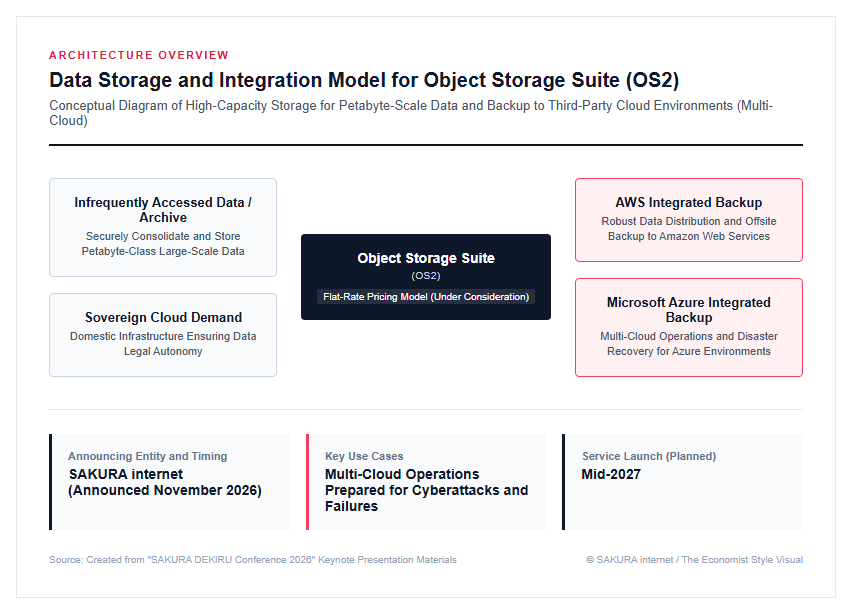
On November 25 and 26, 2026, Sakura Internet held its first large-scale corporate conference, “SAKURA DEKIRU Conference 2026,” in Tokyo. During the keynote on the second day, Satoshi Tagomori, Head of Product Operations, unveiled the new high-capacity storage service, “Object Storage Suite (OS2).” OS2 is primarily designed for the safe, distributed storage of infrequently accessed data such as backups and archives, featuring a scale that effortlessly handles petabyte-class massive data. Regarding the pricing model, rather than the conventional pay-as-you-go model proportional to the number of request executions, the company is considering a flat-rate pricing structure that makes it easier for users to forecast costs. Full-scale service launch is scheduled for 2027. The diagram below illustrates the data storage model of OS2.
Multi-Cloud Backup Mechanism Capable of Offloading to Other Clouds
The most significant feature of OS2 is its ability to directly link and retain backup data not only within its own infrastructure but also across other cloud services such as Amazon Web Services (AWS), Microsoft Azure, and Google Cloud. With traditional single-cloud-contained storage, if a disaster spanning a provider’s entire infrastructure or a cyberattack such as ransomware occurs, there is a critical risk that even backup data stored with the same provider could become simultaneously inaccessible. By ensuring a high degree of compatibility with other clouds, OS2 provides a dual safety net that enables organizations to rapidly restore data from a different provider’s cloud environment in the event of an emergency. This allows enterprises to easily implement a flexible data protection strategy that does not depend on a specific vendor.
Background of Development and Demands for Sovereign Clouds
Mitigating Single Points of Failure and Enhancing Cyber Resilience
In recent years, there have been reported cases where cloud providers themselves fell victim to ransomware attacks or widespread infrastructure outages, leading to the complete shutdown of corporate business systems and management consoles. According to research data, over 80% of cloud-using enterprises face challenges with hidden transfer costs and security design. As of 2026, concerns are rapidly intensifying regarding the “single point of failure” of entrusting both infrastructure and backups to a single cloud provider. Amid the growing demand to implement the “3-2-1-1 rule”—which involves isolating data from a single management domain and storing it in geographically and organizationally distinct environments—OS2’s multi-provider backup integration feature plays a crucial role in building “cyber resilience” that enables business continuity even in the event of a cyberattack.
Strategy of a Domestic Cloud Aiming to Secure Data Sovereignty and Provide “the Power to Choose”
At the conference, President and CEO Kunihiro Tanaka emphasized that for Japan to break free from its “digital defeat” of the past 30 years, having autonomous choices is indispensable, rather than merely using IT for cost reduction. Amid risks of data disclosure requests under overseas regulations such as the US CLOUD Act, interest is rising in domestic clouds operated under local jurisdiction and ISMAP-registered sovereign clouds. Although “Sakura Cloud” was officially adopted as a target for the Digital Agency’s Government Cloud in March 2026, Sakura Internet aims to build a technological foundation that can compete and cooperate equally with overseas clouds, rather than being chosen simply because it is “domestic.” OS2 is a strategic service that provides domestic enterprises with the true “power to choose” by assuming integration with other cloud providers.
Market Outlook and Future Points of Focus
The Expanding Cloud Infrastructure Market and the Establishment of Multi-Cloud Operations
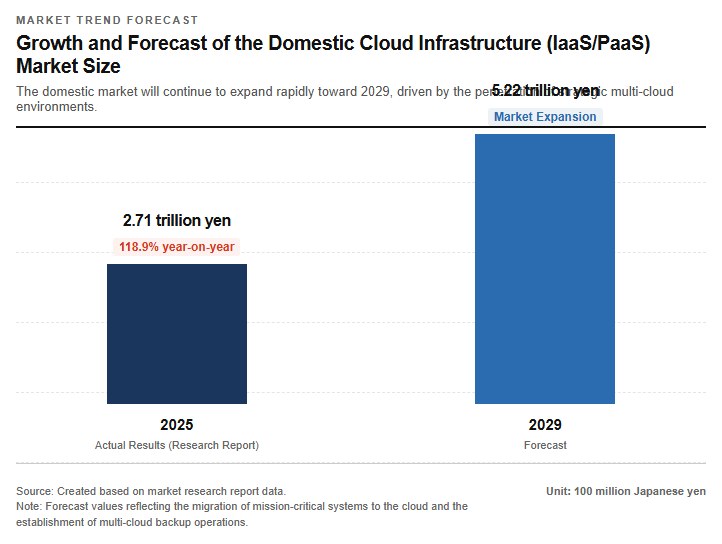
The domestic IaaS and PaaS markets are on a very strong growth trajectory. According to market research reports, the domestic cloud infrastructure service market size is projected to reach 2.71 trillion yen in 2025—an 118.9% increase year-over-year—and expand to 5.22 trillion yen by 2029. Behind this rapid market expansion is the penetration of “strategic multi-cloud” operations, where multiple cloud services are intentionally combined and operated according to use cases and risks, in addition to the migration of traditional core systems to the cloud. In particular, operational models that place highly confidential critical data in a domestic sovereign cloud while distributing large-scale backup data across other companies’ clouds are expected to become widespread as standard design patterns in future enterprise IT infrastructure. The chart below shows the compositional transition of the multi-cloud market.
Expectations for the 2027 Practical Implementation and Future Focus Points for Adoption
Regarding the practical implementation of OS2 scheduled for mid-2027, the key points that companies and local governments should focus on are the details of specific pricing plans and the expansion of the partner ecosystem. In existing object storage, unexpected pay-as-you-go fees frequently occurred during data retrieval or data transfer (egress), putting pressure on corporate cloud budgets. If OS2 can achieve a predictable pricing structure that suppresses cost fluctuations due to transfer volume or request counts, it will become a compelling option for the public sector and enterprise companies with strict cost management. As the company advances its adoption of the government cloud and makes aggressive investments in GPU infrastructure, the release of future technical details and the provision of verification environments are eagerly awaited to see how the company will support the digital foundation of the multi-cloud era through OS2.
Reference Pages
- [Sakura Internet Inc. Official Website] https://www.sakura.ad.jp/
- [Sakura Cloud Manual] https://manual.sakura.ad.jp/cloud/index.html
[#SakuraInternet #CloudStorage #MultiCloud #Backup #SovereignCloud #GovernmentCloud #CyberResilience]
コメント