The open-source software “Paseo,” which integrates multiple AI coding agents and enables parallel execution as a “conductor,” is attracting attention. As development tools proliferate, the value of orchestrators that balance confidentiality in execution environments with operational flexibility is rapidly rising in the AI market in 2026.
- Orchestration for managing multiple agents in one place
- Achieving high confidentiality and control through self-hosted architecture
- Coding experiences from PCs to smartphones, anywhere.
- Maximizing productivity through voice control and parallel execution
- The explosively expanding agent orchestration market
- Design Vulnerabilities and the Need for Multi-Layered Defense
- The importance of using different agents and dividing tasks
- AI Roadmap and Paseo Evolution After 2027
Orchestration for managing multiple agents in one place
Entering 2026, the number of AI coding agents has exploded. Representative examples include Anthropic’s official Claude Code, OpenAI-based Codex, GitHub Copilot, and even open-source tools like OpenCode and Pi. Each of these has different areas of expertise, cost structures, and response models, and it is becoming common for developers to use multiple methods in combination depending on the task. However, when using multiple tools separately, terminals and user interfaces became fragmented, creating challenges such as significant effort for startup, monitoring, and result aggregation.
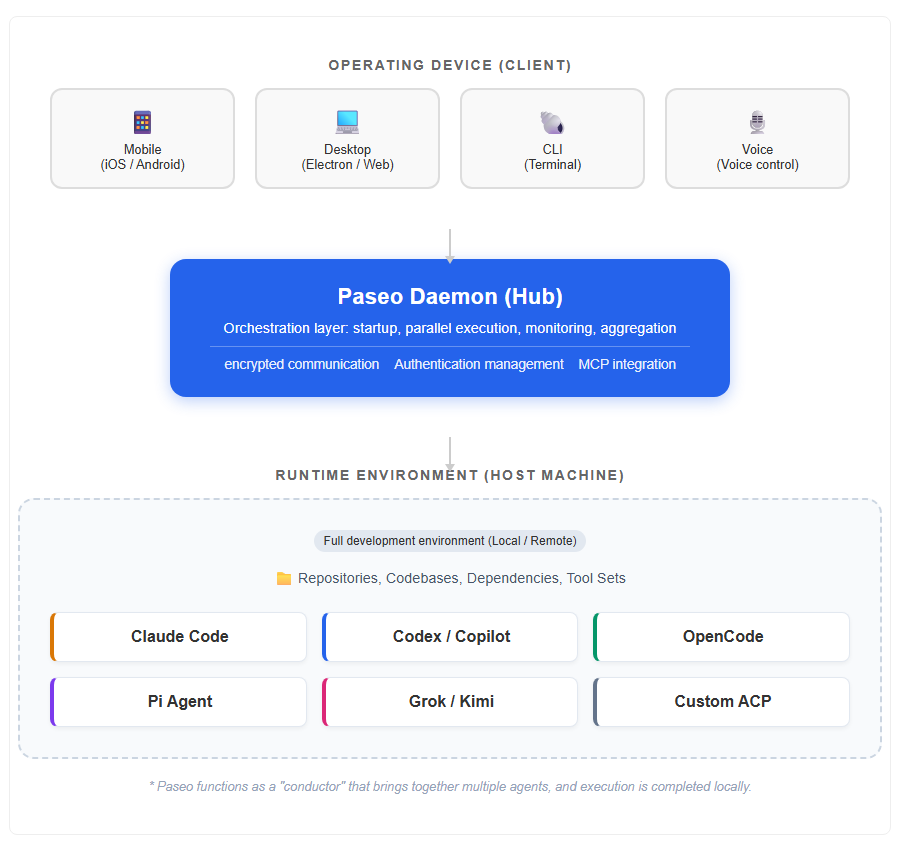
Paseo emerged as an orchestrator that consolidates everything into a single control panel to address the challenge of “agent proliferation.” Paseo has earned about 9.8k stars on GitHub and is rapidly gaining support from developers worldwide. Its biggest feature is that agents from different providers can be executed in parallel from the same interface. This allows multiple AIs to solve the same problem simultaneously and compare their answers, or to delegate feature implementation and test creation to separate agents in parallel. The diagram below shows how Paseo integrates each agent.
Achieving high confidentiality and control through self-hosted architecture
Paseo is open-source software provided under the AGPL-3.0 license, designed to be “self-hosted” on developers’ local machines. Unlike many cloud-based AI tools, agents run within the developer’s own full development environment, where dependencies, tools, and credentials are all in place. This design has a major advantage in preventing critical program code and sensitive credentials from being sent to external SaaS providers, maintaining a self-contained and secure development environment.
They also place extreme emphasis on privacy, officially stating that no telemetry, tracking, or forced logins are included. As of 2026, amid concerns about vulnerabilities in the AI supply chain, this feature of “being able to control the location of your own data” has become a decisive factor for enterprise adoption. Users can build their own dedicated daemon (server) and connect to it from various clients, enabling stable operation unaffected by changes or downtime of external services. Looking back at the history of development, the proliferation of tools has always created a high-level layer that unites them, and Paseo is also trying to take on that role in the field of AI agents.
Multi-device support and voice control are changing development styles
Coding experiences from PCs to smartphones, anywhere.
Paseo’s innovation lies in its overwhelming multi-device capability. You can operate your development environment from a variety of devices, including desktop apps (by Electron), mobile apps for iOS and Android (by Expo), as well as browsers and CLIs (command line interfaces). For example, instructing AI agents to perform complex refactoring at office desks, and then monitoring progress and checking revisions while on the go via smartphone apps—a “asynchronous work style” has become a reality.
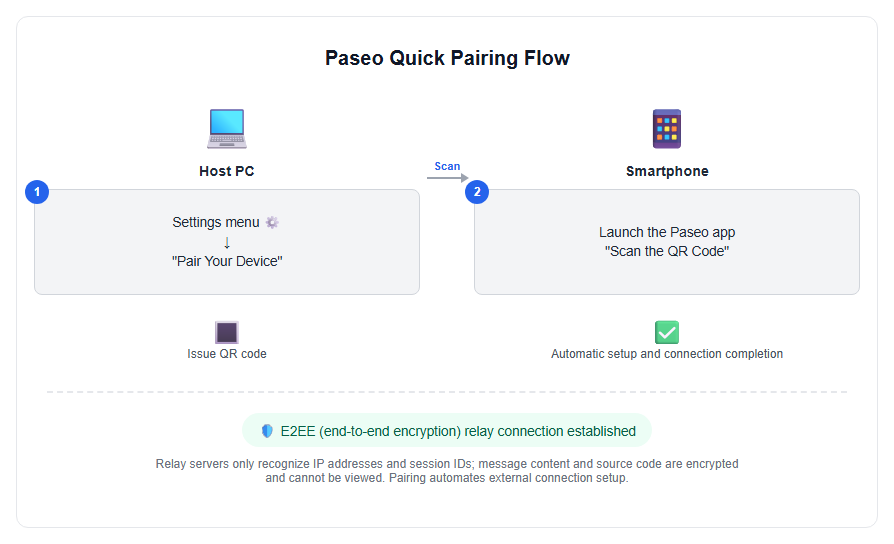
Integration between host machines and each device is extremely smooth; simply scanning the QR code displayed on the settings screen with your smartphone automatically completes pairing and encrypted communication. This connection uses encrypted relay communication, and the relay server is designed so that it cannot read the content of the communication. The latest version 0.1.104-beta.3, released on July 4, 2026, added features allowing agents to operate the in-app browser to retrieve page snapshots and for users to select specific elements within the browser and send them to agents. An environment has been established where development can continue anywhere, as if you were in front of a PC. The diagram below explains the pairing procedure.
Maximizing productivity through voice control and parallel execution
To further boost work productivity, the Paseo is equipped with a powerful voice control mode. Developers can verbally instruct tasks or coordinate coding with AI agents by voice. This speech recognition and reading processing is completed locally, so there is no worry about voice data being sent to external servers. In situations where you can’t let go of your hands or when words are faster than text input, the voice mode serves as an extremely effective interface.
Furthermore, instead of assigning a single task to a single agent, Paseo operates by having multiple agents compete in parallel—a unique approach to Paseo. Since AI outputs are not always constant, it is easy to achieve “multi-layered quality assurance” by having Claude Code and Codex solve the same problems simultaneously and comparing their outputs to select better code. Additionally, by having Agent A handle the implementation of features and Agent B generating the test code simultaneously, the development cycle can be significantly shortened. By leveraging the AI agent’s characteristic of separating the moment of instructions and the processing time, strategic operations are possible to minimize bottlenecks on the human side.
Rapid Growth of the AI Agent Market and Safety Challenges
The explosively expanding agent orchestration market
According to the latest data for 2026, the global market size related to AI agents will reach approximately $185 billion (approximately 27 trillion yen), with an astonishing compound annual growth rate (CAGR) of 58.3%. Particularly noteworthy is the emerging segment called “Agent Orchestration,” to which Paseo belongs. Although this market was almost nonexistent by 2025, it is expected to rapidly grow to a scale of $8.5 billion by 2026. This is driven by the rise of a new business model called ‘agent-type solo companies,’ where a single person uses multiple AI agents to perform advanced tasks.
In Japan as well, the AI agent market has expanded to a scale of 2.1 trillion yen, showing a 68% year-on-year increase. The government’s establishment of the AI Utilization Promotion Act and tax incentives are also supporting adoption by individual businesses and small and medium-sized enterprises. In such a market environment, Paseo’s value stands out for its “vendor-neutral” stance that does not depend on any particular vendor. Even if even better AI models emerge in the future, having Paseo as an integrated interface can significantly reduce the cost of switching or combining them. Market attention has shifted from “which AI is the strongest” to “how to manage and master multiple AIs.”
Design Vulnerabilities and the Need for Multi-Layered Defense
While the market is rapidly expanding, the risks posed by AI agents’ autonomy are also becoming apparent. In April 2026, an incident occurred where an agent of a popular AI coding tool accidentally deleted the production cloud database without verifying, resulting in the loss of customer booking information. To prevent such “disruptive actions caused by carelessness,” modern agents such as Claude Code, which Paseo manages, incorporate multi-layered defense mechanisms. For example, the “Deny-First” rule is applied to all tool executions to address “approval fatigue,” where humans mistakenly keep approving.
Additionally, design vulnerabilities have been pointed out in interdisciplinary protocols such as the Model Context Protocol (MCP) proposed by Anthropic. Multiple CVEs (Vulnerability Identification Numbers) have been reported due to the risk of arbitrary system commands being executed from outside under certain conditions. In contrast, management like Paseo recommends multi-layered security measures, such as running agents in sandbox environments and monitoring tool execution logs in real time. Convenience and safety are always trade-offs, but in an era where autonomous AI handles real business operations, security management capabilities at the foundational level are being demanded more strictly than ever.
The Future of Autonomous AI and Human-led Operational Strategies
The importance of using different agents and dividing tasks
Even if AI agents can operate “autonomously,” the ability to design tasks by humans remains increasingly important. As of 2026, the key to improving productivity is to use appropriate agents according to the size and difficulty of the tasks. For example, for bug fixes or routine feature additions that can be completed within 30 minutes, “autonomous” agents that require minimal user intervention are suitable. On the other hand, for challenging tasks that are unprecedented, editor-type or CLI-type agents that provide human feedback as needed are recommended.
For tasks involving larger-scale refactoring or architectural changes, it is difficult to complete all tasks in one batch, regardless of the type of agent used. Here, it is essential for experienced engineers like tech leads to understand the big picture, break down tasks into appropriate subtasks, and assign each to each agent—a key “arrangement.” Paseo provides the infrastructure for “task division and assignment” on a single screen, ensuring that developers’ roles are shifting from “writing code themselves” to “reviewing AI work and strategizing.”
AI Roadmap and Paseo Evolution After 2027
According to future AI development roadmap forecasts, from 2027 onward, AI will move beyond following a single instruction to a phase of “multi-agent collaboration,” where multiple autonomous AIs synchronize and collaborate to fully handle complex corporate workflows. AI is predicted to actively understand users’ behavioral histories and situations, proactively providing support before instructions are given. Furthermore, from 2027 to 2030, the emergence of “AI scientists” in materials science and pharmaceuticals who independently formulate hypotheses and conduct experiments is anticipated.
Amid this evolution, open-source orchestrators like Paseo serve as a crucial stronghold to prevent the “black boxing” of technology and ensure that humans continue to hold the lead in technology. As AI becomes smarter, entirely new architectures and communication methods are needed to manage it. Paseo is not just a tool-aggregation software; it can be seen as a prototype shaping future workflows where humans and multiple AIs work together. The rapid evolution of AI has caused human bottlenecks and exhaustion, leading to “AI fatigue,” but at this turning point in the era, the ability to smartly “direct” AI will become the most valuable capability required of the next generation of engineers.
[#AIエージェント #Paseo #コーディング支援 #オープンソース #オーケストレーション #生産性向上 #セキュリティ #科学技術]

コメント