The Ehime Prefectural Government has decided to transition to an internet-centric operational environment by fully adopting zero-trust security for its next-generation network infrastructure. This move aims to eliminate the operational complexity of juggling multiple physical PCs and virtual desktops, securely leverage cloud services, and strengthen business continuity during natural disasters.
- Full Adoption of Zero-Trust Security and Next-Generation Network Infrastructure
- Shifting to the “Beta Prime” Model for Enhanced Cloud Integration
- Replacing Virtual Desktops with On-Device Logical Isolation
- Secure Ubiquitous Connectivity via the Cato SASE Platform
- Proactive Threat Defense through EPP, EDR, and a Dedicated SOC
- Enhancing Disaster Resilience and Future Digital Initiatives
Full Adoption of Zero-Trust Security and Next-Generation Network Infrastructure
Net One Systems Co., Ltd. and SCSK Security Co., Ltd. announced on August 6, 2026, that they had secured the contract for the Ehime Prefectural Government’s next-generation network infrastructure. Scheduled to go live in January 2027, the new system will fully adopt a zero-trust security architecture. Previously, Ehime Prefectural Government staff had to juggle multiple physical PCs and virtual desktops (VDI) across three isolated segments: the My Number System, the Local Government Wide Area Network (LGWAN), and the Internet. This workflow created substantial administrative and operational friction. The next-generation network infrastructure directly addresses these inefficiencies by introducing advanced security controls designed to streamline the workspace. The initiative aims to dramatically improve employee productivity and system management while strictly adhering to municipal security standards.
Shifting to the “Beta Prime” Model for Enhanced Cloud Integration
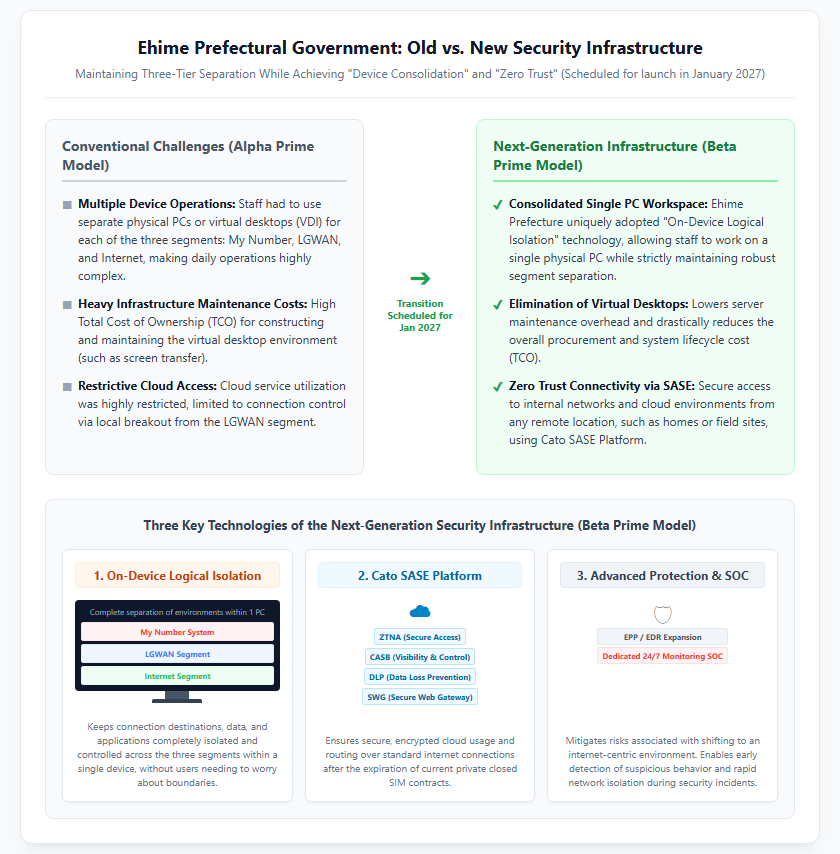
To boost administrative efficiency, the Ehime Prefectural Government previously implemented the “Alpha Prime” model under the national three-tier security framework. This model used local breakout technology to allow limited access to specific cloud services directly from the LGWAN connection. However, as the government looked toward deeper digital transformation and broader cloud adoption, the Alpha Prime model’s restrictive access became a bottleneck. Consequently, the prefecture decided to migrate to the internet-centric “Beta Prime” model, placing standard user devices and core operational systems directly within the internet segment. This shift enables rapid, flexible utilization of diverse cloud ecosystems and lays the groundwork for advanced, data-driven administrative services. It also supports collaboration with local municipalities to foster a broader regional digital society, paving the way for digitized administrative procedures. The diagram below illustrates the structural transition of the next-generation network.
Replacing Virtual Desktops with On-Device Logical Isolation
The most innovative aspect of Ehime’s network overhaul is the complete decommissioning of the virtual desktop infrastructure in favor of on-device logical isolation. Historically, maintaining network separation required either multiple physical terminals or heavy screen-transfer virtualization, both of which imposed high Total Cost of Ownership (TCO) and server maintenance burdens. To solve this, the prefecture adopted Security Platform, an on-device logical isolation solution developed by Humming Heads Inc. This technology allows staff to work securely on a single physical PC without worrying about network boundaries. The system completely isolates network destinations, data, and applications for each of the three operational segments within a single device. By eliminating VDI, the prefecture slashes infrastructure costs while vastly improving user experience and reducing the physical hardware footprint.
Advanced Security Architecture and Operations
Secure Ubiquitous Connectivity via the Cato SASE Platform
To transition to an internet-centric model while ensuring both remote work flexibility and robust cloud security, Ehime Prefectural Government adopted Cato Networks’ “Cato SASE Platform”. Currently, staff rely on private closed SIM cards for secure remote access. Once these closed SIM contracts expire, the system will pivot to secure access over standard internet connections. Through Zero Trust Network Access (ZTNA), employees will be able to connect securely and encrypted to internal systems and cloud environments from any remote location, including their homes or field sites. Additionally, the platform provides Cloud Access Security Broker (CASB) to visualize and govern cloud usage, Data Loss Prevention (DLP) to block unauthorized uploads of sensitive government data, and Secure Web Gateway (SWG) to block malicious websites. This SASE integration ensures that administrative convenience is achieved without compromising state-level confidentiality.
Proactive Threat Defense through EPP, EDR, and a Dedicated SOC
Transitioning to an internet-centric environment inevitably increases exposure to external cyber threats, necessitating a major security upgrade. In response, Ehime is deploying Endpoint Protection Platforms (EPP) to prevent malware intrusion alongside Endpoint Detection and Response (EDR) to detect and neutralize suspicious activity in real-time. These measures will extend to existing systems as well. Furthermore, the prefecture is establishing a dedicated Security Operation Center (SOC) to monitor, analyze, and respond to logs and alerts 24/7. This robust monitoring regime allows the government to instantly detect zero-day or advanced persistent threats and logically isolate infected devices from the network. Access to expert cyber analysis, immediate incident notification, and rapid forensic support minimizes blast radiuses during potential breaches, ensuring swift recovery and seamless post-incident handling.
Enhancing Disaster Resilience and Future Digital Initiatives
In Ehime Prefecture, preparing for major natural disasters, such as the predicted Nankai Trough earthquake and severe storm floods, is a top priority. The newly designed network infrastructure significantly enhances business continuity, ensuring that critical public information and essential administrative functions remain operational during a crisis. With only their issued physical PC and a standard internet connection, staff can securely access the internal network and cloud systems from emergency shelters, remote offices, or homes. Under the Second Ehime Digital General Strategy formulated in March 2024, the government is driving forward citizen-centric DX, and this resilient infrastructure serves as its backbone. Moving forward, the prefecture plans to expand this modern network to digital approval processes and various administrative applications, ultimately optimizing workflows and creating a more attractive, modern working environment for younger civil servants.
Reference Pages
- 【Net One Systems Press Release】https://www.netone.co.jp/news/release/20260806_01.html
【#ZeroTrust #LocalGovernment #Cybersecurity #EhimePrefecture #CloudAdoption #OperationalEfficiency #NetworkInfrastructure #Technology】

コメント