Japan Exchange Group (JPX), which owns the Tokyo Stock Exchange, is undertaking the largest-ever expansion to double its stock order processing capacity. The background includes a sharp increase in trading volume following the historic high of the Nikkei Stock Average, as well as increased system load that could shake market stability.
- 1-1: Raising to 1.5 Billion Transactions per Day and the Largest Investment Scale Ever
- 1-2: Evolution and New Features of the Stock Trading System “arrowhead”
- 2-1: The Rise of HFT and the Expansion of Individual Investor Base
- 2-2: The “Infrastructure Philosophy” Learned from the 2020 System Outage
- 3-1: Medium-Term Management Plan 2027 and Digital Transformation
- 3-2: The True Value of Solid Market Infrastructure Supporting ‘Japan Buying’
1-1: Raising to 1.5 Billion Transactions per Day and the Largest Investment Scale Ever
The Tokyo Stock Exchange has decided to double its stock order processing capacity from the current 830 million per day to approximately 1.5 billion orders in the fall of 2026. This is the largest scale of system enhancement ever. To realize this enhancement, the TSE plans to invest several hundred million yen in memory enhancement for data centers operating the stock trading system “Arrowhead.”
The background to this decision is the dramatic increase in order volume driven by a booming market. The average number of orders per day in June 2026 reached approximately 230 million, swelling 1.9 times compared to just one year ago. With the Nikkei Stock Average surpassing the 70,000 yen mark in June 2026 at a record pace, the momentum of “buying Japan” is accelerating, and the margin in infrastructure is rapidly eroding.
Please refer to the diagram below. JPX has set the stable operation and resilience of its core systems as its top priorities in its medium-term management plan.
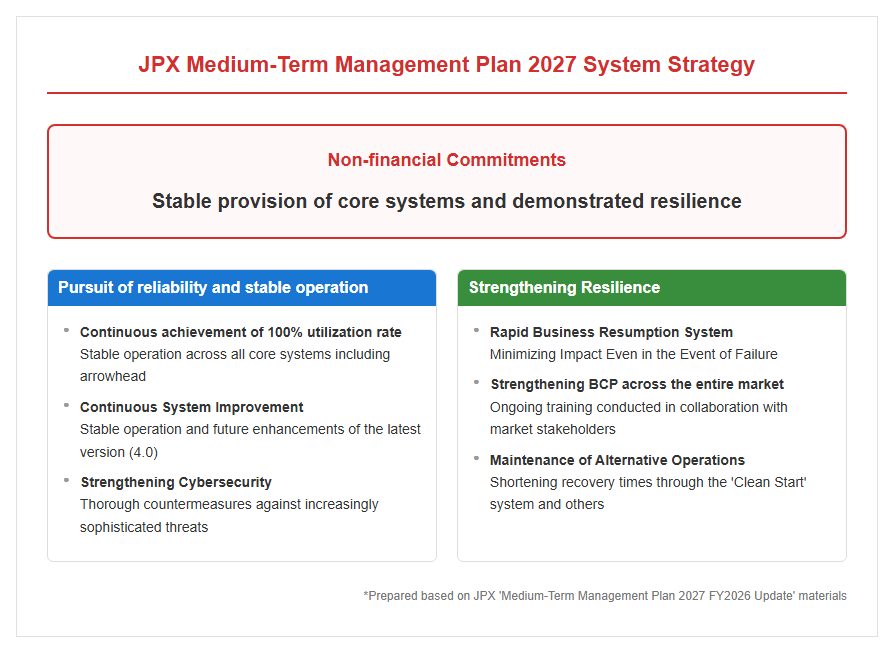
Until now, the TSE has maintained a design philosophy capable of handling up to twice the expected maximum order volume. However, considering the record-high daily order volume of 370 million during the Trump tariff shock in April 2025, current capacity may not be sufficient to handle future market fluctuations. This can be seen as a proactive measure to prevent trouble and maintain trust from global investors.
1-2: Evolution and New Features of the Stock Trading System “arrowhead”
“arrowhead,” the heart of the Tokyo Stock Exchange, has continuously evolved since its launch in January 2010. On November 5, 2024, the latest version, “Arrowhead 4.0,” began operation. This latest system has introduced several important changes to improve investor convenience and enhance international competitiveness.
The main changes are as follows.
-
Extension of trading closing time: The closing time has been extended by 30 minutes from 15:00 to 15:30.
-
Introduction of Closing Auction: To increase transparency in closing price formation, the 5-minute period before closing is designated as the order acceptance period (pre-closing), with the closing session conducted at 15:30.
-
High response performance: Order response time is approximately 0.2 milliseconds, and information delivery time is about 0.5 milliseconds, maintaining world-class speed.
-
Advanced information distribution: New services such as “FLEX Market by Order,” which deliver all call information in detail for each order, have been implemented.
These feature enhancements aim to provide investors with more trading opportunities. In particular, the extension of trading hours is a historic reform for the first time in 70 years, improving the ease of daytime trading. This doubling of processing capacity also lays the foundation for maximizing the capabilities of these state-of-the-art systems.
Background to the Increase in Trading Volume: The Changing Structure of the Japanese Market
2-1: The Rise of HFT and the Expansion of Individual Investor Base
Currently, the order structure gathering on the Tokyo Stock Exchange has changed drastically compared to a few years ago. There are mainly three structural factors supporting the explosive expansion of trading volume.
First, it holds an overwhelming share of “high-frequency trading (HFT),” where computers automated, high-speed, and large-scale trading are repeated. HFT firms account for 70% to 80% of all TSE orders, creating an environment where large volumes of small orders occur every millisecond. While HFTs contribute to improving market liquidity and promoting price tracking, they are also the biggest factor in system load.
Second, there is a surge in transactions by individual investors. As a result of the zero-commission implementation of domestic stock trading fees by major online securities firms such as SBI Securities and Rakuten Securities since autumn 2023, the number of individual orders has more than doubled. Through the expansion of the NISA system and other measures, the shift from “saving to investing” is accelerating, and personal money is flowing into the market on an unprecedented scale.
Third, the segmentation of orders by institutional investors. Instead of placing large orders all at once and placing orders in smaller segments to avoid market impact, “slice trading” has become increasingly common, leading to an increase in the number of orders per trade. These factors combined to raise the system’s assumed capacity, which was about 390 million transactions per day during the COVID-19 pandemic, to the expected level of 1.5 billion now.
2-2: The “Infrastructure Philosophy” Learned from the 2020 System Outage
The reason the Tokyo Stock Exchange has come to place such importance on processing capacity (buffers) is the bitter experience of a large-scale system failure that occurred on October 1, 2020. At that time, the shared disk device malfunction combined with the failure to switch to backups led to a “nightmare” situation where trading of all stocks was suspended all day. The Financial Services Agency issued a business improvement order, severely damaging international trust in Japan’s financial market.
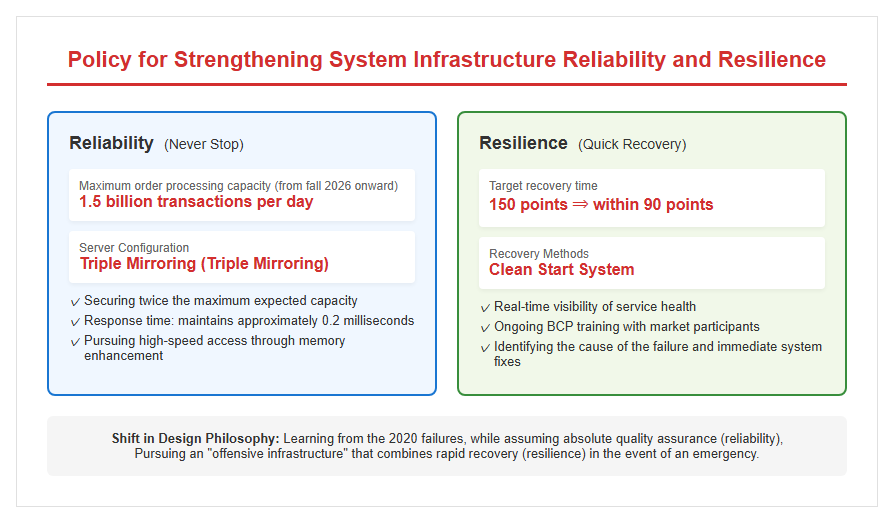
After this disruption, JPX’s management fundamentally changed their system design philosophy. In addition to the old slogan “Never Stop,” we have placed the strengthening of “resilience” to quickly recover even if you do stop, as two pillars.
The basic concept of infrastructure investment is as follows.
-
Double the maximum value: Always maintain capacity to handle twice the highest trading volume ever.
-
Reduced recovery time: A clean start system was established during system failures, reducing recovery time from 150 minutes to 90 minutes.
-
Continuous preventive maintenance: Identify the direct causes of failures and pursue reliability to the extreme, such as triple-layering hardware configurations.
Based on the lesson that “it is difficult to notice distortions in infrastructure during booming times,” we continue investing to prepare for future “what ifs” even amid current stock market surges. The diagram below shows JPX’s policy to strengthen the reliability and resilience of its system infrastructure.
Future Outlook: JPX’s Strategy Toward Becoming an Asset Management Nation
3-1: Medium-Term Management Plan 2027 and Digital Transformation
JPX is currently promoting its “Medium-Term Management Plan 2027,” with “Pioneering a New Era for the Japanese Stock Market” as one of its key themes. This is in step with the government’s push to realize an “asset-based nation,” accelerating the creation of a market environment where domestic and foreign investors can invest funds with confidence.
On the system side, efforts are not only on enhancing processing power but also actively considering the introduction of advanced technologies such as AI (artificial intelligence) and blockchain (DLT).
-
AI Utilization: AI is being introduced for the search service “J-LENS” for listed company disclosure information and for the advancement of sales screening operations.
-
Next-generation data: High-frequency data delivery through external platforms like Snowflake.
-
Post-trade efficiency: Building a cross-industry data platform to shorten settlement periods (T+1 integration).
We are also strengthening investment in human capital, supporting the quality of system operations from a soft perspective by acquiring specialized personnel in the digital field and enhancing employee training. As the operator of market infrastructure, JPX aims to realize its long-term vision for 2030, “Target 2030,” by balancing stable operations with improved convenience.
3-2: The True Value of Solid Market Infrastructure Supporting ‘Japan Buying’
The true value of this system enhancement is not tested in the current favorable phase, but rather at moments of crisis when the market suddenly changes and orders surge explosively. In past cases, panic selling and algorithmic automated trading during sharp stock price drops have overlapped, causing order volumes to jump several times the normal level.
Investing in infrastructure to respond to “buying Japan” is also a preparation to prevent panic without causing the market to come to a halt in the event of a potential future “selling Japan.” The Japanese market has a rare single-point concentration structure, with nearly 90% of trading concentrated on the Tokyo Stock Exchange, so a stop on the TSE would mean the shutdown of the Japanese economy. To overcome this vulnerability and cover Japan’s unique vulnerability—which is not distributed across multiple exchanges like in the U.S.—collateral backed by overwhelming processing power is essential.
Going forward, whether the Japanese stock market can establish itself as Asia’s key market depends not only on stock price levels but also on maintaining the world’s most “unstoppable, never-behind” robust infrastructure. This largest-ever expansion can be seen as an effort to strengthen the literal “framework” that supports the reliability of the Japanese economy.
[#東京証券取引所 #JPX #資産運用立国 #システム投資 #アローヘッド #日本経済 #HFT #レジリエンス]
コメント