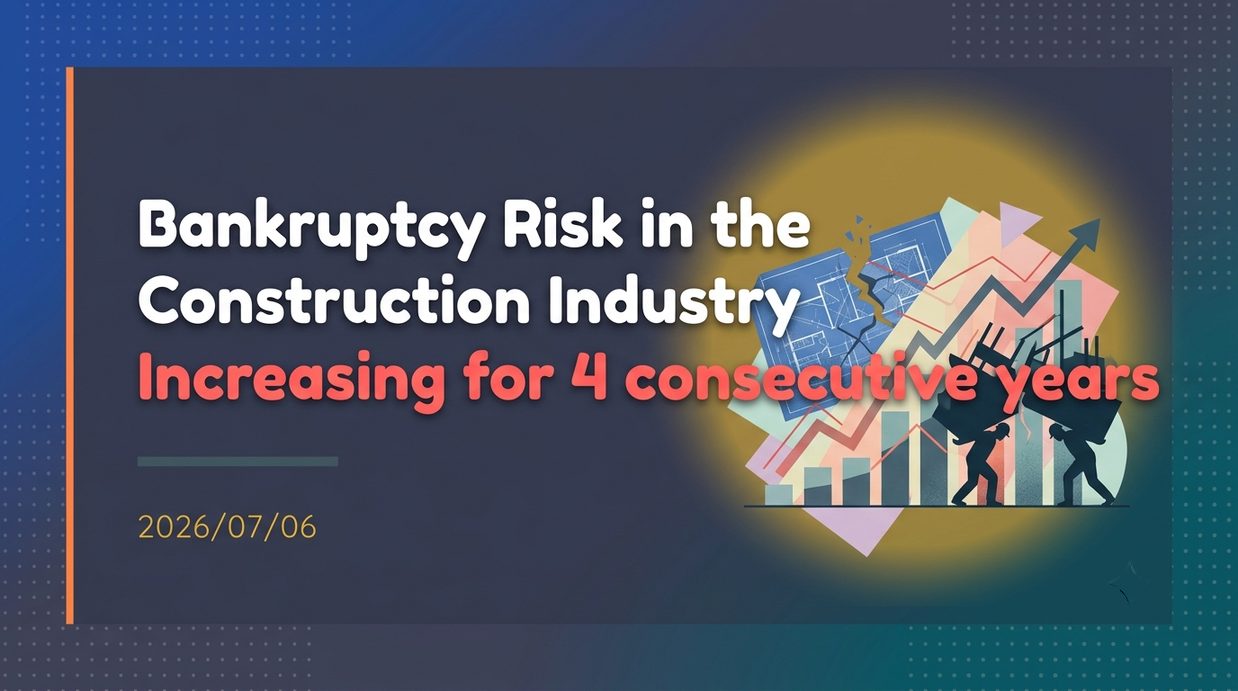
The number of bankruptcies in the construction industry in 2025 will reach 2,021, the highest in the past decade, and marks the fourth consecutive year of increase. Behind this are structural factors such as soaring material prices, severe labor shortages, and increased labor costs due to the “2024 problem.”
- Bankruptcy trends surpassing 2,000 for the first time in 12 years
- The “Triple Suffering” Damage That Stands Out by Job Type
- The fear of ‘profitable bankruptcy’ progressing behind sales growth
- “The 2024 Problem” and the Aging of Executives Leading to Withdrawal
- Predictions for the ‘Largest Construction Bankruptcy Era in History’ in 2026
- The boundary between surviving and disappearing companies
Bankruptcy trends surpassing 2,000 for the first time in 12 years
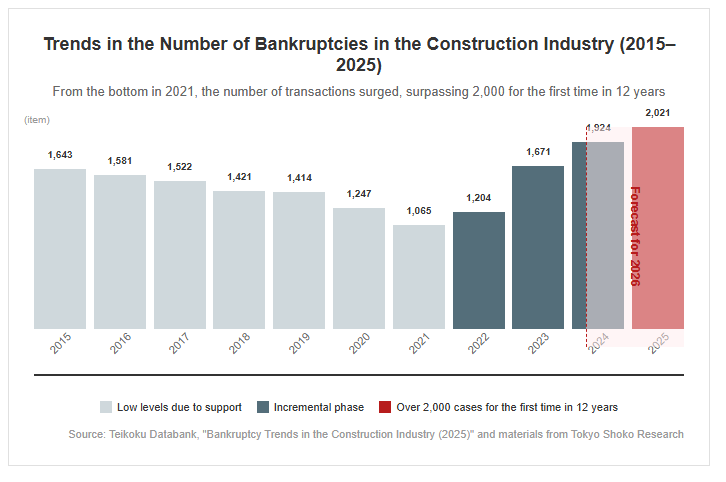
The number of bankruptcies in the construction industry (debts of 10 million yen or more, legal liquidation) that occurred in 2025 (January to December) increased by 6.9% year-on-year, reaching 2,021 cases. This marks the first time in 12 years since 2,347 cases in 2013 that the number has surpassed 2,000, marking the fastest pace in the past decade. This is the first time since 2000 that the number of bankruptcies in the construction industry has increased for four consecutive years. This surge is not just a temporary economic fluctuation, but suggests that the industry’s serious structural problems have reached their limits.
Looking at the scale of bankrupt companies by debt amount, there were 1,167 cases of small or micro bankruptcies with debts under 50 million yen, accounting for 57.7% of the total. Meanwhile, large-scale bankruptcies with debts over 1 billion yen have surged, with reports showing a 133.3% increase from 9 cases the previous year to 21 cases in 2024. In this way, difficulties are spreading not only to small businesses with weak management strength but also to mid-sized and larger companies, which is a current characteristic.
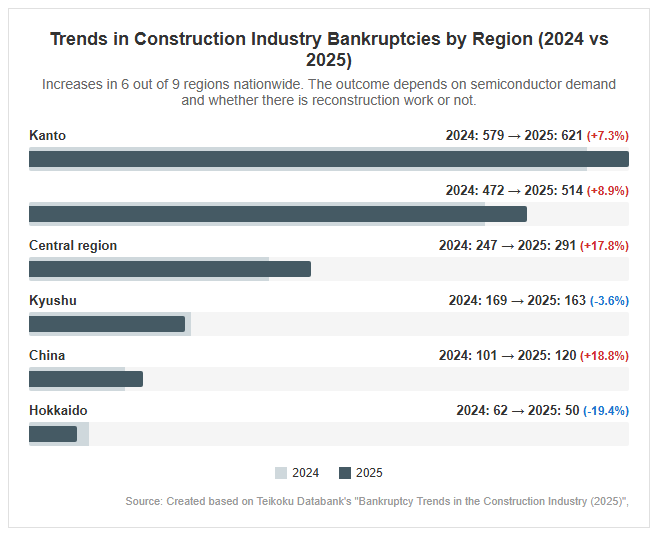
Looking at regional trends, bankruptcies increased in six out of nine regions nationwide. Growth is particularly notable in the Chugoku region (120 cases, up 18.8% year-on-year) and Chubu region (291 cases, up 17.8% year-on-year). On the other hand, in Hokkaido, where large-scale projects such as redevelopment in Sapporo and semiconductor manufacturing facilities are underway, Kyushu where demand for semiconductor factories remains strong, and Hokuriku where earthquake reconstruction work is underway, the number of bankruptcies has slightly decreased, and the situation is diverging depending on the level of regional economic activity. Please refer to the diagram below.
The “Triple Suffering” Damage That Stands Out by Job Type
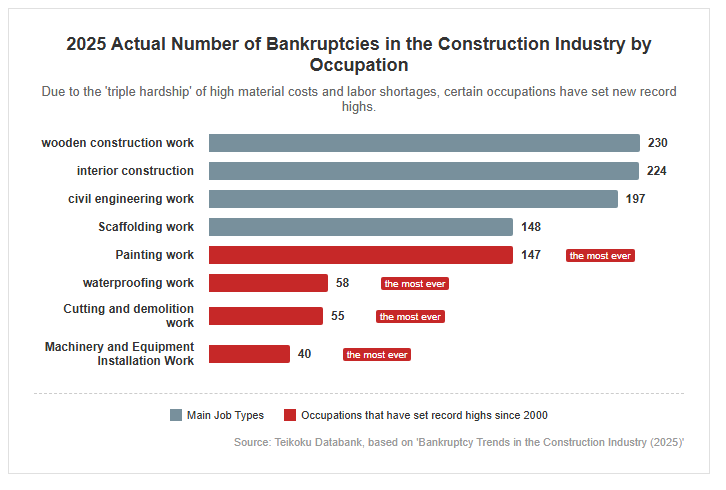
As bankruptcies across the construction industry increase, certain business types are facing their worst situation ever, especially in ‘job-specific construction businesses’ and ‘equipment construction businesses.’ These industries, which undertake parts of building and infrastructure processes, are highly labor-intensive and have been directly affected by recent labor costs and labor shortages. Specifically, bankruptcies surged in the scaffolding and dismantling and cutting businesses, and the painting business, waterproofing work, and machinery installation business also surpassed the Lehman Shock era, recording the highest number of cases since 2000.
One major factor causing these occupations to struggle is the drawbacks of the multi-layered subcontracting structure. For secondary and tertiary subcontractors who have weak bargaining power with prime contractors, it is extremely difficult to pass on the increase in material and labor costs to construction costs. According to a survey by Teikoku Databank, the price pass-through rate for the construction industry is only 42.1%, meaning operators are absorbing more than half of the cost increases themselves.
Furthermore, the cooling of the detached housing market is further impacting. In the “Wooden Construction Construction Business,” the number of new units starting has decreased due to rising housing prices, and stricter confirmation applications due to the reduction of the “Type 4 Special Provision” have led to longer construction periods and worsened cash flow conditions. Sites that used to operate as long as they received orders are now falling into a vicious cycle of reduced construction capacity, extended construction periods, and rising outsourcing costs, leading to a series of cases where they give up on continuing their businesses. Please refer to the diagram below.
High costs and cash flow limits driving management to the brink
The fear of ‘profitable bankruptcy’ progressing behind sales growth
A major feature of bankruptcies occurring in the current construction industry is the rapid collapse of “booming companies,” where despite strong orders and increased sales, cash on hand runs out and they go bankrupt. There is a certain demand for condominium development, infrastructure repairs, and manufacturing equipment construction, so the order environment itself is by no means bad. Among the bankrupt companies, many have been confirmed to have seen revenue growth until recently.
However, precisely because revenue increases, payments such as material costs and outsourcing costs come first, increasing the demand for working capital. When combined with a sharp rise in material prices, the initial budget is significantly exceeded, resulting in lost profits. Construction companies are suffering from superficial sales increases that do not bring real benefits, to the extent that they lament that “the increase in finished construction costs is only due to material price increases.”
In fact, 240 cases of “high price bankruptcies” will occur in fiscal year 2025, with many cases where cash flow has reached its limit without reflecting the surge in steel, lumber, and housing equipment prices in contract prices. For example, Shinei Painting Industry (debt of 90 million yen), which suffered from worsening profits due to rising labor and material costs, and SHINKI (debt, 100 million yen), which continued to post losses due to soaring outsourcing costs, are typical examples. For companies burdened with large financial debts that cannot secure the funds to repay their loans, increased sales have actually become a factor that raises the risk of bankruptcy.
“The 2024 Problem” and the Aging of Executives Leading to Withdrawal
The worsening labor shortage is also a decisive factor driving up the number of bankruptcies. In particular, the overtime work cap regulation (the so-called 2024 issue), which began in April 2024, has not only increased costs for securing labor but also posed new challenges to the industry, such as addressing construction delays. As the competition for wage increases to secure skilled workers intensifies, small and medium-sized construction companies with limited capacity for wage increases continue to face the outflow of skilled workers and the difficulty of hiring young workers.
In addition, serious issues include the aging of business owners and the difficulty of successors. As of March 2025, the average age of presidents in the construction industry has reached 60.3 years, an increase of more than six years compared to 1995. In 2025, 78 bankruptcies were identified primarily due to business owners’ illness or death, the highest since 2000. There are also many cases where a successor cannot be decided, leading to loss of motivation to continue the business and choosing to close the game through bankruptcy.
According to an analysis by Teikoku Databank, there were as many as 120 bankruptcies caused by “successor difficulties.” Especially for small businesses, the decline in on-site construction capacity leads to extended or delayed construction periods, which in turn lead to higher outsourcing costs and penalties, creating an inescapable negative spiral. There were 113 bankruptcies caused by such labor shortages, a steady increase from 99 the previous year. Companies unable to secure the “scarce resource” of construction capability are forced to exit the market.
Survival strategies for survival, and outlook for 2026
Predictions for the ‘Largest Construction Bankruptcy Era in History’ in 2026
Experts predict that 2026 will mark the beginning of the “largest construction bankruptcy era in history.” This is because, in addition to previous high costs and labor shortages, multiple economic pressures are peaking simultaneously. First, repayments of “zero-zero loans” (effectively interest-free and unsecured loans), which have supported companies’ survival during the COVID-19 pandemic, are now in full swing, and grace periods such as refinancing guarantee systems are also coming to an end. With the heavy burden of loan repayments, companies that find it difficult to borrow new funds are frequently going bankrupt.
Next, a major risk is a return to a ‘world with interest rates’ due to changes in the Bank of Japan’s policy. Rising borrowing rates directly squeeze the profits of builders burdened with excessive debt. Furthermore, the increased burden of social insurance premiums due to wage increases is a matter of life and death for small and medium-sized businesses with low profit margins.
With bankruptcies across all industries exceeding 10,000 for the second consecutive year in fiscal 2025, there is a view that the number of bankruptcies in the construction industry is likely to increase further and surge sharply after summer. Operators who cannot maintain internal systems to respond to changes in cost structure are now at a critical point where it is difficult to extend their lives. Please refer to the diagram below.
The boundary between surviving and disappearing companies
To survive these turbulent times, it is essential to break free from the “Showa illusion” and enhance management resilience. The biggest key to survival lies in receiving orders at fair prices and thorough cost management. Companies with an old-fashioned system—repeatedly taking ‘low-price orders’ out of fear of losing work, and relying on determination and speed to get cash by moving around the field—are the fastest targets to fail in today’s inflationary economy.
Specifically, the following three conditions are considered important.
-
Bargaining Ability: The ability to reasonably pass on price increases in material costs and labor costs to prime contractors and clients.
-
Cost management: Accurately grasp your company’s cost structure on a monthly basis and have the courage to decline unprofitable work.
-
Diversification of Partners: Building a business portfolio resilient to external shocks, independent of any single company or industry.
The era of great bankruptcy, if viewed differently, is also a painful operation to reduce rivals and restore fair prices and working conditions. Companies that overcome this phase are freed from discount competition and can use the profits they secure to raise artisans’ wages, hire younger workers, and increase holidays. Whether the construction industry can evolve into a new 3K that can realize the “new 3K” of making money, looking cool, and moving is a real question now.
[#建設業倒産 #人手不足 #2024年問題 #物価高騰 #価格転嫁 #ゼロゼロ融資 #中小企業経営 #事業承継]


コメント