Municipalities in Shimane Prefecture, including the prefectural government and Matsue City, have revised their public works procurement systems to factor in extreme summer heat. This initiative is driven by the urgent need to protect construction workers from severe heatwaves and to advance work-style reforms across the industry.
- Background and Key Highlights of Shimane’s Shift in Summer Procurement
- Key Regulatory Revisions and Heatstroke Initiatives in Shimane and Matsue
- National Adoption Rates in Municipalities and Remaining Challenges
- Legal Mandates and Guidelines for Constructive Schedule Setting
- Introducing Summer Shutdowns and New Technologies to Transform Job Sites
- Impacts of Material Procurement Issues and the Future Outlook
Background and Key Highlights of Shimane’s Shift in Summer Procurement
In recent years, record-breaking summer heatwaves have posed severe risks to the health and safety of workers at outdoor construction sites. In response, local governments in Shimane Prefecture are overhauling their public procurement systems and project scheduling to prioritize worker safety. This initiative is driven not only by the rising threat of heatstroke but also by the overtime cap implemented for the construction sector in April 2024 (commonly known in Japan as the 2024 Problem). Tight deadlines that overlook unavoidable downtime, or construction schedules reliant on excessive overtime to make up for delays, are no longer legally viable. To balance regulatory compliance with the need to improve harsh working conditions, Shimane Prefecture and the City of Matsue are actively factoring in extremely hot days and the Wet Bulb Globe Temperature (WBGT) index as planned non-working days within their contract schedules. These reforms in local government procurement represent both a vital safety measure to protect lives and a crucial step toward securing the long-term sustainability of the construction industry.
Key Regulatory Revisions and Heatstroke Initiatives in Shimane and Matsue
In December 2023, Shimane Prefecture’s Civil Engineering Department updated its trial program for adjusting site management overheads for heatstroke prevention, integrating the Ministry of the Environment’s Wet Bulb Globe Temperature (WBGT) index into its definition of extremely hot days. This ensures that project cost estimations are calculated using a realistic heat index that accounts for humidity, solar radiation, and radiant heat, rather than relying solely on dry-bulb temperature. Meanwhile, the City of Matsue has introduced additional extreme heat countermeasures to address the normalization of intense summer temperatures. These new guidelines, effective for projects commissioned on or after September 1, 2026, apply to all city-funded construction projects except for building repairs (eizen works). Please refer to the diagram below for a summary of these measures:
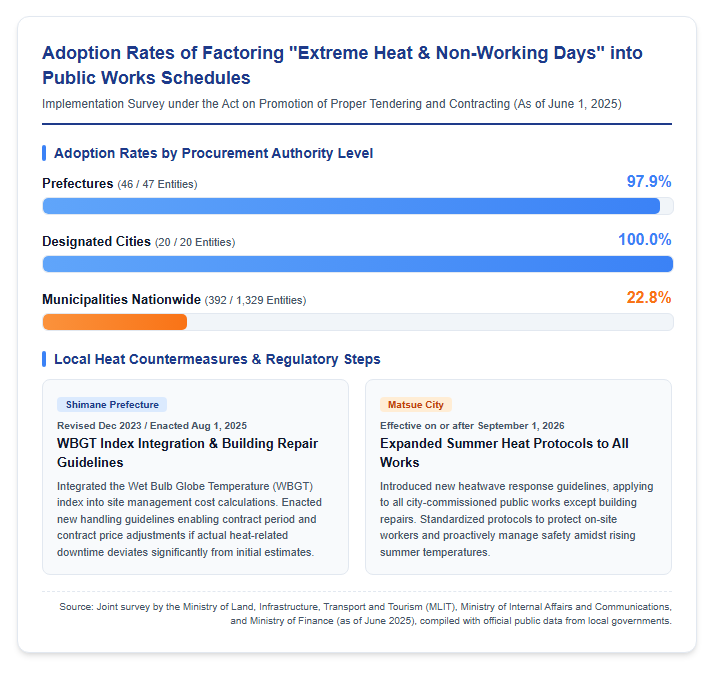
Furthermore, on August 1, 2025, Shimane Prefecture enacted the Guidelines for Handling Non-Working Days Due to Extreme Heat in Shimane Prefectural Building Repair Works. Under these guidelines, if the actual number of non-working days due to extreme heat deviates significantly from the initial estimate made at the time of procurement, the contract schedule and contract price can be formally adjusted. This framework ensures that contractors do not bear an unfair financial or operational burden when faced with unexpected heatwaves, allowing for flexible project extensions.
Status and Legal Framework of Factoring Heatwaves into Public Contracts
National Adoption Rates in Municipalities and Remaining Challenges
Factoring extreme heat into public contract schedules reveals a stark disparity between large-scale entities, such as prefectures and designated cities, and smaller municipal governments. According to a joint survey conducted by the Ministry of Land, Infrastructure, Transport and Tourism (MLIT), the Ministry of Internal Affairs and Communications, and the Ministry of Finance under the Act on Promotion of Proper Tendering and Contracting for Public Works, as of June 1, 2025, 46 out of 47 prefectures (97.9%) and all 20 designated cities (100.0%) adjusted project schedules to account for extremely hot days. In contrast, only 392 out of 1,329 municipalities nationwide (22.8%) implemented similar measures. Although this represents a 7.9-percentage-point increase from the previous year, nearly 80% of local municipalities still do not factor extreme heat downtime into their initial construction schedules. This lag is largely due to a lack of specialized expertise, incompatible cost-estimation software, and tight budgetary and scheduling constraints in smaller local administrations. Recognizing the growing severity of summer heatwaves, the MLIT is intensifying its efforts to push this municipal adoption rate to 100%.
Legal Mandates and Guidelines for Constructive Schedule Setting
Factoring extreme heat into project schedules is no longer merely a matter of courtesy by public procurers; it has become an increasingly codified legal obligation. The MLIT’s Guidelines for Compliance with the Construction Business Act in Transactions between Public Sector Clients and Contractors and the Standards for Construction Periods set by the Central Construction Industry Council explicitly classify extremely hot days—defined as days when the WBGT index reaches 31 or higher—as unavoidable downtime that must be accounted for in scheduling. Under Article 20 of the Construction Business Act, contractors must estimate the necessary working days by factoring in potential heat-related downtime and submit this to the client. In turn, Article 20, Paragraph 4 mandates that clients make sincere efforts to respect and accommodate these estimates. If a client unilaterally enforces an unreasonably short construction period without factoring in heatwave-related downtime, they risk violating Article 19-5 of the Construction Business Act, which prohibits the imposition of unreasonably short construction periods. Even if both parties sign the contract, a schedule that implicitly relies on illegal overtime can be ruled a statutory violation. In severe cases, licensing authorities may issue formal recommendations or publicly name violating clients under this strict regulatory framework.
New Work-Style Trends and Material Procurement Challenges in Construction
Introducing Summer Shutdowns and New Technologies to Transform Job Sites
As global temperatures rise, conventional site countermeasures like mandatory hydration and air-conditioned vests are reaching their limits. Consequently, the industry is looking toward systemic shifts, such as summer shutdowns and flexible working hours to avoid peak heat hours. These initiatives, currently pioneered in public works projects by the national and leading prefectural governments, are expected to expand nationwide. For instance, the MLIT plans to pilot temporary summer shutdowns (spanning late July to mid-August) starting in the summer of 2026. Northwest of Shimane, on government building projects overseen directly by the MLIT, heat countermeasures have been expanded starting in fiscal year 2026. These rules encourage project managers to actively avoid outdoor labor during peak heat periods through mutual agreement between clients and contractors. Additionally, procurement evaluations are being revised to reward technical proposals that improve productivity—such as precast concrete components, automated construction, and Building Information Modeling (BIM)—thereby reducing labor-intensive outdoor tasks. Cost-estimation models are also trialing a premium markup on labor costs to offset expenses associated with heat-related work stoppages. Rather than just easing the physical toll on workers, these reforms are accelerating the adoption of construction DX (digital transformation), paving the way for a modern project management model that maintains productivity while keeping job sites safe.
Impacts of Material Procurement Issues and the Future Outlook
Advancing summer heat countermeasures requires careful consideration of economic and supply chain factors, such as rising project costs and fluctuating material availability. Standard heatstroke prevention expenses—covering industrial fans, air conditioning, hydration supplies, and WBGT monitoring equipment—are typically included within a project’s initial budget as part of general temporary facility and site management overheads. However, specialized, high-cost measures, such as installing heavy-duty shading nets on scaffolding, require contractors to submit formal modification requests. Clients must then negotiate in good faith to revise the project design and properly allocate additional funds. Meanwhile, broader geopolitical challenges have introduced severe volatility. In May 2026, Shimane Prefecture temporarily suspended bidding on renovation projects for 12 public facilities, including prefectural schools, hospitals, and housing units, due to supply chain anxieties over naphtha (crude gasoline) stemming from escalating tensions in the Middle East. Naphtha is a vital raw material for paints, waterproofing membranes, and insulation for high-voltage electrical cabling, making procurement highly difficult. Faced with the combined threats of heatwave scheduling delays, supply shortages, and geopolitical inflation, public sector contracts must leverage flexible contract price adjustment mechanisms (such as slide clauses) and prompt design-change processes. The industry’s ability to smoothly adapt to these volatile shifts remains a key focal point for the future.
References
- 【Shimane Prefectural Civil Engineering Department: Partial Revision of the Trial Program for Adjusting Site Management Overheads for Heatstroke Prevention | Notice from the Chuo-Oochi Construction Industry Association】https://ohchi-kenkyo.jp/pdfdownload/archives/75
- 【Shimane Prefecture: Work-Style Reform Initiatives in Prefectural Building Repair Works (Top / Building Repairs Division)】https://www.pref.shimane.lg.jp/eizen/gyoumu.html
- 【Shimane Prefecture: Heatstroke Prevention Measures in Construction Works】https://www.pref.shimane.lg.jp/infra/kouji/kouji_info/sekisan/oshirasesekkei/kensetsukoujiniokerumousyotaisaku/kensestsukoujiniokerumousyotaisaku.html
- 【Heatstroke Prevention Measures in Construction Works / Matsue City Official Website】https://www.city.matsue.lg.jp/soshikikarasagasu/zaiseibu_kensetsukojikanrishitsu/nyusatsu_keiyaku/1/26437.html
- 【Guidelines for Compliance with the Construction Business Act in Transactions between Clients and Contractors (8th Edition) – Ministry of Land, Infrastructure, Transport and Tourism】https://www.mlit.go.jp/totikensangyo/const/1_6_bt_000191.html
【#ShimanePrefecture #HeatCountermeasures #HeatstrokePrevention #PublicWorks #WorkStyleReform #ConstructionBusinessAct #MatsueCity】


コメント