On July 6, 2026, Microsoft announced an additional layoff of approximately 4,800 employees worldwide, and in line with this, embarked on a historic restructuring of its Xbox business and sales divisions. Behind this move is the executives’ strong determination to fundamentally transform software development while maintaining massive investments in AI infrastructure.
- Additional reductions and eligible categories in July 2026
- Voluntary retirement programs and workforce adjustments
- From Software Factory to Intelligence Engine
- Fundamental restructuring of sales and consulting departments
- The Xbox division’s “reset” and studio independence
- Soaring development costs for AAA titles and project cancellations
- Transitioning to a “Diamond-Shaped” Organization and the Skills Required
- Market expectations and the path to medium- to long-term growth
Additional reductions and eligible categories in July 2026
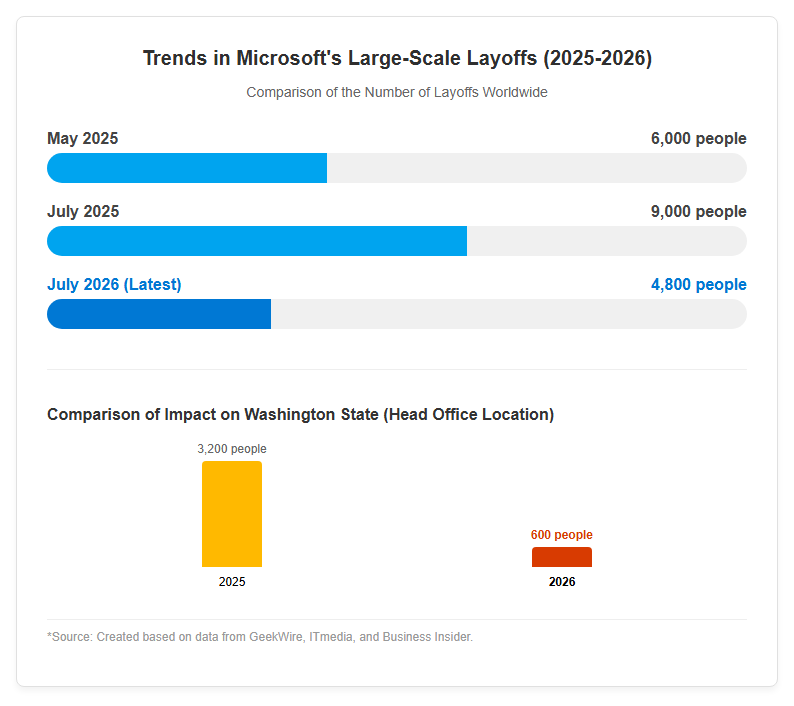
On July 6, 2026, Microsoft announced plans to lay off 4,800 employees, approximately 2% of its global workforce. This round of reductions coincided with the start of the company’s new fiscal year, primarily targeting sales, consulting, and the Xbox gaming division. By region, about 600 people were laid off around the headquarters in Redmond, Washington, but the total number of employees in the state is expected to remain stable at around 52,000. The company is carrying out large-scale layoffs totaling 15,000 in 2025, with 6,000 in May and 9,000 in July, and this round is once again positioned as part of its ongoing organizational optimization. Additionally, this round of personnel reductions includes the legal department, with an estimated 465 legal professionals worldwide affected.
The photo below shows Microsoft’s headquarters in Washington State, USA, where this large-scale layoff was announced.
Voluntary retirement programs and workforce adjustments
In this round of reductions, Microsoft actively utilized mechanisms that encourage voluntary turnover, not just mandatory layoffs as before. Specifically, we introduced the first voluntary retirement program for U.S. employees, recruiting approximately 9,000 employees at or below a certain rank whose combined age and years of service reach 70 years. As a result, approximately 3,000 people, or roughly 30% of the target population, accepted the program, making it possible to keep the scale of involuntary layoffs lower than the previous year. Chief People Officer Amy Coleman emphasizes that AI is not directly taking away jobs, but also that AI is changing the way work is done, and she has indicated a policy to reskilling engineers into customer service and AI-focused roles going forward.
Shift in Management Strategy and Shift to AI
From Software Factory to Intelligence Engine
In a memo to all employees, CEO Satya Nadella declared that it is time to transform Microsoft’s mission from a “software factory” to an “intelligence engine.” This means reconstructing every layer of the technology stack for AI, enabling every individual and organization to realize what they want to build themselves. AI is an extremely costly technology, and investing in infrastructure such as NVIDIA’s specialized semiconductors, data centers, and massive power sources requires enormous funds. Microsoft positions this layoff as a strategic way to reduce traditional roles and reallocate capital to invest in next-generation AI technology and secure talent. In fact, the company’s stock price has fallen 30% over the past nine months due to concerns over AI infrastructure investments, with about $1.2 trillion lost in market capitalization, adding pressure to tighten operational cost controls.
Fundamental restructuring of sales and consulting departments
With the advent of the AI era, Microsoft is aiming to fundamentally transform the way sales and consulting departments serve as customer touchpoints. At the core of this is a new $2.5 billion initiative called “Microsoft Frontier Company,” announced in June 2026. This initiative aims to directly deploy 6,000 engineers within client companies to support the implementation and utilization of AI on the ground. This strategic shift has reduced the roles of traditional sales and consultants, while increasing demand for talent with more advanced technical expertise who can build AI solutions through direct customer interaction. President Brad Smith analyzes that with the spread of AI, code generation itself has become cheaper and faster, but even more so has become increasingly important for roles in product management, software design, and direct customer collaboration.
Crossroads in the gaming business and industry challenges
The Xbox division’s “reset” and studio independence
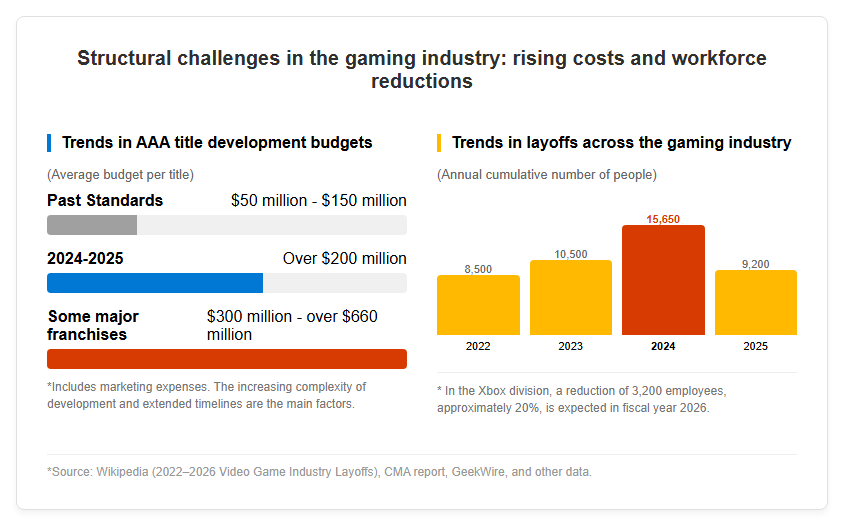
One of the most severely impacted divisions in this restructuring is the Xbox Games business. Newly appointed CEO Asha Sharma demanded a “reset” of the Xbox business and initiated the largest structural reform in the division’s history. With this announcement, about 1,600 jobs will be cut from the Xbox division, with a total of 3,200 jobs expected to be cut within the fiscal year (about 20% of the division’s total). The background is that Xbox’s profit margins are extremely low compared to competing platforms and publishing businesses, and development studios are losing 64 cents on every dollar invested, resulting in a tough revenue situation. To resolve this situation, Microsoft decided to spin off four game studios, including “Toys for Bob,” and switch to independent operations. This is a tough choice to streamline a structure under a large organization’s umbrella, which has inflated operating costs, aiming for long-term growth and profitability.
The chart below illustrates the recent increase in game development costs and the resulting restructuring within the industry.
Soaring development costs for AAA titles and project cancellations
One challenge facing the entire gaming industry is the development costs of AAA (Triple A) blockbuster games, which have soared to unsustainable levels. Budgets that once ranged from around $50 million to $150 million have exceeded $200 million for blockbusters releasing in 2024 and 2025, and for major franchises like Call of Duty, combined development and marketing costs have reached hundreds of millions of dollars. Microsoft was also unable to escape this pressure, and after more than six years of development, it decided to cancel or shut down promising titles such as Blizzard Entertainment’s survival game “Odyssey,” Rare’s “Everwild,” and The Initiative’s “Perfect Dark.” As the rapid demand growth during the pandemic subsides and consumer habits change, companies are forced to refrain from developing high-risk new IP (intellectual property) and focus resources on established brands.
Future Outlook and Key Points
Transitioning to a “Diamond-Shaped” Organization and the Skills Required
Tech companies like Microsoft are transforming from traditional “pyramid-shaped” organizations to more sophisticated “diamond-shaped” organizations. This means that AI-driven automation reduces the repetitive and analytical tasks once handled by junior staff, streamlining the bottom of the organization. At the same time, demand is increasing from experienced mid-level to senior-level experts who can guide AI systems and manage complex projects. This shift has raised concerns about increased barriers to entry for young graduates and other professionals, but companies are being compelled to create new training models such as simulation learning and mentorship to nurture the next generation of leaders. What is needed in the coming era is not just programming skills, but a hybrid skill set that combines “AI literacy,” which effectively and ethically wields AI, combined with human-specific creativity and strategic thinking.
Market expectations and the path to medium- to long-term growth
Microsoft’s recent major restructuring may be painful in the short term, but Wall Street investors have generally welcomed it as a “slim and efficient approach.” The AI revolution is a structural transformation comparable to the industrial revolution of the past, and reallocating the resources needed to get through this transition period is an inevitable process. Industry analysts predict that between 2025 and 2026, the video game market will return to growth with the arrival of “Grand Theft Auto VI” and new hardware. For Microsoft as well, whether its massive investment in AI infrastructure will bear fruit and establish itself as an intelligence engine is key to its medium- to long-term stock price recovery and sustained growth. The companies that were able to build new business models that collaborate with AI and humans early on will define the next chapter in the history of technology.


コメント