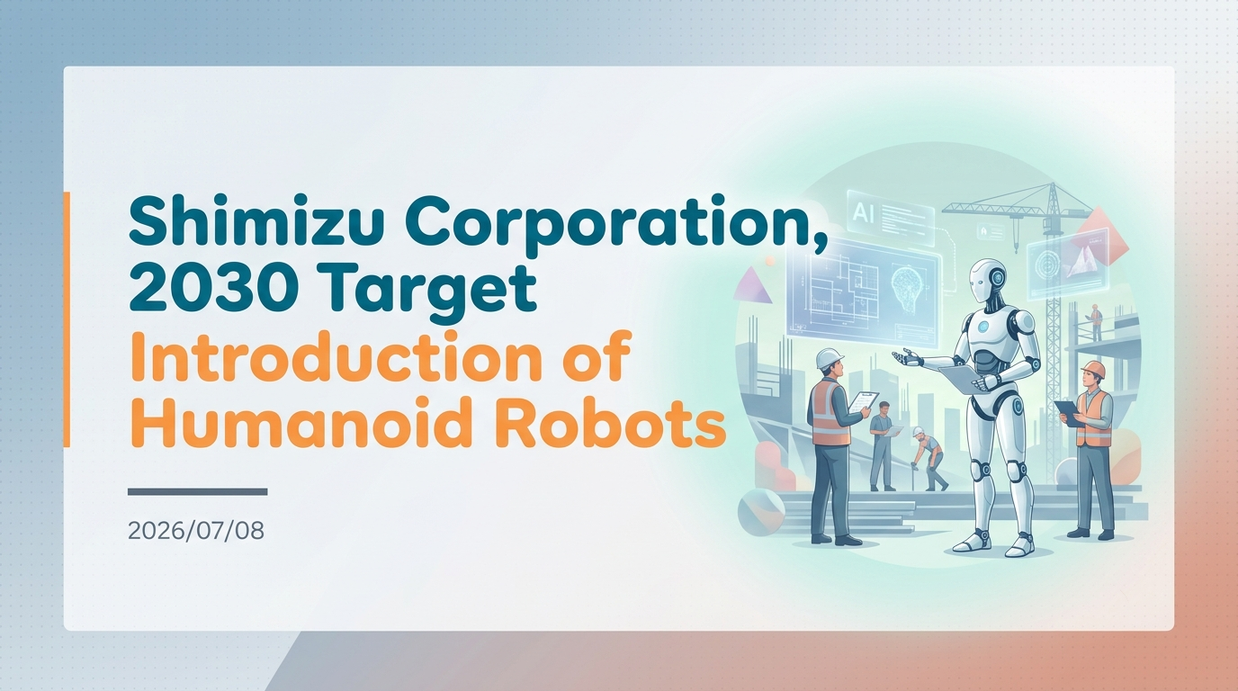
It has been revealed that Shimizu Corporation is advancing plans to fully introduce autonomous humanoid robots (humanoids) to construction sites by fiscal year 2030. In the construction industry, where labor shortages persist, there is growing expectation of a fundamental improvement in productivity through the collaborative work between robots and humans utilizing the latest physical AI.
- Shimizu Corporation’s 2030 Introduction Plan and Physical AI
- Specific tasks performed by robots and their versatility
- Decisive Differences from Conventional Robots
- Worsening shortage of young people and disruption of skill transmission
- Government Work Style Reforms and Labor Market Tightening
- A new work environment aiming for coexistence with humans
- Hardware constraints and adaptation to on-site environments
- Comprehensive evaluation of return on investment (ROI)
- Cost reduction and widespread adoption scenarios through mass production
- Industrial Safety and Health Act and Challenges of Fence-Free Operation
- The relationship between product liability (PL law) and learning AI
- Tensions between data privacy and labor management
- The Ministry of Land, Infrastructure, Transport and Tourism’s roadmap to 2040
- Industry standardization by the Construction RX Consortium
- Shimizu Corporation’s Future Vision as a Digital General Contractor
Shimizu Corporation’s 2030 Introduction Plan and Physical AI
Shimizu Corporation, a major general contractor in Japan, is promoting a future-oriented plan to introduce autonomous humanoid robots equipped with AI at construction sites, targeting around fiscal year 2030. At the core of this initiative is the concept of physical AI (embodied AI), which enables robots to recognize their surroundings, make complex decisions, and autonomously perform precise physical movements. Traditional construction site robots were mostly single-purpose machines specialized for specific repetitive tasks such as material transport, site surveying, or rebar assembly. However, what Shimizu Corporation envisions is realizing versatile robot craftsmen who can adapt to the messy and unstructured realities of the site and work closely with humans. This project positions the company at the forefront of global competition, sending general-purpose humanoids from the laboratory stage into the harsh realities of construction sites with uneven terrain, dust, and constantly changing layouts.
Specific tasks performed by robots and their versatility
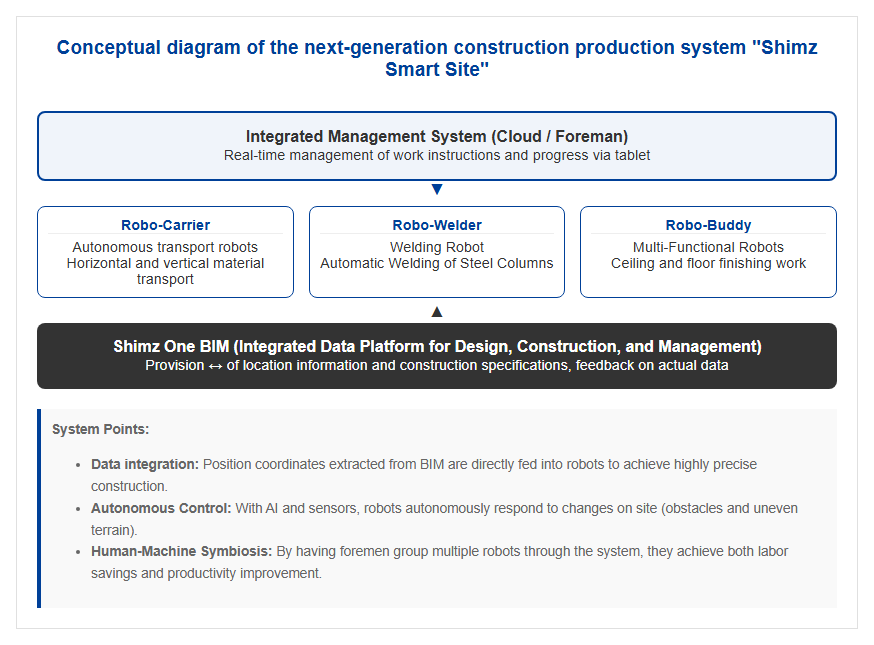
Shimizu Corporation’s humanoids are designed so that a single unit can acquire multiple skills. Specifically, it is expected to autonomously switch between complex interior finishing tasks such as plastering walls and painting work involving spraying paint. Such multifunctionality is an extremely important factor in Japanese construction sites, where a wide variety of tasks are required and precise movements are required in narrow, scaffolded spaces. Traditionally, automating interior finishing has been considered technically extremely difficult, but advances in physical AI are now making it possible to mimic the versatility of skilled human workers. The diagram below illustrates the concept of the next-generation architectural production system that the company aims to envision, featuring autonomous robots working together.
,
Decisive Differences from Conventional Robots
The biggest difference between the humanoids planned for introduction and conventional automated construction machinery lies in their ability to adapt to unstructured environments. Automating environments with flat floors and predictable layouts, like factory production lines, was relatively easy, but construction sites are extremely unstable places where conditions change daily due to weather and processes, with heavy machinery and people mingling together. Shimizu Corporation’s robots aim to interpret such complex visual information and autonomously avoid obstacles while executing objectives following natural language instructions. By having robots handle physically demanding and repetitive preparatory work, skilled human workers can focus on the final high-precision finishing work that requires more specialized expertise. This is not just a replacement of human hands, but a new vision of a workplace where robots function as companions to craftsmen.
[Background and Purpose] Demographic crisis facing the construction industry
Worsening shortage of young people and disruption of skill transmission
Japan’s construction industry is facing demographic cliffs due to the world’s fastest aging population. According to a survey by the Ministry of Health, Labour and Welfare (2023 edition), those aged 55 and over account for 35.2% of all construction workers, while only 11.6% of those under 29 are young, indicating a remarkably low number of young people entering the industry compared to other industries. Behind this is the persistent perception that construction site work is 3K (tough, dirty, dangerous), making it a less attractive profession for young people. While veteran artisans are retiring at an accelerated pace, the lack of successors is threatening the continuity of the advanced skills passed down over many years. Shimizu Corporation’s goal for fiscal year 2030 coincides with the period when the wave of skilled worker retirements is expected to peak, making the search for technological solutions urgent.
Government Work Style Reforms and Labor Market Tightening
Government reforms aimed at improving the labor environment are also factors that further tighten the labor market in the short term. In particular, the overtime cap regulation in the construction industry that took effect in April 2024 has forced a review of the construction system that has relied on long working hours, making productivity improvement the top priority for the entire industry. As a result of labor shortages, labor costs at construction sites have been rising year by year, increasing by an average of about 18 percent between 2020 and 2024. Even if one person is absent, the entire construction period is delayed, and to compensate, giving up holidays or working at night leads to further cost increases and accident risks, creating a negative spiral. In such circumstances, robotizing certain tasks has become a survival strategy to equalize costs and ensure reliable construction schedules.
A new work environment aiming for coexistence with humans
Shimizu Corporation’s strategy is not to completely replace humans with robots, but to create a work environment where humans and robots can coexist. By assigning robots physically demanding and dangerous high-altitude work, the aim is to significantly reduce the physical burden on aging workers while maintaining the high-quality standards that are a strength of Japan’s construction industry. For example, scaffolding workers who assemble and dismantle scaffolding, and formwork carpenters who install reinforced concrete formwork, have high accident rates and become increasingly dependent on individuals, making it difficult for ICT technology to benefit from these fields. By introducing robots as a supplementary tool in these fields, we aim to enable supervisors and skilled craftsmen on site to focus on management and education rather than the work itself, thereby realizing a long-term skill transfer and attractive workplace.
[Challenges and Investment] Hurdles to Practical Application and Profitability
Hardware constraints and adaptation to on-site environments
Putting humanoids to practical use at construction sites faces significant challenges not only in software but also in hardware. With current technological levels, the battery life of many humanoid robots is limited to about 90 to 120 minutes per charge, but if they cannot support continuous operation of 8 to 20 hours per shift on site, their practicality is limited. Unlike household or service robots, they are essential to cope with the harsh environmental conditions unique to construction sites. It is required to have heat and cold resistance from minus 10 degrees to 45 degrees, dust and water resistance equivalent to IP65, and the ability to autonomously recover from falls on uneven terrain. Furthermore, balancing high output and torque, capable of lifting materials weighing 15 kilograms with one arm and over 30 kilograms with both arms and climbing stairs, has become a key technical challenge for mass production.
Comprehensive evaluation of return on investment (ROI)
When considering robot adoption, the biggest concern for companies is return on investment (ROI). Traditionally, evaluations were tended to be based solely on labor cost reduction, but going forward, more comprehensive value judgments will be required. Robots can operate 24 hours a day, 365 days a year, and have the potential to achieve a high rate of 98 percent compared to the average human utilization rate of about 70 percent. This difference appears as a significant compound productivity gap over time. Moreover, not only quantitative evaluation but also indirect effects such as reducing occupational risks due to hazardous work and minimizing rework by stabilizing quality cannot be ignored. In actual cases, robotization has been reported to reassign employees to higher-value roles, improving overall productivity by more than 15 percent.
Cost reduction and widespread adoption scenarios through mass production
To overcome economic hurdles, a significant reduction in aircraft prices is essential. Currently, the unit price of general-purpose humanoids is high, ranging from about $150,000 to $500,000, but analysts suggest that during the widespread phase, the cost will need to drop to around $20,000 to $50,000 (about 3 million to 7.5 million yen). One estimate suggests that if a mass production system of about 500 units per month is established, manufacturing costs per unit could be reduced to about 790,000 yen. Based on this scenario, even if the sales price is set at the 2 million yen range, sufficient profit can be secured, and companies implementing the product such as general contractors can recoup their investment within about two years. To promote adoption not only among major companies like Shimizu Corporation but also among small and medium-sized construction companies nationwide, the key lies in cost competitiveness through mass production and establishing a subscription-based operational model that includes updating operation libraries.
[Legal and Logical Issues] Ensuring Safety and Responsibility
Industrial Safety and Health Act and Challenges of Fence-Free Operation
A major point of contention is consistency with the current legal framework when introducing humanoids on-site. Traditionally, industrial robots have been required to operate in isolated spaces enclosed by fences under the Industrial Safety and Health Act. However, the true value of humanoids lies in their fence-free operation (fence-less operation), where humans work together in the same space. International standards such as ISO 10218 are establishing safety standards for collaborative robots, but it remains unclear to what extent Japan’s current legal system can allow robots and humans—heavy objects that move autonomously—to coexist in the high-risk environment of construction sites. If safety is prioritized and monitoring and regulations are strengthened, work efficiency drops; if monitoring is weakened, safety is compromised. Therefore, there is a demand for detailed safety rule design that can withstand on-site implementation.
The relationship between product liability (PL law) and learning AI
The question of who is responsible if an AI-powered robot causes an accident is extremely complex. For conventional machines, the Product Liability Act (PL law) applies, but for humanoids that undergo additional learning through on-site data collection, the boundary between defects at shipment and behavioral changes caused by additional training during operation becomes blurred. For example, if a collision occurs due to unexpected behavior after training special data from a specific site, manufacturers may claim exemption, while users will claim algorithmic flaws, leading to a conflict. Additionally, the length of the causal chain, which makes it difficult for accidents to have a single cause, such as blind spots in visual sensors, communication delays, and changes in site layout, is also a problem. To clarify these responsibilities, it is urgent to establish contract practices that record detailed audit logs and determine risk allocation based on them.
Tensions between data privacy and labor management
Humanoids continuously capture video, audio, and location information to understand their surroundings. This includes the faces, voices, and behaviors of all workers on site, raising challenges under the Personal Information Protection Act. While on-site data collection is directly linked to safety management, the constant recording of workers’ statements and work efficiency as digital data raises concerns about excessive surveillance and diversion to labor management. Before implementation, it is necessary to establish data governance guidelines before implementation, such as how to separate data necessary for safety from data that can be used for individual evaluation, what is collected, where to store, and when to delete. In the Basic Plan for Artificial Intelligence, which the government approved by the Cabinet in December 2025, the role of civil liability in AI utilization and the establishment of data integration infrastructure are positioned as important policy issues.
[Future Outlook] i-Construction 2.0 and Industry Transformation
The Ministry of Land, Infrastructure, Transport and Tourism’s roadmap to 2040
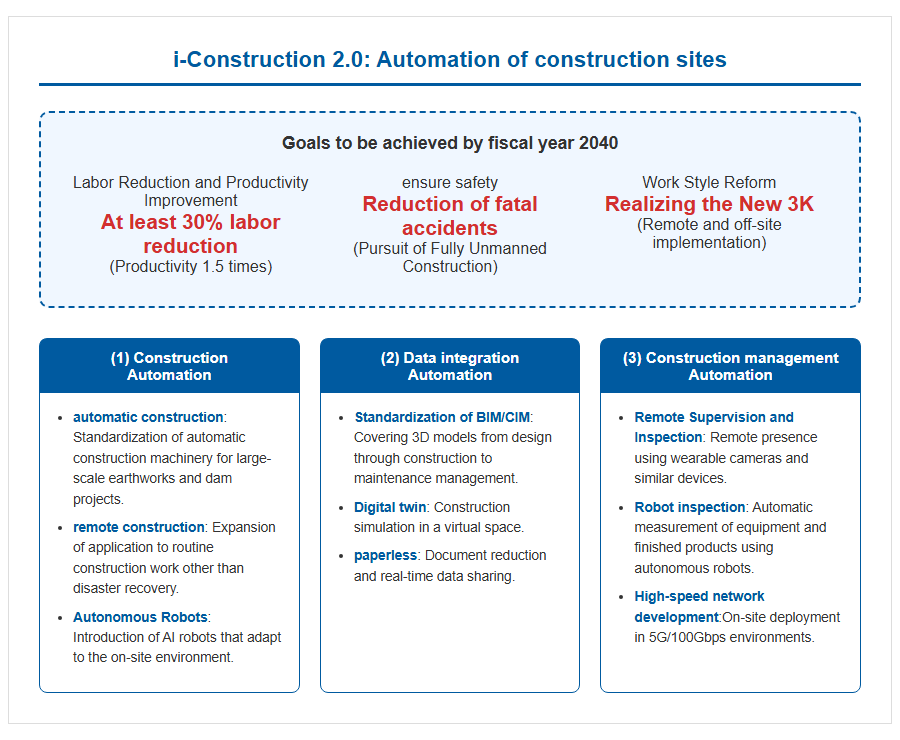
The Japanese government has announced ‘i-Construction 2.0,’ which accelerates automation at construction sites, setting an ambitious goal to reduce labor by at least 30%, or 1.5 times productivity, by fiscal year 2040. This roadmap proposal aims for real-time utilization of site acquisition data in the short term of about five years, and standardization of automated construction in large-scale earthworks and similar projects in the medium term, up to ten years from now. The introduction of humanoids by Shimizu Corporation for fiscal year 2030 is an important milestone that aligns with this government goal. Not only construction but also automation of data integration with BIM data, and automation of construction management such as remote supervision and inspection, are being advanced as three pillars, envisioning a future where construction sites themselves become massive factories. The diagram below shows the overall picture of the automation of construction sites that the government aims for.
,
Industry standardization by the Construction RX Consortium
To reduce costs and diversify risks in technology development, Shimizu Corporation established the “Construction RX Consortium” on September 22, 2021, together with Kajima Corporation and Takenaka Corporation. This consortium aims to accelerate the standardization and adoption of technology by collaborating on the common challenge of robotics transformation (RX), rather than competing construction companies developing robots individually. Initially formed by 16 participating companies, the scale had expanded to over 70 by April 2022, with a growing trend across the industry to build a common foundation for robotic installation. This has made it possible to implement advanced AI technologies in society, which was difficult for a single company, and industry-wide initiatives to address the national challenge of labor shortages are accelerating.
Shimizu Corporation’s Future Vision as a Digital General Contractor
Shimizu Corporation is advancing the construction of “Shimz One BIM,” which integrates BIM data from design through construction to post-completion building management (FM), clearly demonstrating the philosophy of designing robots and BIM as a single production system. After demonstrations using three types of robots at the “Shimz Smart Site” that began in 2018, the introduction of humanoids in fiscal year 2030 is positioned as the culmination of that effort. If robots autonomously move by referencing BIM location information and provide real-time feedback to BIM based on site conditions, an advanced cycle will be realized, reconstructing the very productivity structure of the construction industry. In its mid-term DX strategy starting in fiscal 2024, the company is making significant investments in developing digital talent, aiming to evolve into a new era of ‘digital general contractors’ where robots work alongside craftsmen.
[#清水建設 #ヒューマノイド #フィジカルAI #建設DX #人手不足 #2030年問題 #働き方改革 #i-Construction]


コメント