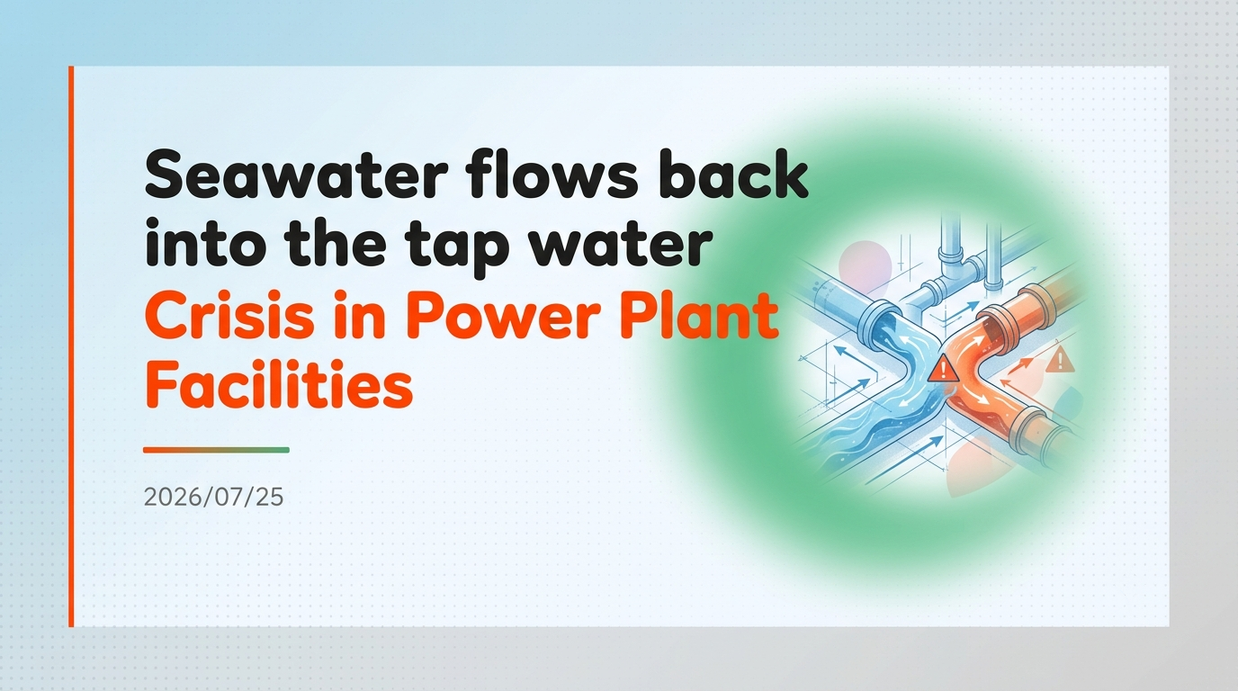
Seawater flowed back from the equipment at the Hokuriku Electric Power Tsuruga Thermal Power Plant into the tap water, causing abnormalities in the tap water of nearby residents. This incident is caused by “cross-connections,” which are prohibited under the Water Act, raising questions about the safety of infrastructure management and legal compliance.
- Brief Reports of the Incident and Issues Occurred
- Role and Mechanism of Seawater Electrolyzers
- Definition of violations of Article 16 of the Water Supply Act and illegal connections
- Safety Management from the Perspective of Water Facility Design Guidelines
- Timeline of the anomaly revealed by residents’ voices
- Consideration for Surrounding Areas and Current Status of Health Damage
- Improvement Measures and Inspections Required of Hokuriku Electric Power
- Lessons Faced by Infrastructure Operators and Focus Points Going Forward
Brief Reports of the Incident and Issues Occurred
On July 21, 2026, a serious facility management deficiency was discovered at Hokuriku Electric Power’s Tsuruga Thermal Power Plant in Tsuruga City, Fukui Prefecture. It was confirmed that seawater was flowing backward from the seawater electrolyzer used within the power plant into the local drinking water pipes. This case was discovered after a local resident sent a report to Tsuruga City stating that ‘tap water tastes like seawater,’ and was investigated and uncovered.
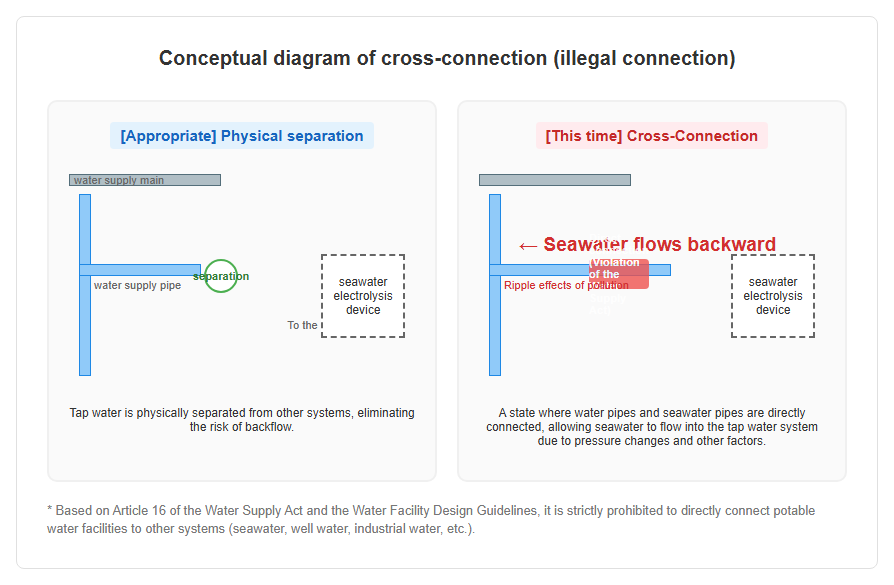
The investigation revealed that the water supply facilities, which should normally be physically separated, were directly connected to the seawater pipes, a so-called “cross-connection.” This connection clearly violates Article 16 of the Waterworks Act and, as a serious threat to public health, Tsuruga City issued an improvement instruction to Hokuriku Electric Power on July 23, 2026. The instructions included eliminating illegal connections, inspecting all similar locations within the power plant, and submitting detailed reports after improvements. The diagram below illustrates the design concept of a general water facility, but in this case, such safe separation was not implemented.
Role and Mechanism of Seawater Electrolyzers
The seawater electrolyzer that caused the backflow is an auxiliary device that plays an important role in the operation of the power plant. This device has the function of producing sodium hypochlorite by electrolyzing seawater. By injecting the generated sodium hypochlorite into the seawater intake system, it suppresses the attachment and growth of marine organisms such as shellfish and seaweed into the piping, ensuring stable intake of cooling water.
Since thermal power plants use large amounts of seawater as cooling water, blockages in the intake system directly lead to reduced power generation efficiency and equipment damage. Therefore, the operation of the seawater electrolyzer is essential for the normal operation of the power plant, but in response to this incident, Hokuriku Electric Power immediately shut down the device. According to Hokuriku Electric Power’s announcement, shutting down this device will not affect the continued operation of the power plant itself. From July 22, 2026, after the incident was discovered, emergency measures were completed to physically disconnect the water supply pipes from the piping system of the equipment.
Legal Background and the Serious Risks of ‘Cross-Connection’
Definition of violations of Article 16 of the Water Supply Act and illegal connections
The most serious issue in this case is the occurrence of “cross-connections,” which are prohibited under Article 16 of the Waterworks Act. Cross-connection refers to a state where the supply system of potable tap water is directly connected to a non-tap water system (such as well water, industrial water, seawater, or drainage). This is an act strictly prohibited by law because it poses a serious pollution risk to the entire water system.
If the backflow prevention device fails or the pressure within the system changes, seawater and other contaminants can flow back up the pipes to public water mains, posing a risk of contamination spreading to widespread homes and facilities. In the recent case of Tsuruga City, seawater was mixed in at a level where residents could actually detect abnormalities, and criticism was inevitable for lacking the basic safety management required of infrastructure operators. Hokuriku Electric Power officially acknowledged that this incident was a violation of the Water Supply Act and has apologized.
Safety Management from the Perspective of Water Facility Design Guidelines
The Ministry of Land, Infrastructure, Transport and Tourism (formerly under the Ministry of Health, Labour and Welfare) provides detailed provisions for appropriate measures to prevent water pollution accidents caused by backflow. According to the guidelines, the basic principle is that tap water piping is physically separated from other systems, and to prevent possible backflow, it is necessary to secure a ‘outlet space’ and install a backflow prevention valve.
Please refer to the diagram below.
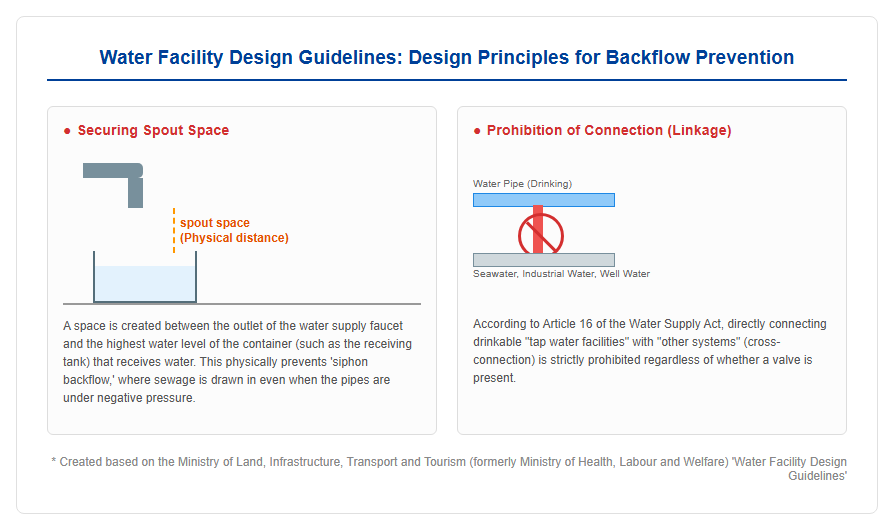
。 This is a fundamental design principle that must not be connected to the water supply system or other water systems. In particular, when water containing high concentrations of salt, such as seawater, is mixed in, it not only accelerates pipe corrosion but also raises concerns about adverse health effects caused by fluctuations in chlorine concentration and the introduction of impurities. In this case of the Tsuruga Thermal Power Plant, it is highly likely that these basic design guidelines and regulations were overlooked during the design phase or subsequent expansion, renovation, and maintenance processes.
Background to Discovery and Impact on Local Communities
Timeline of the anomaly revealed by residents’ voices
The discovery of this incident began on July 21, 2026, when residents of the Maruyama, Tayu, and Akasaki districts of Tsuruga City reported the case to the city. Several households reported that ‘tap water tastes like seawater,’ and when Tsuruga City conducted an emergency investigation together with Hokuriku Electric Power, it was confirmed that seawater was actually flowing backward from the water supply line supplying the electrolyzer unit inside the power plant.
Organizing the specific timeline, an anomaly was discovered on July 21, 2026, and Hokuriku Electric Power immediately shut down the equipment. On July 22, Tsuruga City carried out physical separation work to disconnect the water supply pipes leading to the power plant from the equipment piping. Then, on July 23, 2026, the mayor of Tsuruga City handed Hokuriku Electric Power an administrative guidance letter for improvement based on violations of the Water Supply Act. Without the keen awareness of residents, pollution could have worsened even further.
Consideration for Surrounding Areas and Current Status of Health Damage
In response to the extremely unusual situation of seawater mixing into tap water, Hokuriku Electric Power and Tsuruga City rushed to check the health status of nearby residents. As of July 25, 2026, there have been no specific reports of health damage caused by abnormal water quality from residents in the area. Although the seawater itself is not toxic, the continued significant deviation from drinking water standards has caused strong concern among local residents.
Hokuriku Electric Power issued a statement expressing deep apologies to everyone in the Mariyama, Tayu, and Akasaki districts where the incident occurred, saying, “We have caused great inconvenience and inconvenience.” Furthermore, it is essential to continue flushing and water quality testing of the supply system until it is confirmed that water quality has been properly restored. This incident, where the massive infrastructure of a power plant threatened the safety of tap water directly linked to residents’ daily lives, is being viewed as a matter of corporate social responsibility that goes beyond mere equipment failure.
Future developments, key points, and measures to prevent recurrence
Improvement Measures and Inspections Required of Hokuriku Electric Power
Based on the improvement instructions received from Tsuruga City, Hokuriku Electric Power is required to take several strict measures. First, consider equipment modifications to completely eliminate cross-connection conditions in seawater electrolyzers and implement permanent safety measures. This includes changes to physical insulation structures that will never cause backflow again.
Next, to confirm whether this incident is unique to the Tsuruga Thermal Power Plant or whether similar deficiencies have been left unattended at other facilities, the “Inspection of Similar Locations Across the Power Plant” is being conducted. Hokuriku Electric Power has other important bases, such as the Shiga Nuclear Power Plant in Ishikawa Prefecture, and a company-wide safety management system is needed to re-examine it. After the improvement measures are completed, Hokuriku Electric Power is obligated to submit a detailed cause analysis and a report summarizing recurrence prevention measures to Tsuruga City and obtain the city’s approval.
Lessons Faced by Infrastructure Operators and Focus Points Going Forward
This seawater backflow incident exposed that even large corporations supporting infrastructure can make fatal mistakes in basic compliance and equipment management. In the past, incidents of seawater contamination into the grid have occurred at Chubu Electric Power’s Hamaoka Nuclear Power Plant, highlighting the unique challenges of risk management in plants handling seawater.
The future focus will be on how Hokuriku Electric Power can restore the trust it has lost. The company is currently facing multiple challenges, including views on the geological structure of the Shiga Nuclear Power Plant and improper operational handling of distribution facilities. It is necessary to investigate not only simple equipment repairs but also to investigate the organizational background of why compliance with the fundamental water supply law was missed during each process of design and maintenance. As a public infrastructure provider committed to coexistence with local communities, transparent information disclosure and thorough efforts to prevent recurrence will likely be key focuses going forward.
Reference Page
-
[Receipt of Improvement Instructions from Tsuruga City for Seawater Backflow from Seawater Electrolyzer Unit to Tap Water at Tsuruga Thermal Power Plant https://www.rikuden.co.jp/press/attach/26072301.pdf
-
[Backflow of Seawater from Seawater Electrolyzer at Tsuruga Thermal Power Plant to Tap Water Supply https://www.rikuden.co.jp/press/attach/26072101.pdf
-
[Water Supply Facility Design Guidelines (Ministry of Land, Infrastructure, Transport and Tourism)] https://www.mlit.go.jp/mizukokudo/seisaku/mizukokudo_seisaku_tk_000021.html
[#北陸電力 #敦賀火力発電所 #水道法 #クロスコネクション #インフラ安全 #福井県敦賀市 #海水逆流]


コメント