On July 7, 2026, NTT Data Corporation and NTT Docomo Business Corporation announced a new cyber risk response service utilizing Frontier AI, which possesses advanced analytical capabilities. As attackers exploit AI to escalate their methods, there is a growing focus on automating and accelerating corporate security operations by combining AI-powered defenses with expert organizational expertise.
- Full Service Overview and Launch in July 2026
- Worsening Cyberattack Situation and Organized Threats
- A Consistent Support Process That Dramatically Transforms Vulnerability Response
- Insights into Multi-AI Utilization Independent of Specific Technologies
- Verification System by the Expert Organization “NTTDATA-CERT”
- Critical Infrastructure Protection and “Project YATA-Shield”
- Future Developments and Initiatives for Sovereign AI
Full Service Overview and Launch in July 2026
This new service, which will be available starting July 31, 2026, is a comprehensive solution that combines NTT Group’s advanced security expertise with the latest frontier AI technologies. A system has been established to consistently support the previously fragmented process from “threat detection” to “remediation and operation.” The development is driven by the current situation where attackers are organizing and exploiting generative AI, making it difficult to address with traditional methods. Companies are exposed daily to a vast amount of vulnerability information, and in reality, they spend a significant amount of time deciding what to prioritize among them. This service addresses this challenge through AI analysis capabilities, based on the operational record of over 10,000 mission-critical systems cultivated by NTT Data and NTT Docomo Business. By supporting everything from design to construction, monitoring, and continuous operational improvement in every phase, we aim to fundamentally strengthen corporate cyber resilience.
Worsening Cyberattack Situation and Organized Threats
The cyberattack landscape has reached a major turning point in 2025. According to statistics, the number of global ransomware incidents has surged from 5,336 cases in 2023 to 8,159 cases in 2025, a roughly 1.5-fold increase in just two years. The situation is serious within Japan as well, with 116 reports of damage to the National Police Agency in the first half of fiscal year 2025 alone. A characteristic of recent attacks is that rather than targeting specific companies, there is a growing tendency to indiscriminately target areas where systems have vulnerabilities. Furthermore, the attackers are highly organized, establishing a criminal business model where ransomware developers and those responsible for the actual attacks share responsibilities. Leaked internal data revealed that negotiations with victims had been manualized, revealing that attacks were being carried out efficiently as part of their operations. Attackers are focusing on generative AI models like DeepSeek and QwenLM, as well as AI chatbots specialized for cyberattacks called “HackBots,” and AI is beginning to be used as a weapon to dramatically improve attack efficiency.
Solutions and Technical Features Brought by Frontier AI
A Consistent Support Process That Dramatically Transforms Vulnerability Response
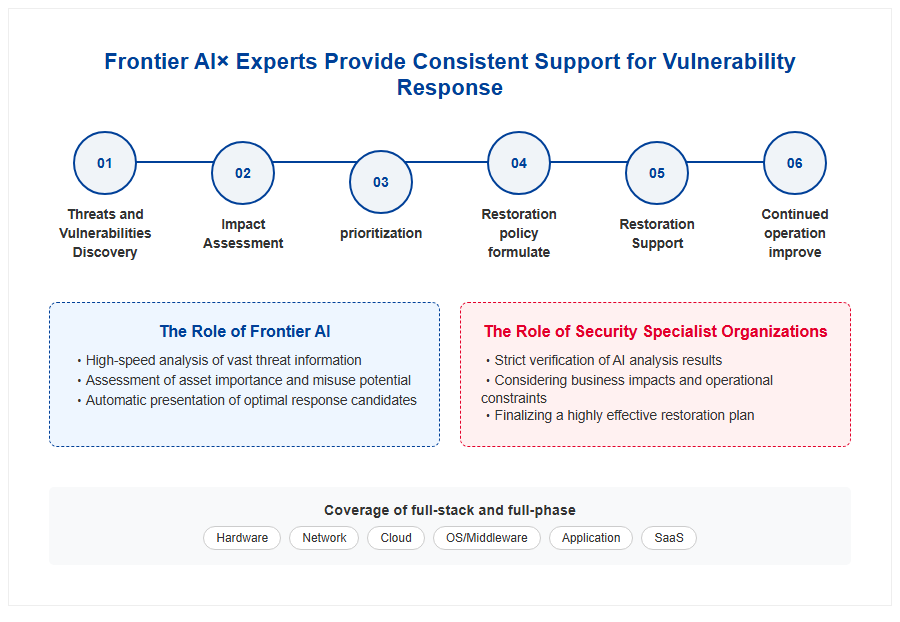
The service offered this time will significantly change the standard for vulnerability response by utilizing Frontier AI. Specifically, it seamlessly connects six phases: threat and vulnerability detection, impact assessment, prioritization, formulation of remediation policies, remediation response, and continued operation. Traditionally, even when vulnerabilities were discovered, many security personnel were overwhelmed deciding how they might affect their own systems or whether to apply patches even if it meant halting operations. In this service, AI instantly analyzes the importance and potential of asset misuse and proposes highly effective response options. This enables efficient implementation of high-priority measures even with limited personnel. Additionally, it enables full-stack support from hardware to cloud, applications, and SaaS, enabling cross-sectional understanding of risks across the entire system, which is a major feature. Please refer to the diagram below.
Insights into Multi-AI Utilization Independent of Specific Technologies
As the technical foundation of the service, “multi-AI utilization” is adopted that does not rely on specific AI technologies. NTT Data has worked closely with domestic and international frontier AI providers, conducting evaluations and validations on multiple AI models. This verification confirms not only threat analysis but also effectiveness in formulating specific remediation policies. Its strength lies in the flexibility to select the optimal AI technology and operational method according to customers’ security requirements, operational environments, and the cloud services they use. Because AI evolves at an extremely rapid pace, by consistently incorporating the latest AI models, we maintain the effectiveness of our services. This allows you to avoid specific vendor lock-ins while benefiting from the best AI technologies available at any given time. This also leads to the establishment of appropriate guardrails against data leaks and privacy risks that companies may worry about when utilizing AI.
Verification System by the Expert Organization “NTTDATA-CERT”
AI-driven analysis is powerful, but ultimately, it is human experts who guarantee its reliability. In this service, the analysis results presented by AI are rigorously verified by experts from both companies, including NTTDATA-CERT, a top-level security organization in Japan. We make final decisions based on the priorities derived by AI, taking into account the actual business impacts and operational constraints. For example, in environments where the system is critical and simple shutdowns are not allowed, alternative solutions are developed that combine configuration changes, access controls, and enhanced monitoring. This advanced process is only possible thanks to the NTT Group’s hands-on experience managing and operating over 10,000 mission-critical systems. Rather than relying solely on human attention, a hybrid approach that combines AI speed with expert expertise enables rapid response while minimizing the risk of misjudgment.
Social Significance and Future Prospects
Critical Infrastructure Protection and “Project YATA-Shield”
The deployment of this service holds extremely important importance in protecting Japan’s social infrastructure. Currently, the government is promoting the strengthening of security for critical infrastructure operators with an eye toward the era of high-performance AI through the cybersecurity package “Project YATA-Shield.” Especially in sectors such as finance, public sector, and manufacturing, service outages caused by attacks have a significant impact on society as a whole, requiring more advanced and proactive defenses. In the financial sector as well, the Financial Services Agency and the Bank of Japan issued a request in May 2026 reflecting changes in the threat of frontier AI, raising industry-wide caution. The NTT Group injects the robust service operation know-how it has cultivated as a critical infrastructure operator into this service. This service, which can propose measures that consider business continuity even in environments where patching is difficult, is expected to become a strong platform supporting cyber defense efforts jointly advanced by the public and private sectors.
Future Developments and Initiatives for Sovereign AI
As the final section, I will discuss future prospects and key points to note. Going forward, NTT and NTT plan to strengthen responses in line with further advancements in frontier AI and to adapt to sovereign AI environments tailored to customer requirements. In the United States, Palantir and NVIDIA have partnered to announce the construction of a “sovereign AI operating system” for governments that do not allow data to leave their companies, accelerating the movement to own domestic AI infrastructure. Similarly, within Japan, demand to utilize advanced AI features while protecting data sovereignty is expected to grow. The NTT Group will deepen collaboration with domestic and international partners and expand its initiatives from both security for AI and AI-powered security. Through this, we aim to contribute to the realization of a safe and secure digital society that can autonomously respond to ever-changing threats without excessive dependence on specific countries or vendors.
コメント