AMD (Advanced Micro Devices) launched the compact AI development platform “Ryzen AI Halo,” equipped with 128GB of ultra-large unified memory, at $3,999 in May 2026. The background to the emergence of this product lies in the industry trend of the main battlefield of AI development shifting from the cloud to local on-premises systems, and the urgent challenge of securing soaring computing resources.
- Introducing a powerful development kit offered for ,999
- Technical breakthroughs brought by 128GB of unified memory
- Hardware configuration and proprietary cooling and power supply design
- “AMD AI Playbooks” and a dedicated ecosystem that break down construction barriers
- Improved cost-effectiveness and data governance through cloud API alternatives
- Performance comparison with competing products and market positioning
- The path to next-generation machines with 192GB and mass-produced models
Introducing a powerful development kit offered for ,999
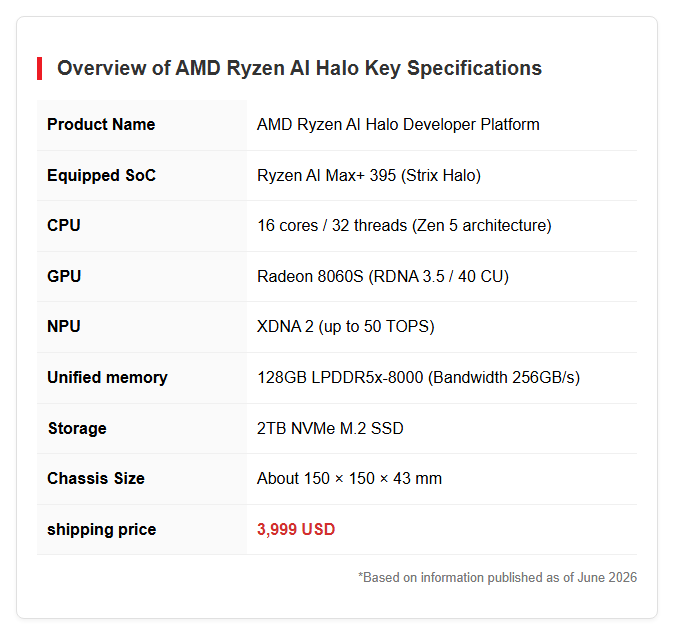
As announced at CES 2026 in January 2026, AMD began accepting pre-orders for the reference mini PC for AI developers, the “AMD Ryzen AI Halo,” in June of the same year, with shipments starting sequentially from July 10. The biggest feature of this product is its adoption of the latest SoC, the Ryzen AI Max+ 395, codenamed “Strix Halo.” This chip is a powerful APU that integrates a 16-core, 32-thread Zen 5 architecture CPU, an RDNA 3.5-based Radeon 8060S GPU with 40 compute units (CUs), and an XDNA 2 NPU with up to 50 TOPS processing power into a single silicon. Prices start at $3,999 (about 644,000 yen), and the OS options are Windows 11 Pro or Linux (a proprietary Debian-based distribution), with no price difference between the two SKUs. The product is positioned not as a mass-produced server, but as a “developer kit” designed for developers and researchers to quickly build agent-based AI applications, fine-tune, and validate inference. Please refer to the diagram below.
Technical breakthroughs brought by 128GB of unified memory
The biggest bottlenecks when running large language models (LLMs) in local environments are memory capacity and bandwidth. The Ryzen AI Halo adopts an integrated memory architecture where the CPU and GPU share the same memory pool, and comes standard with 128GB of LPDDR5x-8000 memory. Memory bandwidth reaches 256GB/s, structurally eliminating latency caused by bus communication between CPU and GPU that often occurs in discrete GPU configurations. This made it possible to hold and run models with large parameters, which were previously difficult to operate due to VRAM capacity constraints, within a single compact enclosure. According to AMD, leveraging this large memory capacity can achieve on average several times the performance of competitors in specific LLM workloads. In particular, the design philosophy that prevents data from leaving the machine offers structural benefits such as compliance with Japan’s Personal Information Protection Law and reducing the risk of trade secret leakage in fields where confidentiality is critical, such as finance, healthcare, and government agencies.
Hardware configuration and proprietary cooling and power supply design
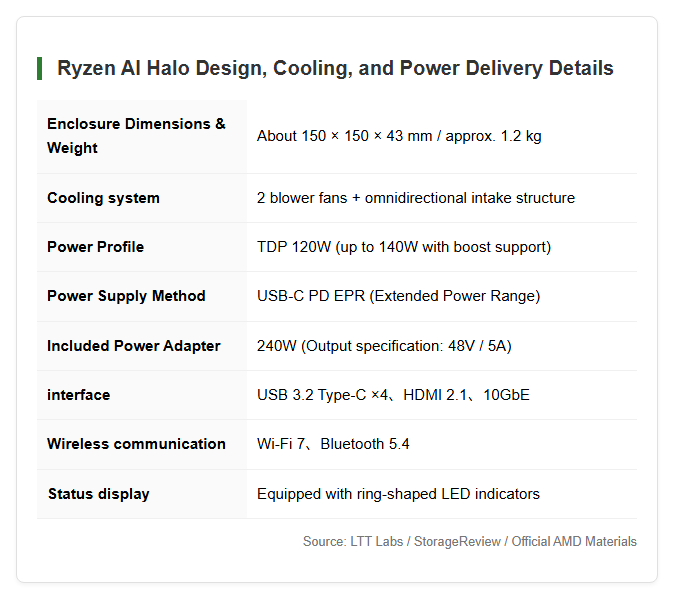
The Ryzen AI Halo chassis is extremely compact, with an installation area of about 15cm square and a height of less than 5cm, yet it achieves both high cooling efficiency and power delivery capability. The overall system TDP (Thermal Design Power) is 120W, but it is designed to boost up to 140W. By combining two blower fans and omnidirectional air intakes, it dissipates heat with relatively gentle sound quality even under heavy load. According to verification, it has stable cooling performance that can maintain the boost state for about 5 minutes. On the power delivery side, it supports USB-C Power Delivery (PD) Extended Power Range (EPR) and is powered via the included 240W adapter. With expanded power delivery capacity of 48V and up to 5A, the convenience of driving 120W-class processors with a single USB-C cable without the need for an external power brick dramatically improves visibility when installing multiple units as racks or clusters. Please refer to the diagram below.
Software that optimizes the development experience and practical cost benefits
“AMD AI Playbooks” and a dedicated ecosystem that break down construction barriers
What AMD focuses most on with this product is the software environment that solves the complexity of building the AI stack, rather than hardware performance itself. Ryzen AI Halo offers a utility called the “Ryzen AI Developer Center” that centrally manages tools and devices, making it easy to update pre-installed applications and roll back systems. Furthermore, to avoid common library dependency issues encountered in the early stages of development, AMD provides a proven “BKC (Best Known Configurations)” configuration. Additionally, the “AMD AI Playbooks,” a guide for beginners, are an important element, documenting steps such as AI coding support combining VS Code and Cline, LLM execution and fine-tuning with PyTorch. As a result, building AI development environments—which was labor-intensive on traditional AMD platforms—has been compressed into just a few steps, greatly improving adoption speed.
Improved cost-effectiveness and data governance through cloud API alternatives
The introduction of Ryzen AI Halo offers more than just technical convenience—it has the potential to fundamentally transform a company’s cost structure. When using cloud LLM APIs, pay-as-you-go billing occurs based on token volume, and repeated calls during the development phase make it difficult to forecast costs. In contrast, for local environments, once you pay the hardware acquisition cost, the only maintenance cost afterward is electricity. According to AMD’s estimates, using cloud APIs for 8 hours a day can save about $750 per month, and in the long run, hardware investment can be easily recouped. Furthermore, the ability to complete fine-tuning and inference within the company without sending confidential information such as internal documents or unpublished product specifications to external API providers’ servers provides a very strong basis for investment decisions for Japanese companies from a data governance perspective.
Competitive Comparison and Future Outlook from the Perspective of the Semiconductor Supply Network
Performance comparison with competing products and market positioning
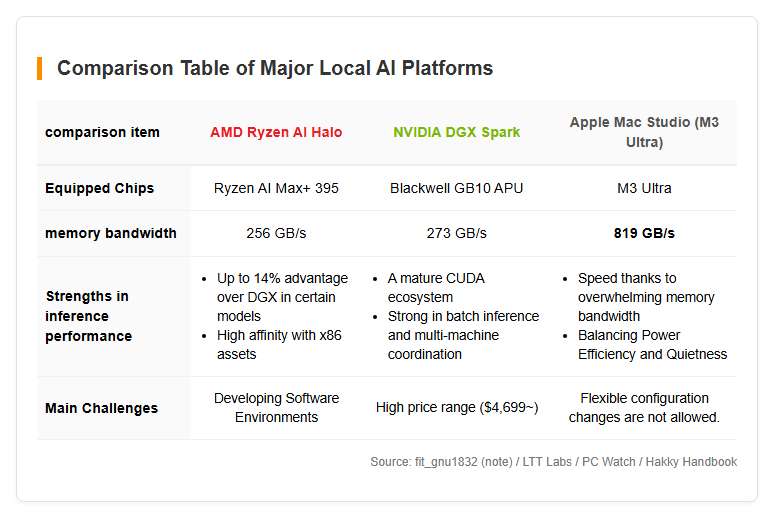
Ryzen AI Halo is positioned as an appliance to compete against strong competitors like NVIDIA’s DGX Spark and Apple’s Mac Studio. In benchmarks for token generation speed, AMD claims to outperform DGX Spark by 7% in GPT-OSS 120B and 12% in Qwen 3.5 122B. On the other hand, in certain processes that heavily depend on memory bandwidth, there have been reports of Mac Studios equipped with Apple’s M3 Ultra offering bandwidths exceeding 800GB/s, achieving about two to three times the speed of Ryzen AI Halo. However, while Macs are strong against small requests, AMD’s platform offers a well-balanced price-performance ratio for development leveraging existing x86-based assets and specific business workloads through improvements in ROCm and integration with the official ecosystem. Please refer to the diagram below.
The path to next-generation machines with 192GB and mass-produced models
AMD has already announced the next-generation rollout of Ryzen AI Halo, and plans to launch models equipped with the new SoC, the “Ryzen AI Max PRO 400” series, in the third quarter of 2026. In this next-generation machine, unified memory has been increased to 192GB, allowing up to 160GB of VRAM to be allocated, enabling even larger local AI models to run. Currently, the global semiconductor supply chain is facing severe tightness in 3nm advanced wafers and CoWoS (2.5D/3D packaging), and TSMC’s capacity expansion continues to lag behind. AMD’s challenge is to secure sufficient volume according to demand and expand its ecosystem from development kits to mass-produced corporate PCs through OEM manufacturers such as ASUS, HP, and Lenovo. Going forward, the competitive axis of AI semiconductors will shift not only from pure performance but also from the battle for supply control over how to secure computing resources stably and over the long term, and how to enhance software reproducibility.
[#AMD #RyzenAIHalo #ローカルAI #ユニファイドメモリ #生成AI #ハードウェア]


コメント