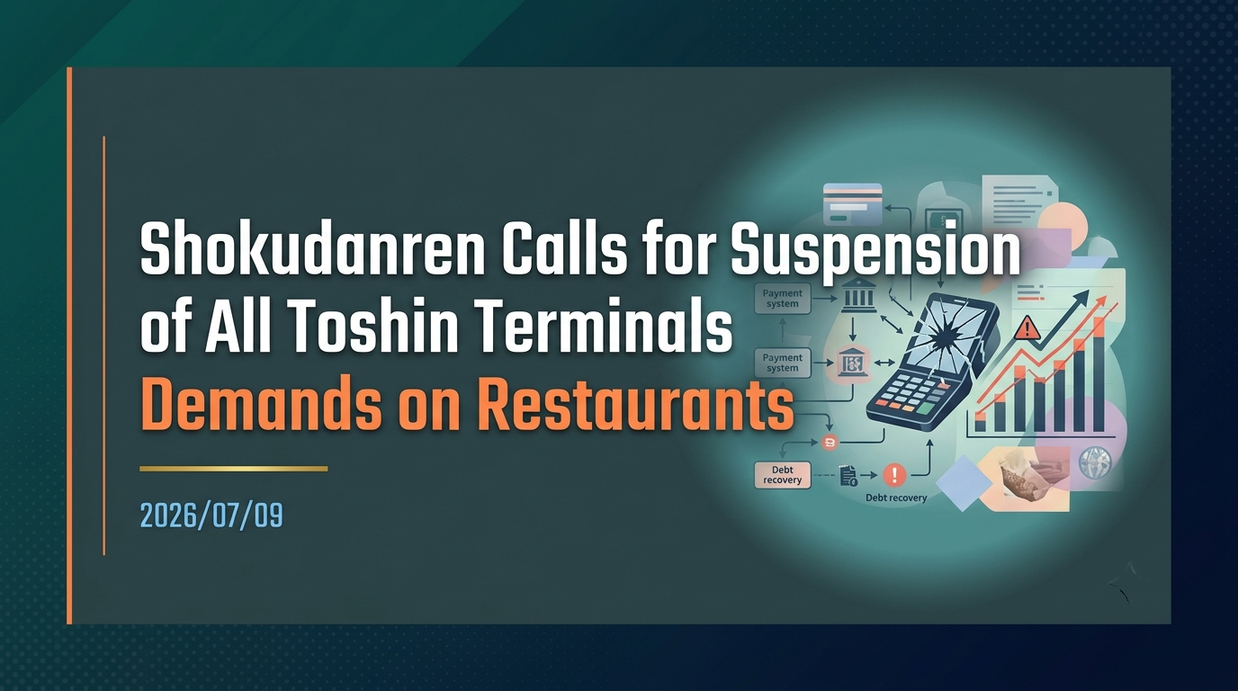
On July 6, 2026, the Japan Federation of Food Service Associations (Shokudanren) issued an urgent warning to member stores following the bankruptcy of the major payment processing company Zentoshin, demanding immediate suspension of terminal usage and aggregation of unpaid sales amounts. The largest bankruptcy of the year, with total liabilities of about 125.9 billion yen, casts a serious shadow over the cash flow of the food service industry, which is based on cashless payments. ,,
- Three urgent requests from the Shokudanren
- Multifaceted Public Support Measures for Affected Stores
- Impact on 200,000 stores and massive debt
- The Crisis of Restaurant Counters Returning to ‘Cash Only’
- The impact of the disappearance of the entertainment district’s ‘Makekomi-ji’ (Temporary Temple)
- 20 Years of Accounting Fraud and Compliance Breach
- Rebuilding Payment Infrastructure and Legal Challenges
Three urgent requests from the Shokudanren
The Japan Federation of Food Service Associations (Shokudanren) issued its first urgent notice on July 6, 2026, in response to the fact that Zentoshin Co., Ltd., a credit card payment service provider, received a bankruptcy commencement decision from the Osaka District Court. , Shokudanren points out that at restaurants using Zentoshin’s services, it is highly likely that it will be difficult to collect sales proceeds that remain unpaid despite card payments. In response to this situation, we strongly urged merchants to immediately implement the following three points. ,
-
Immediate suspension of payments via Zentoshin terminals
-
Accurately aggregating and recording unpaid sales proceeds
-
Urgently secure alternative payment methods
In particular, regarding the aggregation of unpaid amounts, we request that all card payment amounts from the last confirmed payment date onward be recorded. Since these amounts form the basis for filing “bankruptcy claims” in future bankruptcy proceedings, strict management by the store side is essential. According to the bankruptcy trustee’s announcement, Zentoshin’s payment terminals will no longer be usable, and even if they do, the service will not be available, so caution is needed not to continue using them incorrectly. ,
Multifaceted Public Support Measures for Affected Stores
On July 7, 2026, as the second report, Shokudanren announced specific support measures for restaurants affected by the damage. Due to the bankruptcy of payment processors, stores that relied heavily on card payments for their sales now face the risk of ‘profitable bankruptcy,’ where working capital runs dry. To avoid this, Shokudanren provides guidance on securing bridge funds through the Japan Finance Corporation’s “Safety Net Loan,” the Credit Guarantee Association’s separate guarantees, and the use of management safety mutual aid. ,
Of particular interest is the move toward applying the “Safety Net Guarantee No. 1 (Chain Bankruptcy Prevention)” policy under the jurisdiction of the Small and Medium Enterprise Agency. To use this guarantee system, Zentoshin must be designated as a “designated business operator” by notification from the Minister of Economy, Trade and Industry. Shokudanren is currently advocating relevant parties for the early designation of Zentoshin, and has established a policy to disseminate specific application procedures as progress is made. , Please refer to the diagram below.
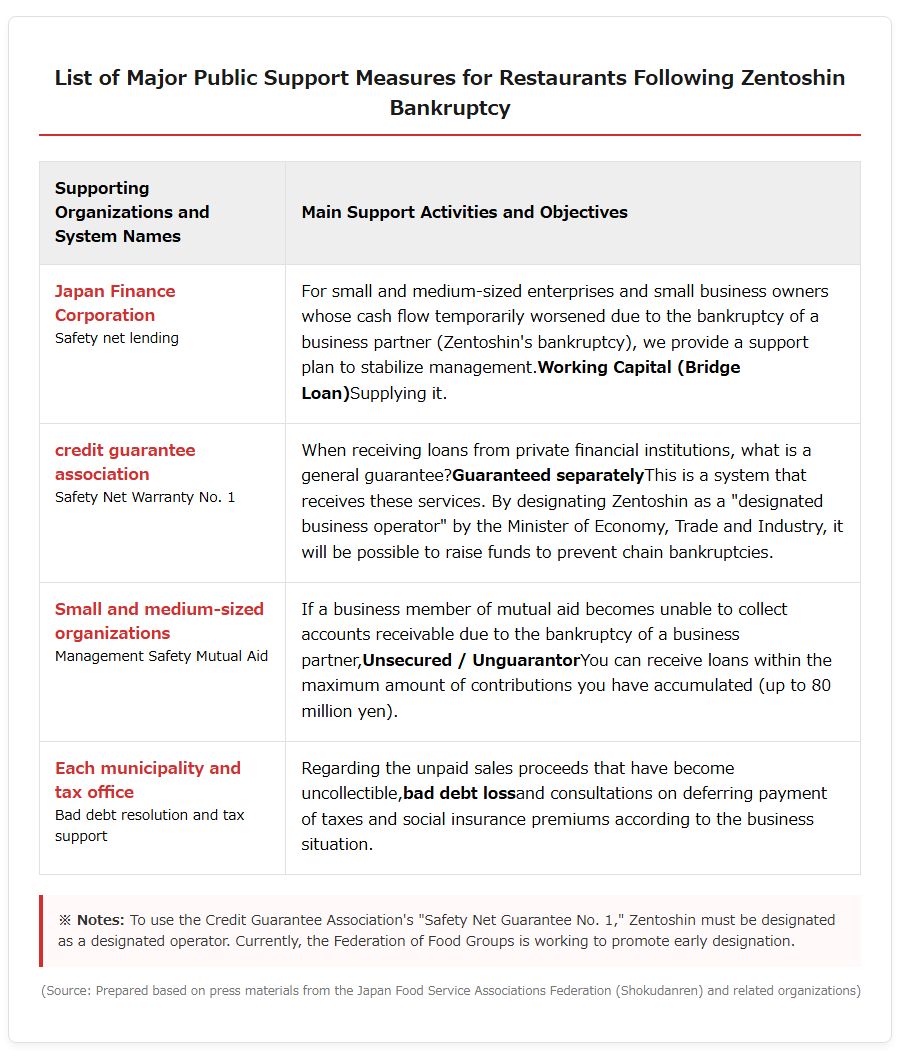
Additionally, tax measures such as write-offs for sales proceeds that remain unpaid are included as support measures.
Impact on 200,000 stores and massive debt
The shock of this bankruptcy drama on the food service industry lies in its overwhelming scale. According to a report by Teikoku Databank, Zentoshin’s total liabilities reached approximately 125.929 billion yen as of the end of the fiscal year ending March 2025, making it the largest bankruptcy case of 2026. As of 2018, the company’s number of member stores had already surpassed 200,000, most of which are small restaurants, bars, and service providers for nightlife businesses. ,,
Zentoshin is also known as the “payment rush temple,” actively accepting late-night and nightlife businesses that are difficult for regular card companies or major payment processors to pass screening. For these stores, Zentoshin’s ultra-high-frequency early advance payment of “twice a week and six times a month” was a lifeline to cover daily procurement and labor costs. Due to the sudden shutdown of that infrastructure, tens of thousands to hundreds of thousands of merchants have experienced unpaid transactions, and in some stores, there are concerns that sales revenue worth several million yen may become unrecoverable. ,,
Confusion in the Food Service Scene and Blind Spots in the Payment System
The Crisis of Restaurant Counters Returning to ‘Cash Only’
Since the decision to commence bankruptcy proceedings for Zentoshin on July 6, 2026, confusion has spread across restaurant counters across Japan. In shopping streets in Tokyo, handwritten notices such as “Credit cards not accepted” and “Cash only” were posted at the entrances of many stores. As cashless payments progress, more customers are carrying only a few thousand yen in their wallets, and some customers leave the store to withdraw cash at checkout, causing operational disruptions. ,
For store owners as well, since 60% to 80% of sales depend on card payments, suspension of deposits is a matter of life and death. , An izakaya owner in Shibuya, Tokyo, is concerned that nearly 1 million yen in sales from the 20-day payment deadline on the 15th may remain unpaid, and cannot hide his confusion over the sudden “error” message causing the terminal to be suspended. In the food service industry, due to the structure of low margins and high sales, even a few percent of monthly sales can be burned, putting the continuity of business in jeopardy, causing tremors on the ground. , Including missed opportunities due to declining customer satisfaction, the impact on the real economy is immeasurable. ,
The impact of the disappearance of the entertainment district’s ‘Makekomi-ji’ (Temporary Temple)
The reason Zentoshin has grown to such a large scale is its history of covering high-risk business formats that major financial institutions tend to avoid. Originally founded in 1987 as the ‘Shinjuku Late-Night Restaurant Cooperative,’ the company has built its customer base centered on cabaret clubs, snack bars, and host clubs located in entertainment districts like Kabukicho and Osaka Minami. These types of businesses tend to experience refund issues (chargebacks), and contracts tend to be rejected during regular screening. ,,
Zentoshin has significantly relaxed the screening criteria, offering these stores what could be considered the only payment method. , Furthermore, through the “early payment service,” it has supported the cash flow of late-night businesses, which are rushing to convert sales into cash. However, to maintain this model, the company relies heavily on borrowing from local banks and others, and the decline in transaction volume during the COVID-19 pandemic directly impacted its cash flow. For merchants, this means not only the loss of payment methods but also the disappearance of the specialized financial infrastructure that supports their business, making securing alternative means a major challenge going forward. ,,
The Deeper Layers of Bankruptcy and Prospects for Recurrence Prevention
20 Years of Accounting Fraud and Compliance Breach
Behind Zentoshin’s bankruptcy lies serious scandals and financial distortions that were not visible to the outside world. Post-investigation by Tokyo Shoko Research has raised suspicions that the company had been engaged in systematic financial fraud for at least 20 years. On paper, the book appeared to be in the black, but in reality, about 17 billion yen in deposits had been inflated, and about 15.4 billion yen in fictitious claims had been recorded, resulting in a serious insolvency situation of about 60.5 billion yen. ,,
Furthermore, the “fraudulent merchant issue” that surfaced in 2024 was the decisive factor. Employees were arrested for installing payment terminals under someone else’s name at a malicious store that failed the screening, and the corporation was referred to prosecutors on suspicion of violating the Act on the Punishment of Organized Crimes. In response to this compliance violation, financial institutions that provided funds simultaneously moved to freeze and collect loans, and the payment network connection was cut off, completely cutting off the path to business continuity. Please refer to the diagram below.
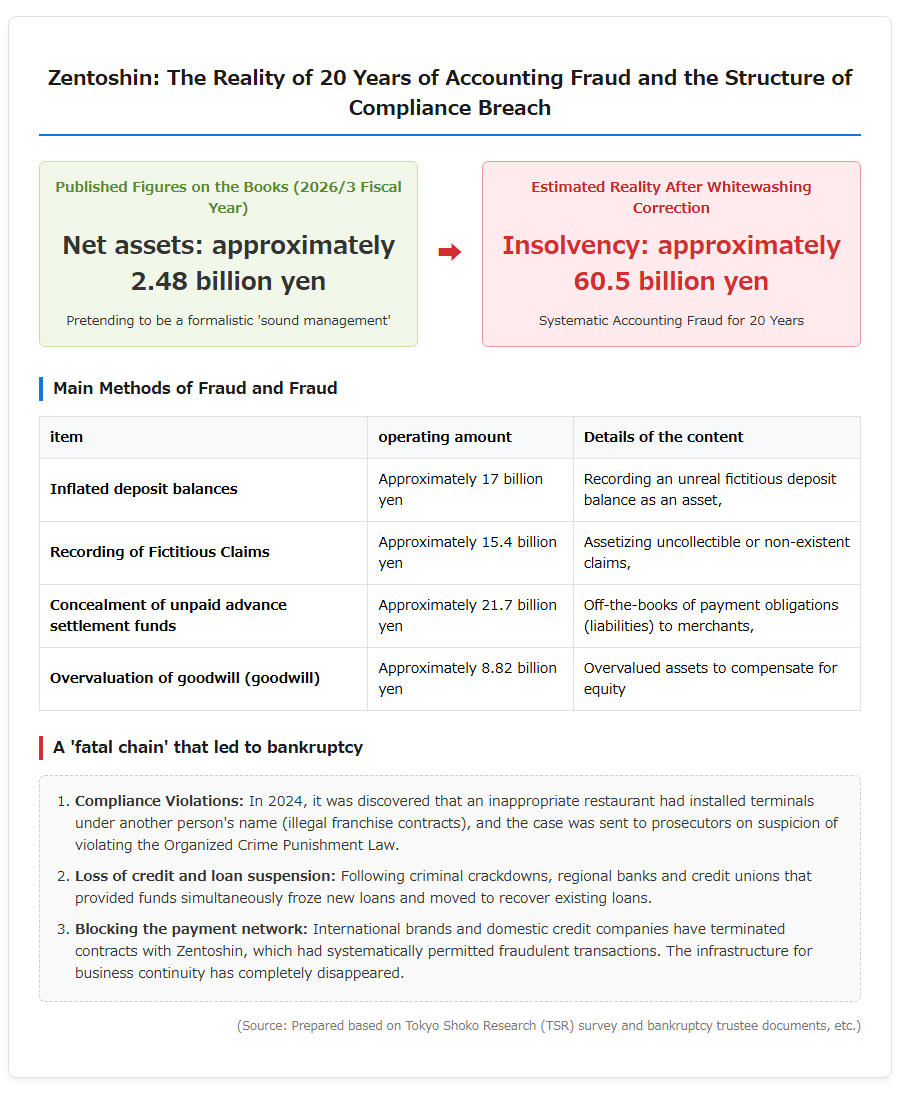
The company’s collapse can be seen as an inevitable result of poor management practices and lack of governance. ,
Rebuilding Payment Infrastructure and Legal Challenges
The biggest focus going forward will be how affected restaurants can quickly rebuild their new payment environment and how institutional reforms will proceed to prevent similar situations. Affected stores need to switch to alternative payment processors such as Square or Alphanote as soon as possible, but depending on the industry, the screening process is expected to take longer. The diversification of payment methods and the importance of a “diversification strategy” that does not rely on any single company have once again been highlighted.
Moreover, this incident has exposed a “regulatory gap” in Japan’s legal system. Under the current Installment Sales Act, payment processors are not obligated to preserve merchants’ sales proceeds, and in the event of bankruptcy, sales proceeds are treated as “general bankruptcy claims” along with other loans. There is growing demand for safeguard systems that segregate settlement funds in dedicated accounts, as seen in Europe and the UK, and for the introduction of ‘statutory trust’ systems that allow merchants priority in refunds. For the food and beverage industry to continue adopting cashless payments with confidence, building such a robust safety net will be an urgent priority.
[#全東信 #食団連 #飲食店経営 #決済代行 #倒産ニュース #キャッシュレス決済 #経済ニュース #ビジネス法務]


コメント