Yaskawa Electric has fully launched its state-of-the-art ‘Robot Factory No. 5’ in Kitakyushu City. We have built a system where robots equipped with “physical AI,” which autonomously make judgments and move, can autonomously produce AI robots, tackling the challenges of severe labor shortages and increasing complexity on production sites.
- Next-generation production base for autonomously assembling AI robots
- Response to variant and variable production using the “distributed cell method”
- Breaking away from teaching playbacks and autonomous decision-making
- Concrete examples of autonomous robots that learn and correct mistakes on the ground
- Investment strategy aiming for 100 billion yen in operating profit by fiscal year 2029
- Partnerships with NVIDIA and others and social implementation “outside the factory”
Next-generation production base for autonomously assembling AI robots
In June 2026, Yaskawa Electric began full-scale operations of its “5th Factory,” a state-of-the-art industrial robot production base, on its headquarters premises in Yahatanishi Ward, Kitakyushu City. This factory is positioned as the core hub of the company’s proposed “Physical AI” initiative, with a total floor area of approximately 30,000 square meters. The factory is a two-story structure, with servo motors, which serve as the core of the robots, produced on the second floor, and parts made there supplied to the first floor to assemble the industrial robot bodies, establishing an integrated production system.
Production capacity boasts a monthly output of 20,000 servo motors and 1,500 robot bodies per month, enabling the manufacturing of a total of 12 robot models. Notably, of the approximately 100 robots introduced in the factory, about one-third (35 units) are the latest AI-equipped robots, “MOTOMAN NEXT.” These AI robots embody advanced automation—’robots build robots’—autonomously producing next-generation AI robots. Please refer to the diagram below.
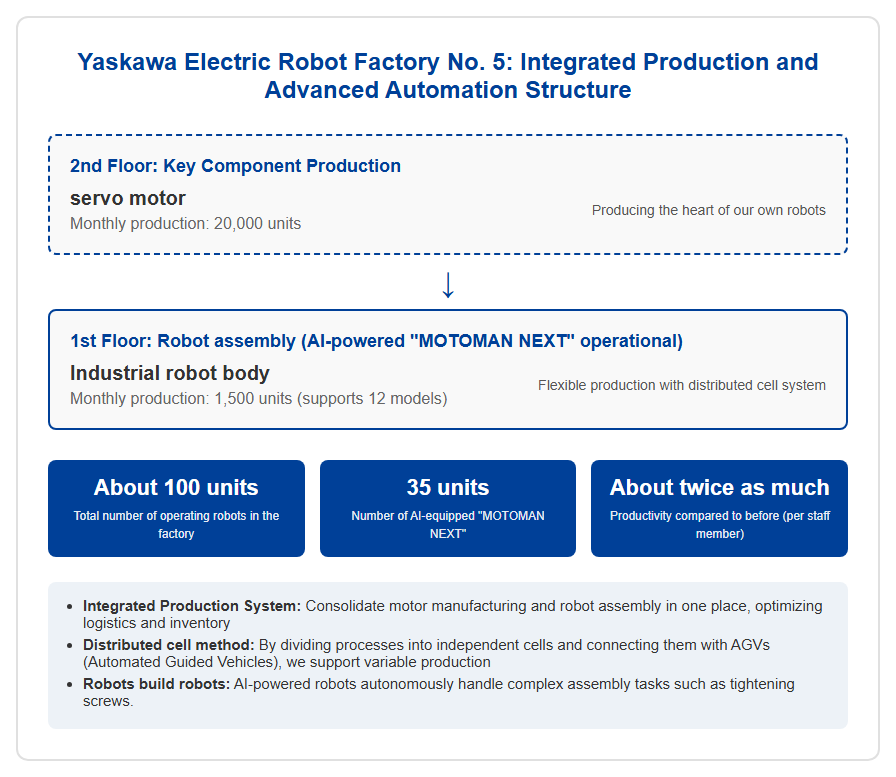
By establishing this integrated production system, delivery schedule management and inventory management of parts that were previously supplied from separate sites have been simplified, and logistics costs have also been reduced. Yaskawa Electric defines this fifth factory not merely as a production base, but as a “mother factory” where AI and mechatronics are highly integrated, and is poised to lead global manufacturing innovation.
Response to variant and variable production using the “distributed cell method”
Another major feature of Factory 5 is the adoption of the new “distributed cell system,” breaking away from the traditional “line production method.” Until now, typical factories mainly used line production by connecting equipment in series via conveyors, but this method had a weakness: if some equipment stopped due to failure or maintenance, the entire line would stop operating.
In contrast, the distributed cell system arranges multiple independent equipment for each process and uses automated guided vehicles (AGVs) to transport parts and products between processes. This allows you to assign work to others even if you shut down certain equipment, allowing for planned maintenance while continuing production. Ayumu Hayashida, Executive Vice President and Managing Director, explained that the advantage of this method lies in realizing “variable production,” which allows flexible adjustments to production volume increases or decreases and the addition of production models.
Additionally, by utilizing our proprietary technologies such as the “YRM Controller” that enables autonomous distributed control, the productivity per staff member has been increased to about twice that of previous levels. Amid a severe labor shortage, this production system, which combines advanced automation with flexibility, can be said to represent a new standard in Japan’s manufacturing scene.
[Technological Innovation] ‘Physical AI’ Responding to Uncertainty
Breaking away from teaching playbacks and autonomous decision-making
For many years, automation in manufacturing sites has been supported by the “teaching playback” method, which precisely repeats the actions taught by humans. While this method is highly effective in routine tasks, it faced limitations in workplaces where there were many ‘uncertainties’ such as subtle differences in the shape of parts handled or changing work environments.
Yaskawa Electric’s “Physical AI” is the key to breaking through these limitations. This technology converts AI’s cognitive and judgment abilities into physical movements, enabling robots to understand their surroundings and move autonomously. The company defines this technology as “the fusion of motion and AI,” aiming to evolve robots from mere “mechanical arms” that move according to programs into entities that “see,” “touch,” and “judge” the real world.
For example, in the process of unpacking boxes in logistics sites, boxes may deform depending on the condition of the contents, but robots equipped with physical AI can flexibly adjust the cutter’s position to fit the shape at the time. By enabling movements that are not “as taught” as taught, it is expected to unlock complex unautomated areas that previously relied on human hands.
Concrete examples of autonomous robots that learn and correct mistakes on the ground
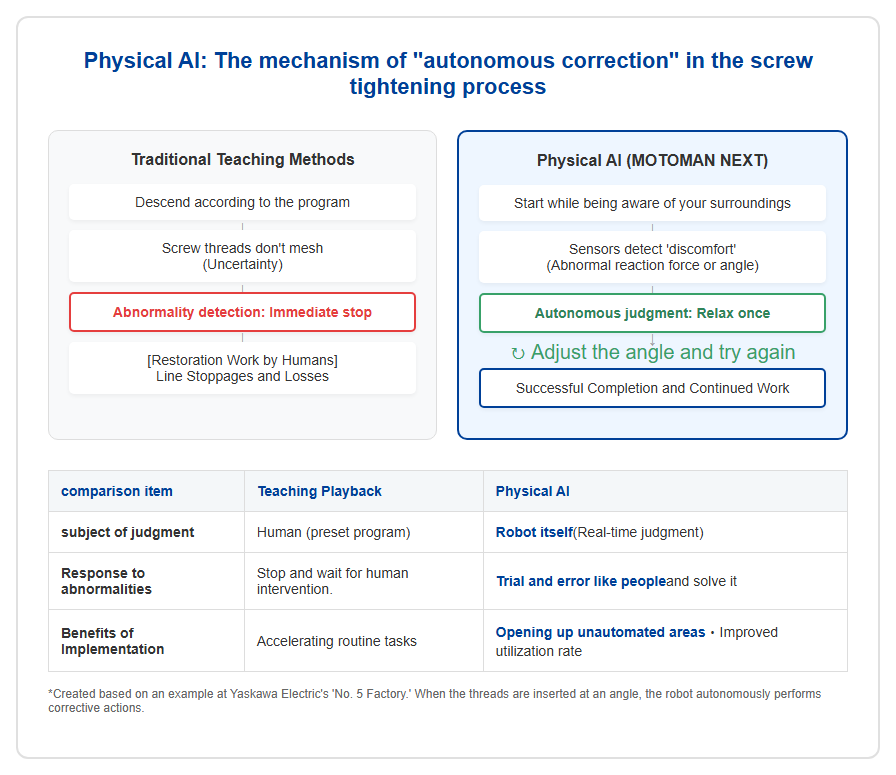
The “MOTOMAN NEXT” operating at the 5th plant demonstrates its advanced autonomy in the actual assembly process. A particularly iconic feature is the robot screw tightening process. With conventional robots, if the screw was slightly angled and the threads didn’t mesh properly, the only option was to keep tightening it forcibly or cause an error and stop.
However, the AI-powered Motman Next instantly detects through sensors that the threads are not meshing, and performs a “retry” by loosening the screw once and then adjusting the angle to tighten it again, just like a human would do. In this way, having the ability to learn and correct errors during work in real time has minimized production line downtime and maintained stable quality. Please refer to the diagram below.
Factory Manager Masawa Yasuno has indicated plans to expand this technology beyond screw tightening to more challenging processes such as sealant coating and component pressing. As AI learns the physical senses of the workplace and acquires the flexibility of skilled workers, the quality of automation in manufacturing is set to change dramatically.
[Management Strategy and Outlook] “Dash 35” and the Future Beyond the Factory
Investment strategy aiming for 100 billion yen in operating profit by fiscal year 2029
In May 2026, Yaskawa Electric announced a new medium-term management plan, “Dash 35.” This plan sets an ambitious goal to raise consolidated operating profit to 100 billion yen, approximately 2.1 times the actual performance for the fiscal year ending February 2026, by the final fiscal year, February 2030 (fiscal 2029). We are also aiming for a 20% increase in sales revenue to 650 billion yen, clearly positioning physical AI as the driving force behind this growth.
Notably, the massive investment plan totaling 250 billion yen over four years is significant. Of this, 130 billion yen is allocated for investment in production facilities, and 120 billion yen for strategic investments to create future growth areas. Especially in strategic investments, we aim to actively utilize M&A and capital alliances to quickly incorporate advanced external technologies related to physical AI.
In the past, competition for industrial robots focused on hardware accuracy and reliability, but in the era of physical AI, victory and defeat will depend on how quickly you can prepare your “training data” and “simulation environment.” Yaskawa Electric is aiming to solidify its position as a next-generation robot manufacturer by incorporating AI, the ‘power to drive’ from external sources, into its own ‘manufacturing power.’
Partnerships with NVIDIA and others and social implementation “outside the factory”
The deployment of physical AI is now expanding beyond the walls of factories to every aspect of society. Yaskawa Electric is partnering with major U.S. semiconductor companies Nvidia and Fujitsu to develop AI infrastructure for autonomously operating robots in manufacturing sites. Jensen Fan, CEO of NVIDIA, positions the foundation for AI training and controlling robots as the “next multi-trillion-dollar industry,” and has high expectations for the synergy with Yaskawa Electric’s advanced control technology.
Additionally, in collaboration with SoftBank, use case development is progressing such as the “next-generation building management system” that integrates communication infrastructure and AI, and the introduction of physical AI robots in offices and commercial facilities is being explored. Furthermore, the medium-term plan includes the introduction of these into a wide range of fields such as agricultural fields such as cucumber leaf pulling, as well as architecture and medical care.
On the other hand, investors remain cautious. As of June 2026, the company’s stock price is at a high level with a PER of about 40 times due to expectations for physical AI, but actual profit contributions are expected to begin to appear from the fiscal year ending February 2029. Whether the social implementation of technology proceeds as planned and whether it can deliver results that meet overheated expectations will be a major focus going forward.
[#安川電機 #フィジカルAI #製造業DX #産業用ロボット #スマートファクトリー #エヌビディア #ソフトバンク #経済]


コメント