On July 9, 2026, OpenAI officially announced the autonomous AI agent “ChatGPT Work,” coinciding with the general launch of the next-generation model GPT-5.6. While traditional AI was a “tool” for answering questions, ChatGPT Work has evolved into a “task handler” that completes complex tasks across files and apps.
- The Arrival of ChatGPT Work and the Integration of Codex
- The GPT-5.6 Family and Application-Specific Pricing Strategies
- Advanced tool manipulation through program execution
- Parallel processing and performance with multi-agent
- Corporate Governance and Accountability
- The dominance of the workloop and forecasts for 2027
The Arrival of ChatGPT Work and the Integration of Codex
On July 9, 2026, OpenAI released its next-generation model GPT-5.6, along with a new business feature called “ChatGPT Work.” This is not just a high-performance chat mode; it is designed as a “delegation layer” that allows users to delegate tasks across files, apps, browsers, spreadsheets, and approval workflows all at once. Its biggest feature is that Codex, a coding agent that had previously been an independent service, has been integrated into ChatGPT’s desktop app. This enables access to local files, review pull requests, project work across multiple repositories, and even direct computer operation all through a single interface called ChatGPT. While traditional AI was a passive entity that only solved individual Q&A, ChatGPT Work has redefined itself as an “autonomous partner” that focuses on projects and completes tasks.
The GPT-5.6 Family and Application-Specific Pricing Strategies
The new GPT-5.6 family consists of three model tiers: Sol, Terra, and Luna, optimized according to the importance and cost of the task. The top-tier SOL model is priced at $5 for input and $30 for output per 1 million tokens, making it suitable for high-value decision-making such as advanced research, complex coding, and security reviews. The mid-range Terra costs $2.50 for input and $15 for output, balancing routine agent duties and internal analysis. The cheapest Luna offers a low price of $1 for input and $6 for output, handling high-volume tasks such as large-scale data extraction, classification, and drafting. Users are encouraged to use it as a “routing system” that uses models according to each phase of work, rather than selecting a single model for each task. For example, you can build efficient workflows such as monitoring with Luna, drafting on Terra, and making final critical decisions on Sol.
Technical Basis and Execution Optimization
Advanced tool manipulation through program execution
One of the key technologies supporting ChatGPT Work’s execution capability is the “Programmatic Tool Calling (PTC)” introduced in the Responses API. This allows the model to write JavaScript itself to tune the tool and run it on an isolated V8 runtime. With the introduction of PTC, models no longer need to repeatedly call tools to process intermediate results, and efficiency dramatically improves by returning only structured data to the model. Specifically, for tasks such as extracting data from 40 financial documents, eliminating duplication, and summarizing, the cost of communicating all intermediate text information to the model can be significantly reduced. The diagram below illustrates the processing flow using PTC and the concept of efficiency improvements compared to conventional methods.
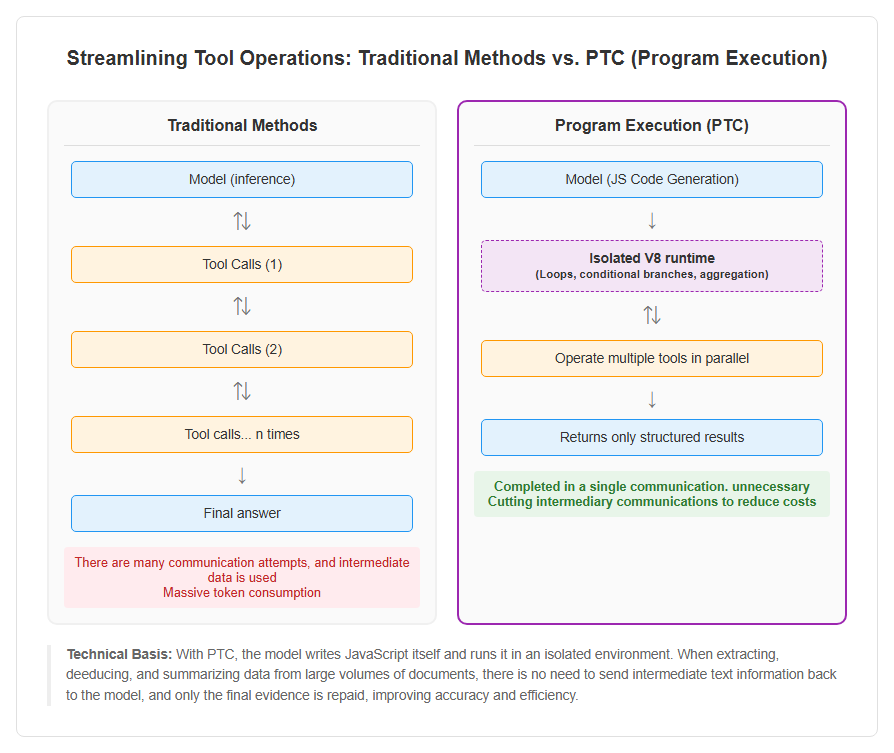
This runtime is subject to strict security restrictions, and package installation or direct network access is not permitted. PTC is highly effective for read-intensive tasks, but for tasks requiring approval, such as writing, direct tool calls for human intervention are still recommended.
Parallel processing and performance with multi-agent
Ultra Mode (Sol Ultra), which enables ultra-high-performance task processing, is a “multi-agent orchestration” feature that integrates multiple agents running in parallel. Instead of a single agent working sequentially, multiple sub-agents simultaneously review code legitimacy, security, testing, and architecture, ultimately synthesizing the results. This parallel processing has shown significant score improvements on specific benchmarks. For example, in Terminal-Bench 2.1, which measures software development capabilities, the standard Sol recorded 88.8, whereas the Sol Ultra reached 91.9. Additionally, SEC-Bench Pro has risen from 71.2 on Sol to 74.3 on Sol Ultra. However, note that the multi-agent format consumes a lot of computational resources, so token usage increases. Since it is cost-effective only when task parallelization is possible, using a single model is suitable for sequential inference tasks with strong dependencies.
Significance of Implementation and Future Prospects
Corporate Governance and Accountability
ChatGPT Work directly addresses the governance challenge of how much authority companies delegate to AI agents. Compatible applications include Slack, Teams, Google Drive, SharePoint, various CRMs, and more. Along with this, enterprise management capabilities have been significantly enhanced. System administrators now have detailed control over plugins, network access, spending limits, and compliance visibility. In particular, for critical actions, it is possible to set policies that require “automatic review” or “human approval.” On the security side, GPT-5.6 is rated as “High” in cybersecurity and biological/chemical weapon risks, implementing about ten times the number of cyber guardrails compared to previous models. On the other hand, as pointed out in a report by Singapore’s IMDA in May 2026, legal liability when autonomous agents cause unexpected damage, and the risk of actions beyond user intent remain important considerations.
The dominance of the workloop and forecasts for 2027
In the latter half of 2026, the competitive axis of the AI market will shift from the performance of individual models to the dominance of the “work layer” where AI actually performs its work. OpenAI’s strategy is to vertically integrate the ChatGPT interface with the GPT-5.6 capability layer, selling users the entire “work loop.” As a result, competition with Anthropic, Meta, and Google has shifted from model intelligence to ecosystem depth. Going forward, “predictive intelligence” where AI anticipates trends and warns of risks will become the standard, fundamentally changing the way we work. Gartner predicts that by the end of 2026, 40% of enterprise apps will feature task-specific agents. The future winners are expected to be not just companies introducing the latest models, but organizations that have acquired the “design capability” to delegate which tasks to AI with how much autonomy. 2026 marks a decisive turning point for AI to shift from a “convenient tool” to an “indispensable business partner.”
[#ChatGPTWork #OpenAI #AIエージェント #GPT56 #働き方改革 #自律型AI #DX #最新技術]

コメント