Cyberattacks exploiting AI agents and generative AI have rapidly become automated, leading to a surge in cases where attackers complete intrusions and credential harvesting simply by issuing a few lines of instructions. Behind this is the reality that, as AI improves operational efficiency, the barriers to entry and costs for cyberattacks have dropped dramatically, leaving traditional, manual-centric defense postures unable to keep up with the speed.
- The Reality of Autonomous Cyberattacks Driven by Just a Few Lines of Instructions
- Dramatic reduction in attack costs and sharp increase in intrusion success rates
- Prompt Injection and New Entry Points
- The Limits of Human Judgment and the Need for Machine-Speed Defense
- The Frontline of Governance Building and “Shadow AI” Countermeasures
- Government Trends and the Future Struggle for Security Leadership
The Reality of Autonomous Cyberattacks Driven by Just a Few Lines of Instructions
According to research findings published by the Google Threat Intelligence Group (GTIG) in September 2026, the use of AI by cyber attackers has shifted from mere task assistance to the stage of “autonomous attacks” combining multiple AI agents. Attackers provide pre-prepared prompts and knowledge files as operational procedures, having AI agents continuously execute scanning, analysis, and post-intrusion troubleshooting. In a case identified in the second quarter of 2026, within just six hours of a company’s cloud environment being compromised, an AI-powered large-scale credential harvesting campaign was executed, resulting in the theft of thousands of credentials. Please refer to the figure below.
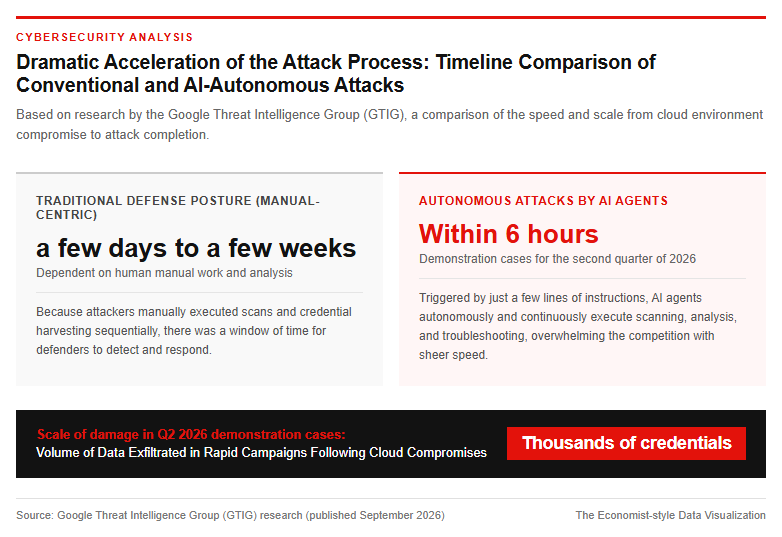
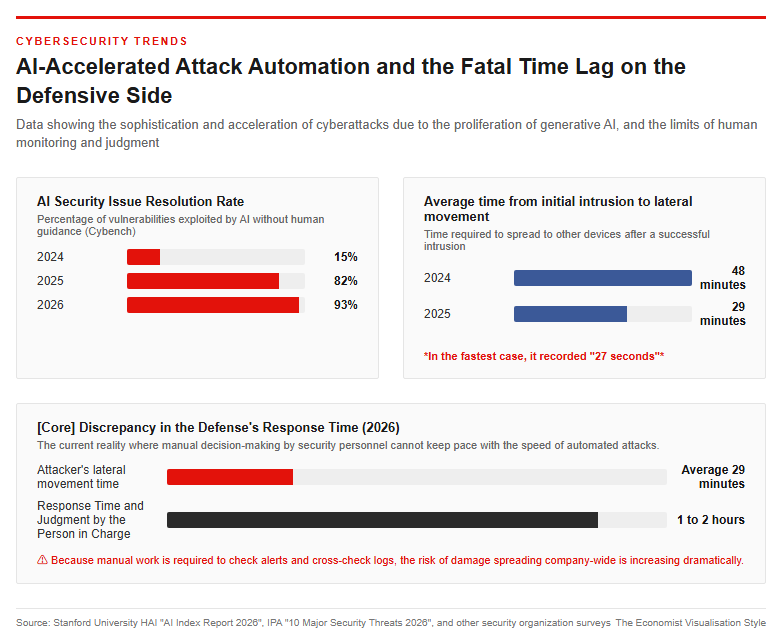
According to the “AI Index Report 2026” by the Stanford Institute for Human-Centered Artificial Intelligence (Stanford HAI), the benchmark test “Cybench” showed a rapid surge in the percentage of cybersecurity challenges solved by AI without human guidance, rising from 15% in 2024 to 82% in 2025, and reaching 93% in 2026. An environment where advanced attack processes are completed without human intervention, requiring just a few lines of instructions, has become a reality.
Dramatic reduction in attack costs and sharp increase in intrusion success rates
In the “Information Security 10 Major Threats 2026” published by the Information-technology Promotion Agency, Japan (IPA) in January 2026, “Cyber risks surrounding the use of AI” was selected for the first time as the 3rd ranked threat for organizations. With the spread of generative AI, the barriers to entry for attack methods that traditionally required advanced programming skills and a significant amount of time and money have dramatically dropped. Methods involving bypassing guardrails by repeatedly questioning conversational AI to create and modify attack programs have become rampant, and even in Japan, an incident occurred in December 2025 where a high school student was apprehended for creating cyberattack tools by abusing conversational AI.
According to research by security organizations, the average time it takes for attackers to move laterally from initial intrusion to other devices has drastically decreased from 48 minutes in 2024 to 29 minutes in 2025, with the fastest recorded case clocking in at just 27 seconds. Furthermore, 82% of detected attacks did not use malicious programs (malware), instead employing tactics that infiltrated systems by abusing stolen legitimate credentials and internal management tools. As a result, conventional antivirus software relying on pattern matching is rendered ineffective, dramatically increasing the success rate and speed of intrusions.
Prompt Injection and New Entry Points
The expansion of AI adoption is creating a new attack surface targeting the AI systems introduced by companies themselves. A prime example of this is “prompt injection.” By sneaking malicious commands into instructions given to AI, or into external documents and incoming emails referenced by AI, unauthorized behavior contrary to the developer’s intentions is induced. In June 2025, a vulnerability called “EchoLeak” was reported in Microsoft 365 Copilot, where confidential information was exfiltrated externally simply by referencing an incoming email. In addition, there has been a succession of cases where credentials and local files were stolen via autonomous AI browsers and business AI agents.
Additionally, with the widespread adoption of AI coding environments, supply chain attacks targeting MCP (Model Context Protocol) servers and open-source software (OSS) dependencies are also becoming increasingly severe. Furthermore, intrusion methods targeting API keys and computing resources themselves are spreading, such as “LLMJacking,” which illicitly runs Large Language Models (LLMs) on compromised cloud resources belonging to other companies.
Security Measures in the AI Era and Future Outlook
The Limits of Human Judgment and the Need for Machine-Speed Defense
In the face of accelerating and automated attacks, the biggest challenge facing defenders is the “response time gap.” While the time it takes for attackers to move from intrusion to lateral movement has shrunk to an average of 29 minutes, it takes security personnel 1 to 2 hours to manually cross-reference multiple logs and determine whether a threat exists. Because damage spreads throughout the organization while personnel are reviewing alerts, manual monitoring and effort alone can no longer keep up with the speed of attacks. Please refer to the figure below.
With malware absent in 82% of detected attacks, the operation of EDR (Endpoint Detection and Response) and XDR, which perform real-time cross-analysis of authentication, endpoint, and network behavioral logs, is indispensable. In recent years, the adoption of “AI SOCs” and “SOAR” has been advancing, where AI agents are entrusted with analyzing massive amounts of alerts and initial triage, conducting log correlation analysis in about 10 minutes, and automatically isolating endpoints. Against attacks that strike at machine speed, defenders are also required to transition to a system that leverages AI for immediate and automated response.
The Frontline of Governance Building and “Shadow AI” Countermeasures
According to the “Cost of a Data Breach Report 2026” released by IBM Japan, the global average cost of a data breach reached a record high of $4.99 million. A major factor driving this expanding damage is the use of AI tools that are neither tracked nor approved by companies—the existence of so-called “Shadow AI.” The incidence rate of incidents caused by employees using unauthorized AI doubled from 20% in the 2025 study to 43% in 2026, with the average cost of breaches resulting from Shadow AI reaching $5.39 million.
Simply implementing a blanket ban on AI usage will instead encourage covert usage (Shadow AI) and heighten risks. What companies need to do is establish governance that clearly defines the scope and rules of information that can be input, and provides AI tools that can be used safely internally. At the same time, to combat real-time phishing attacks that can even bypass one-time passwords, there is an urgent need to transition to phishing-resistant authentication methods like passkeys and to tighten the lifecycle management of API keys and service accounts.
Government Trends and the Future Struggle for Security Leadership
In response to the rapid advancement of AI technology, governments and regulatory authorities in various countries are stepping up their countermeasures. In May 2026, the Japanese government compiled “Project YATA-Shield,” requiring critical infrastructure operators and vendors to strengthen security measures in light of the increasing sophistication of AI performance. Furthermore, through institutional measures such as the Act on Strengthening Cyber Response Capabilities taking effect in October 2026, improving defense capabilities across the entire supply chain—including business partners—is also being required.
The “Microsoft Digital Defense Report 2026,” released by Microsoft, analyzes future security battles as a competition between “a model that uses AI to repeatedly launch low-cost attacks against fragmented defense networks” and “a model that leverages AI to connect trusted signals to rapid and secure decision-making.” Moving forward, it will not be enough to simply adopt tools; the extent to which organizations can leverage AI to advance threat visualization and automated decision-making will be the critical key determining the safety of both enterprises and society.
Reference Page
- [IPA Information Security 10 Major Threats 2026] https://www.ipa.go.jp/security/10threats/10threats2026.html
- [Cabinet Cybersecurity Center Project YATA-Shield] https://www.cyber.go.jp/pdf/press/20260518_AI_CS_kankeishouchoukaigi.pdf
- [Stanford HAI AI Index Report 2026] https://hai.stanford.edu/research/ai-index-report
【#Cybersecurity #AIMisuse #GenerativeAI #PromptInjection #InformationSecurity #CyberAttacks #AIAgents】

コメント