On July 10, 2026, the Ministry of Economy, Trade and Industry announced that it would provide up to approximately 1.3 billion yen in support for Vestas, a major Danish wind turbine manufacturer, to establish a new manufacturing base in Kitakyushu City. The underlying goal is to break the high-cost structure of import dependence and establish offshore wind power as the main renewable energy source.
- Massive Support for Vestas by the Ministry of Economy, Trade and Industry
- A two-phase manufacturing base plan based in Kitakyushu City
- Breaking Free from the ‘Cost Hell’ and Business Sustainability
- Economic Security and Strategies Toward Chinese Manufacturers
- Benefits for domestic suppliers such as Nippon Steel
- Japan’s Role as a Supply Hub for the Asian Market
- Institutional Reform and Japan’s Challenge Toward 2040
Massive Support for Vestas by the Ministry of Economy, Trade and Industry
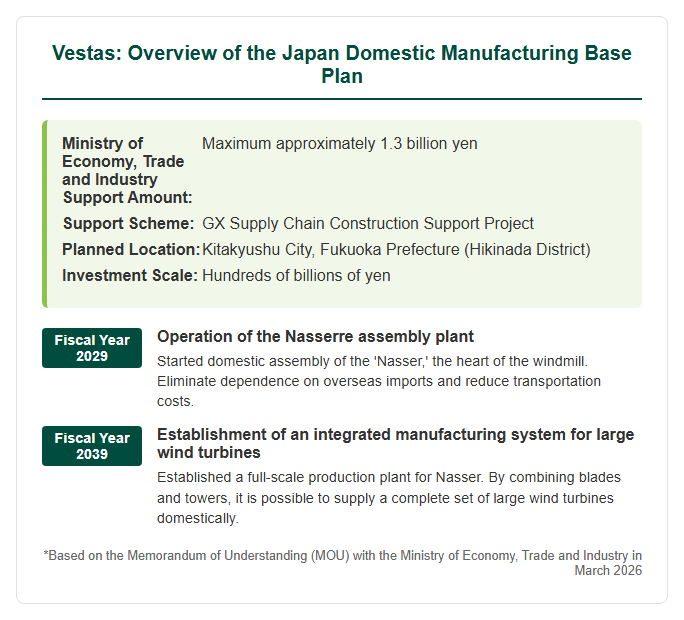
On July 10, 2026, the Ministry of Economy, Trade and Industry decided to grant subsidies of up to approximately 1.3 billion yen to Vestas, a Danish company that is one of the world’s largest windmill manufacturers. This support is part of the government’s “GX (Green Transformation) Supply Chain Construction Support Project,” and is a concrete action based on the memorandum of cooperation signed between the Ministry of Economy, Trade and Industry and the company in March 2026. Vestas has been supplying wind turbines to the Japanese market since 1993, boasting an installed capacity exceeding 1.5 GW domestically and a proven track record of extensive maintenance and operation. The Japanese government has selected the company as a trusted partner to accelerate the introduction of offshore wind power, which directly contributes to improving energy self-sufficiency. The establishment of full-scale manufacturing bases by global wind turbine manufacturers in Japan marks a crucial turning point in Japan’s energy policy. Please refer to the diagram below.
A two-phase manufacturing base plan based in Kitakyushu City
Vestas has selected the Hikinada area of Kitakyushu City, Fukuoka Prefecture as its new manufacturing base. The city was chosen not only for its well-developed port infrastructure but also because suppliers and partner companies are concentrated nearby, giving it an extremely high advantage as a logistics hub. The plan is planned to proceed in two phases: first, the assembly plant for the core part of the wind turbines, the ‘Nasser’, will be operational by fiscal year 2029. The nacelle is the heart housing generators, speed increasers, and control systems, and until now, most of these have relied on imports from overseas. Furthermore, in the future, the company aims to establish a full-scale production plant for nacelles by fiscal year 2039, establishing a system capable of integrated supply of large wind turbines combined with blades and towers. This project, expected to involve investments of several tens of billions of yen, holds the potential to transform Kitakyushu City into a “green energy supply hub.”
Why domestic production is necessary now?
Breaking Free from the ‘Cost Hell’ and Business Sustainability
The biggest barrier to the widespread adoption of offshore wind power in Japan was the extremely high implementation cost. According to estimates by Mitsubishi Research Institute, between 2019 and 2025, the cost of manufacturing a windmill will increase by about 1.2 times, and installation costs will increase to about 2.6 times. Especially in Japan, being far from Europe and incurring the high shipping costs of transporting large parts by ship, the recent weakening yen has further pushed import costs higher. In fact, the case where Mitsubishi Corporation was forced to withdraw from a large-scale project won by the Mitsubishi Corporation Federation because construction costs ballooned to more than twice the estimated amount at the time of bidding sent shockwaves through the industry. By establishing manufacturing bases domestically, transportation costs can be reduced and parts can be procured locally, which is expected to help correct the high cost structure. Vesas’s entry into Japan is expected to serve as a trump card to end this “cost hell” and ensure the profitability and sustainability of offshore wind power projects.
Economic Security and Strategies Toward Chinese Manufacturers
In the global wind power market, China’s Goldwind Technology (Goldwind) and others are rapidly expanding their market share, leveraging overwhelming price competitiveness. Amidst these circumstances, the European Union (EU) has been strengthening efforts to provide subsidies for wind technology within the region and exclude Chinese products, leading to global discussions about wind power from the perspective of “economic security.” In Japan as well, the strategy of “domestic production utilizing foreign capital” is accelerating while incorporating advanced foreign technologies and securing domestic supply chains. By partnering with Vestas, which does not rely on Chinese products and possesses Europe’s top-class technology, the aim is to ensure the safety of energy infrastructure while enhancing the competitiveness of domestic industries. The Ministry of Economy, Trade and Industry positions Vestas as a supply base for the Asian market, and in the future, plans are envisioning exporting wind turbines produced in Japan to Vietnam, the Philippines, Australia, and other countries.
Spillover Effects and Medium- to Long-Term Outlook
Benefits for domestic suppliers such as Nippon Steel
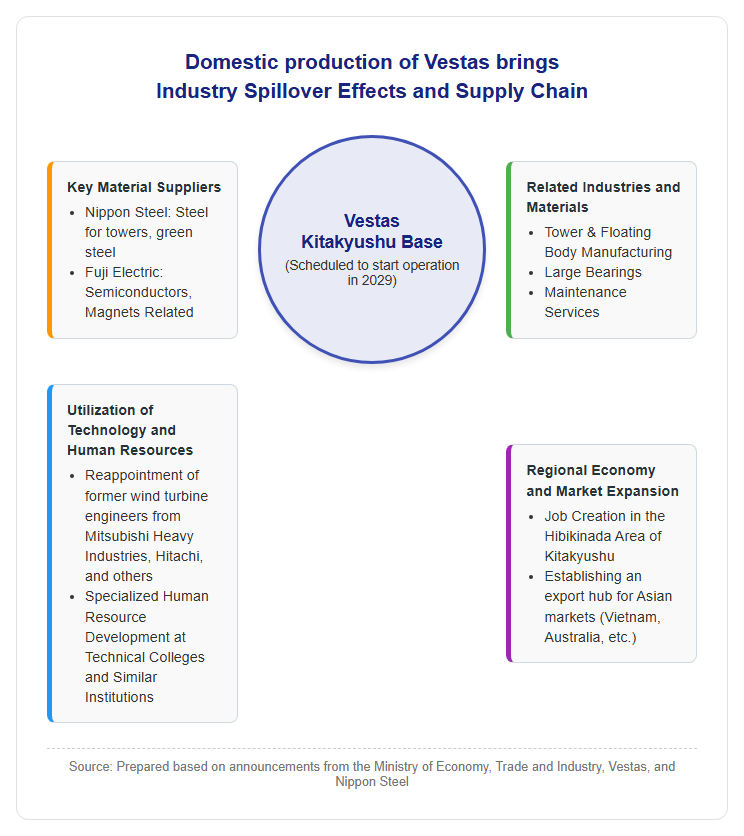
The start of domestic production of Vestas represents a huge business opportunity for Japan’s heavy industry industry. Key components such as steel, semiconductors, and magnets are expected to be procured from domestic companies like Nippon Steel and Fuji Electric. In particular, a memorandum of understanding has been signed with Nippon Steel to deepen cooperation in supplying steel materials for towers and utilizing ‘green steel’ that reduces carbon dioxide emissions. In Japan, where Mitsubishi Heavy Industries and Hitachi once manufactured wind turbines, there remains a foundation of highly skilled engineers, and the utilization of these talents and job creation in rural areas are also expected. The ripple effects on related industries such as wind turbine towers, floating structures, and bearings are significant, and there is potential for the entire Japanese offshore wind industry to be restructured around the Vestas base. Please refer to the diagram below.
Japan’s Role as a Supply Hub for the Asian Market
According to estimates by the World Wind Conference (GWEC), offshore wind deployment is expected to expand about sevenfold by 2034 compared to 2024, with growth in the Asian market considered especially certain. The Ministry of Economy, Trade and Industry is capitalizing on this tailwind and aims to make Japan a ‘supply hub’ for wind turbine supply in Asia. By exporting wind turbines produced in Japan to neighboring countries, this is a blueprint for fostering them as a new growth industry for Japanese manufacturing. For Vestas as well, the Japan base has become strategically essential to maintain its presence in the rapidly growing Asian market. If this move becomes more serious, Japan will shift from being a mere renewable energy importer to becoming an export hub for clean energy technologies. Becoming a hub in the Asian market is an important part of Japan’s national strategy to balance enhancing its international presence with economic growth.
Institutional Reform and Japan’s Challenge Toward 2040
The government positions offshore wind power as the main renewable energy source with the goal of net-zero greenhouse gas emissions by 2050. The Basic Energy Plan, approved by the Cabinet in 2025, set an ambitious goal to raise the share of wind power in the power mix to 4–8% by fiscal 2040 (about 1% in fiscal 2023). To achieve this goal, it is necessary to accelerate the annual deployment of several gigawatts, and the government is also revising the system to extend the maritime area usage period from the general principle of 30 years to up to about 50 years. Furthermore, legal amendments have been made to enable offshore wind development in exclusive economic zones (EEZ), raising expectations for floating offshore wind power generation utilizing vast deep-sea areas. Vestas’ domestic factory plan will serve as a “touchstone” to support such institutional reforms and market revitalization. The challenge that will determine Japan’s energy transition is now about to begin in earnest.
[#洋上風力発電 #ベスタス #経済産業省 #再生可能エネルギー #GX #北九州市 #経済安全保障 #サプライチェーン]


コメント