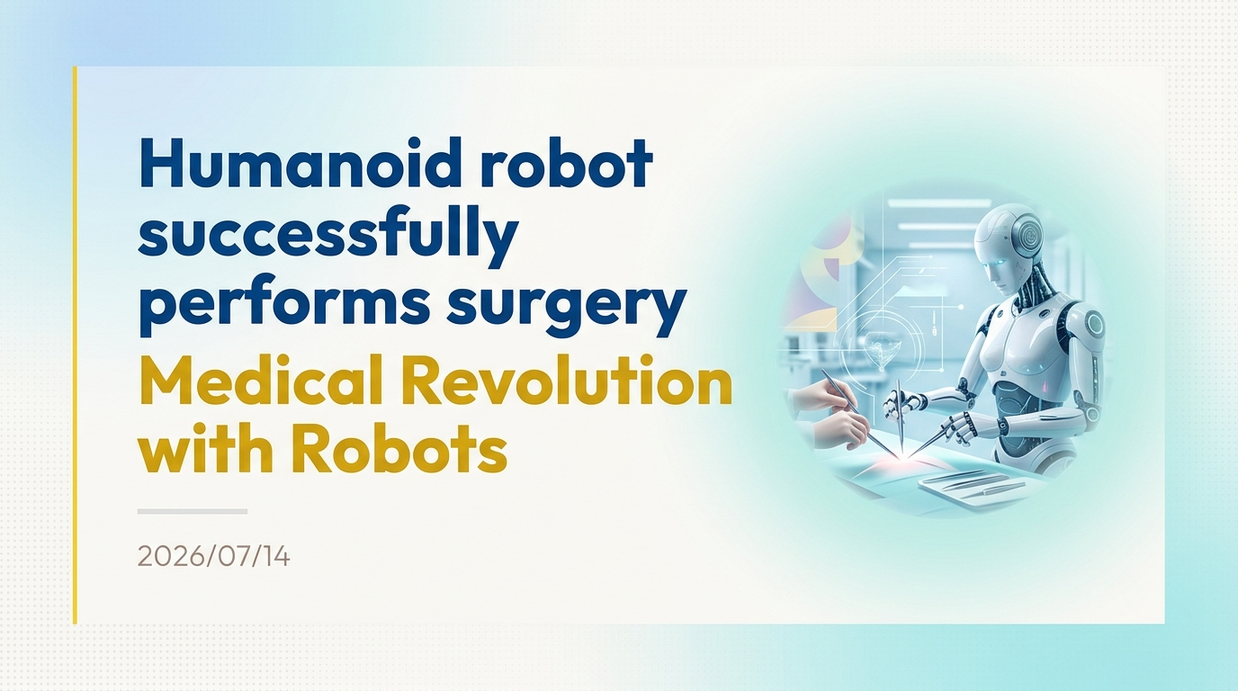
A research team at the University of California, San Diego (UCSD) has succeeded in performing the world’s first living surgery using humanoid robots. This achievement has the potential to overturn the conventional wisdom of traditional robotic surgery, which required expensive and massive dedicated equipment, and dramatically improve access to healthcare in remote areas and disaster sites,,。
- The full story of the historical experiment and the results of the surgery
- The astonishing specifications of the surgical humanoid robot “Surgie”
- The significance of the medical revolution brought by general-purpose humanoid robots
- The Potential of Telemedicine and Solving the Problem of Doctor Shortages
- Current Limitations and Technical and Safety Barriers
- Outlook for the humanoid robot market toward 2050
The full story of the historical experiment and the results of the surgery
On July 8, 2026, the scientific journal Nature published the world’s first research paper on living surgery using humanoid robots. This trial, conducted as a joint effort between an engineering team and a surgical team at the University of California, San Diego (UCSD), involved a remotely operated humanoid robot performing gallbladder removal on large non-primates (pigs),,。
This project was led by Professor Michael Yip of UCSD’s Department of Electrical and Computer Engineering as the engineering leader, with Assistant Professor Shagray Liu from UCSD School of Medicine responsible for remote operation of the robot. Notably, the surgery was successful with two different configurations. One was the “mixed human-robot team,” where humanoid robots performed the surgery and human surgeons assisted as assistants. The other is the ‘team of robots,’ where two humanoid robots work side by side and complete the surgery,,。
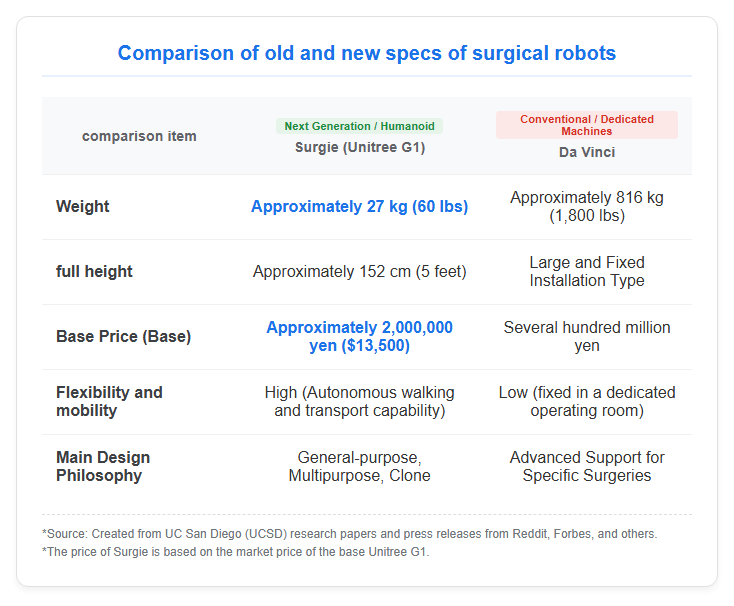
This cholecystectomy (laparoscopic cholecystectomy) is one of the most frequently performed surgeries in general surgery and requires highly dexterous instruments capable of replicating wrist movements, making it an important indicator for evaluating robot performance. Please refer to the diagram below.
The astonishing specifications of the surgical humanoid robot “Surgie”
The humanoid robot used in this experiment is nicknamed “Surgie” by the research team and is customized based on the general-purpose humanoid robot “G1” from China’s Unitree,,,。 The Surgie’s greatest features are its overwhelming compactness and low cost.
It stands about 5 feet tall (approximately 152 cm) and weighs only 60 pounds (about 27 kg), which is only about one-thirtieth the weight of the massive body of the existing surgical support robot “Da Vinci,” which weighs about 1,800 pounds (about 816 kg),,。 Also, while dedicated systems like Da Vinci require investments in the hundreds of millions of yen, the base Unitree G1 is very affordable, priced at about $13,500 (just over 2 million yen).
Based on this lightweight and inexpensive hardware, the research team developed an adapter to hold general-purpose surgical instruments, proving that humanoid robots can smoothly adapt to existing medical workflows. Surgeons participating in the study were amazed that Surgie fit naturally into the limited space of the operating room and was able to be introduced without altering the existing equipment configuration.
Benefits of Introducing Medicine into Medical Settings and Differences from Existing Technologies
The significance of the medical revolution brought by general-purpose humanoid robots
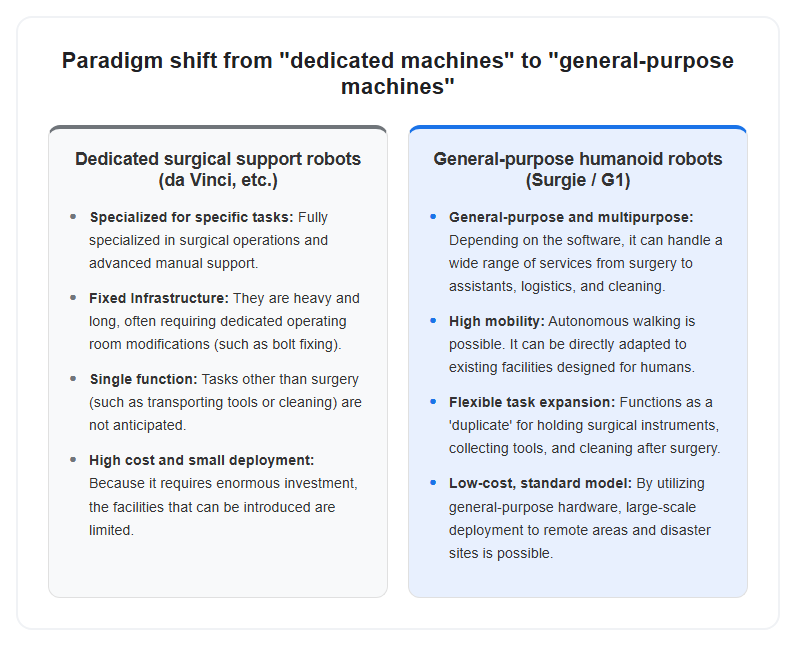
Dedicated robot systems like those in Da Vinci, which had dominated operating rooms until now, boasted advanced precision but were also “expensive dedicated machines” specialized for specific functions. In contrast, the approach of humanoid robots, which succeeded this time, presents the potential of a “general-purpose machine” capable of handling a wide variety of tasks by combining software with general-purpose hardware,,。
Humanoid robots can not only perform the surgery itself, but also theoretically use their ‘human form’ to transport instruments in the operating room and perform post-surgery cleaning. Furthermore, introducing existing surgical support robots required large-scale renovations of the operating room itself to secure large installation space, but humanoid robots with mobility can enter existing human operating rooms and perform tasks in the same position as humans,,。
Professor Yip hopes that in the future, autonomous surgical programs developed for Da Vinci can be directly “copied and pasted” into humanoid robots and operated by platform-independent surgical automation. This could allow small hospitals that cannot afford expensive dedicated machines to benefit from advanced robotic surgeries by introducing affordable humanoid robots,,。 Please refer to the diagram below.
The Potential of Telemedicine and Solving the Problem of Doctor Shortages
Another major strength of humanoid robots is their function as “physical avatars of doctors” through remote operation (teleoperation). The research paper highlights that this technology has the potential to dramatically improve access to healthcare in harsh environments such as rural medically sparse areas, battlefields, and even outer space, where specialists find it difficult to reach directly,,。
Currently, the shortage of surgeons has become a serious problem in many countries, leading to longer waiting times for surgeries and widening healthcare disparities. If remote surgery utilizing humanoid robots becomes widespread, specialists in urban areas will be able to perform real-time surgeries on patients hundreds of kilometers away through robots.
Additionally, the team has set a future goal of developing an “autonomous surgical assistant.” This aims to establish a system where robots can safely perform surgeries with fewer personnel by having robots play the role of assistants in regions struggling with surgical team staff shortages. In this experiment, it has been confirmed that the robot can faithfully reproduce the doctor’s operations and achieve accuracy equivalent to existing surgical support systems.
Challenges for Practical Application and Future Forecasts for 2050
Current Limitations and Technical and Safety Barriers
Although the successful surgery using pigs this time is a groundbreaking achievement, many engineering and clinical challenges remain before it can be introduced in clinical settings in humans,,。 One of the biggest issues was that the robot had to undergo multiple “recalibrations” during surgery,,。
As a result, this experiment took significantly longer than a typical surgery,,。 Early laparoscopic surgeries initially took 6 hours but have now been shortened to about 30 minutes. The research team is optimistic that these are engineering challenges that will be resolved over time, but their current practicality is limited. Additionally, improving latency (communication delay) during operations is an essential condition for realizing long-distance remote surgery,,。
Furthermore, concerns about safety and security cannot be ignored. Regarding the Unitree G1 used as the base for this time, a specific command injection vulnerability has been reported in 2025, and to use it as a medical device, strict cybersecurity measures and stability are required to set it apart from consumer robots. It is expected that it will still take several years before clinical trials in humans begin.
Outlook for the humanoid robot market toward 2050
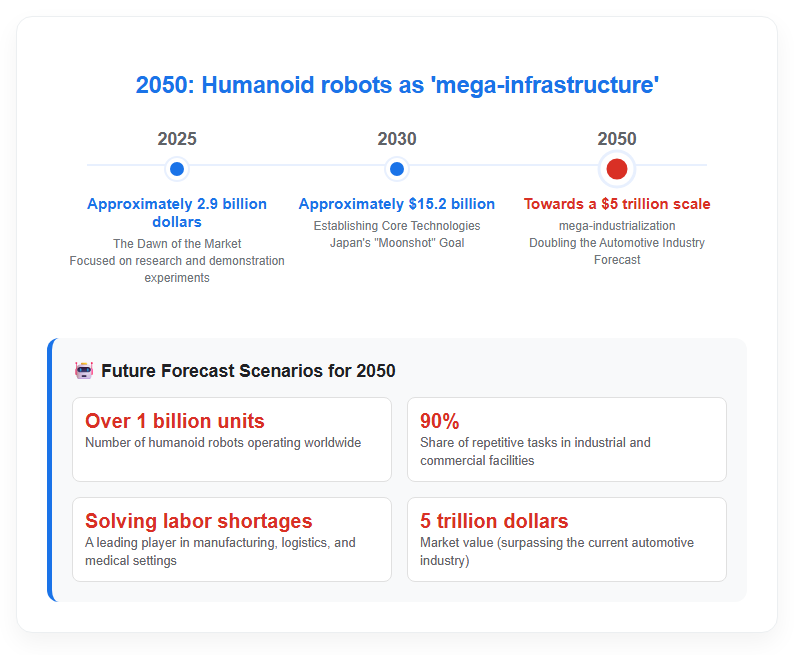
From a long-term perspective, the spread of humanoid robots in the medical field is predicted to become part of a massive growth industry. According to Morgan Stanley’s 2025 study, the market size for humanoid robots could reach $5 trillion by 2050, potentially twice the size of the automotive industry.
In this scenario, by 2050, more than one billion humanoid robots will be operational worldwide, many of whom will perform repetitive tasks or specialized tasks in industrial and commercial facilities. In the medical field as well, it is expected that more affordable and multifunctional humanoid robots will emerge as new options, in contrast to established leaders such as Intuitive Surgical, which currently dominates the robotic surgery market,,。
The Japanese government has also established foundational technologies for general-purpose autonomous AI robots by 2030 as part of its ‘Moonshot Target,’ aiming to utilize them in factories and hospitals. UCSD’s research marks a significant turning point in the evolution of robots from “dancers and housework” to “life-saving precision tools,” and in 2050, it may become common to see humans and robots performing surgeries side by side in medical settings,,。 Please refer to the diagram below.
[#ロボット手術 #ヒューマノイド #医療技術 #遠隔医療 #UCSD #AI #未来予測]


コメント