Chinese AI startup StepFun announced the world’s first “AI Agent Smartphone” on July 13, 2026. This move symbolizes the complete shift of the main battlefield in the AI race from cloud data centers to end devices in the hands of individuals.
- Historical announcement on July 13, 2026 and its background
- Defining an “agent” that makes traditional smartphones a thing of the past
- Automation of operations using the Step-GUI model and MCP protocol
- “Edge-Cloud Collaboration” architecture achieving low latency of 0.1 seconds
- Partnership with Huaqin Technology and a massive 5 billion yuan funding.
- Market Share Forecast for 2026 and the Shadow of the Memory Supply Crisis
- Future Roadmap for AGI (Artificial General Intelligence)
Historical announcement on July 13, 2026 and its background
The AI agent smartphone announced by StepFun on July 13, 2026, marked a historic milestone that significantly reshaped the power dynamics between the mobile and AI industries. The launch event held in Shanghai was themed “The True Intelligent Body of the Agent Era,” demonstrating to the world a dramatic shift from “cloud-based chatbot-based devices” to “intelligence where the device itself autonomously thinks and operates.” The background to this announcement includes the following key elements:
-
OpenAI has achieved its next-generation AI device deployment planned for 2027 more than a year ahead of schedule.
-
Led by top industry leaders such as former Microsoft Vice President Jiang Daxin and former Megvii Technology founder Yin Qi
-
Strong policy support from the AI industry promotion strategy “Mosu Shencheng” promoted by the Shanghai municipal government
Thanks to this world-first achievement, smartphones have evolved beyond simply serving as communication devices or app execution platforms into super personal computers that understand user intentions and act autonomously. In less than three years since its establishment in April 2023, the significance of Chinese startups redefining the global standards for cutting-edge technology is truly significant.
Defining an “agent” that makes traditional smartphones a thing of the past
At the heart of AI agents lies not simply in answering users’ questions in text, but in their ability to autonomously perform specific tasks. While traditional AI-powered smartphones perform limited operations (such as setting alarms and checking weather forecasts) through voice assistants, the AI agent introduced by StepFun searches for information beyond the scope of applications, reads context, and performs multiple operations in combination.
For example, with just a single command from a user to “Get ready for a weekend business trip,” AI can consistently handle the complex process of checking calendars, booking flights and hotels for the right time slots, and collecting and organizing necessary meeting materials from the cloud. Such changes demand a fundamental redesign of mobile operating systems and are closely related to visions like Honor’s proposed “Agentic OS.” By making AI the core (orchestrator) of the system, users are freed from the hassle of launching and operating individual apps, and can enjoy all kinds of services simply by directly interacting with the intelligence behind the screen. Please refer to the diagram below.
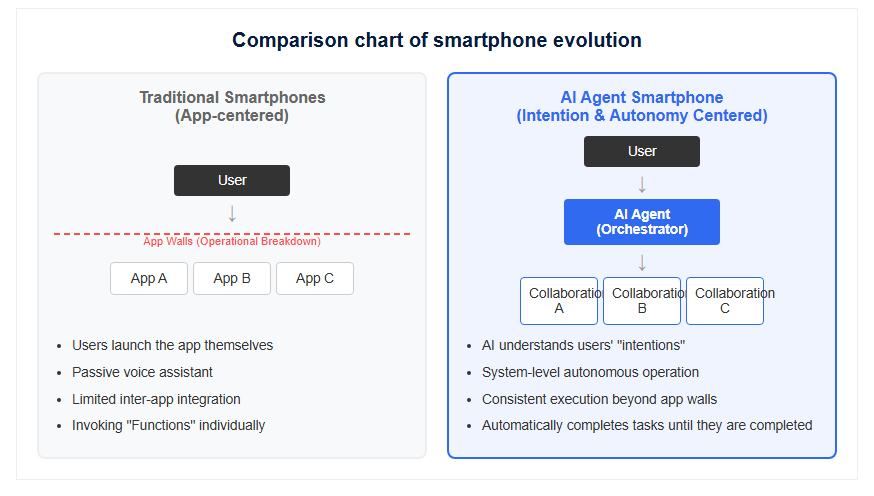
Advanced technological architecture supporting autonomous operation
Automation of operations using the Step-GUI model and MCP protocol
For AI agents to operate autonomously on smartphones, it is essential to have the ability to “see” and understand screens just like humans do. Supporting this is the Step-GUI model developed by StepFun, along with the GUI-MCP open protocol for implementing it on devices. The company will gradually release these technologies starting in 2025, bringing innovations such as:
-
Developers and manufacturers can deploy AI agent functions on existing devices in just 10 minutes.
-
Even if the app does not provide a dedicated API, AI can recognize the UI on the screen and directly perform operations.
-
Breaking the “app walls” faced by traditional AI, enabling advanced integration across multiple applications
The Step-GUI model instantly analyzes the placement of buttons, text boxes, and icons on the screen to determine which operation is best suited to the user’s objectives. This allows AI to replicate in digital space processes similar to how humans manipulate smartphone screens with their fingers. ZTE’s flagship model “Nubia Z80 Ultra” has already implemented cross-application tool calling functions using this GUI agent model, and its practicality is highly regarded.
“Edge-Cloud Collaboration” architecture achieving low latency of 0.1 seconds
To enable fast and privacy-conscious processing within devices, StepFun introduced the “Step Edge” series and established a “edge-cloud collaboration” architecture that highly integrates end devices with the cloud. This is a hybrid system that allocate computational resources according to the weight and urgency of the processing.
-
High-frequency tasks such as image recognition, speech recognition, UI operations, and simple image generation are handled by local models within the device.
-
Integrate with large-scale cloud-based models only when complex inference or massive data searches are required.
-
Tool call delay reduced to just 0.1 seconds, allowing continued operation even in unstable internet environments.
In particular, models like Step 3.5 Flash adopt a “sparse MoE (Mixture of Experts)” structure, which has a massive parameter of 196B but limits the actual activation parameters to 11B during inference. This enabled us to operate intelligence comparable to large-scale models with 1 trillion parameters, despite the limitations of smartphone battery capacity and thermal design. This highly efficient design is the technological breakthrough that has made always-on operation of AI agents a reality.
A strong industrial foundation and the future of the market
Partnership with Huaqin Technology and a massive 5 billion yuan funding.
A decisive role in mass production and global adoption of the product was its strategic partnership with Huaqin Technology, one of the world’s largest ODM (Original Design and Manufacturing Manufacturer) manufacturers. The relationship between the two companies is based on deep technological integration that goes beyond mere manufacturing outsourcing, with hardware “value reconstruction” as follows:
-
Adoption of a heterogeneous computing architecture of “CPU + GPU + NPU” with NPU (Neural Circuit Processing Unit) as the main power source
-
Equipped with large-capacity, high-speed DRAM exceeding 16GB to run large-scale models locally.
-
Advanced cooling solutions using graphene and vapor chambers to address heat generated by constant AI operation
Additionally, StepFun completed a B+ round in January 2026 raising over 5 billion yuan (approximately 120 billion yen). With strong investor support from companies like Tencent and Shanghai SDIC, the company’s AI models have already been adopted in devices from major manufacturers including OPPO and Honor, with the number of installed units exceeding 42 million units. This robust industrial ecosystem serves as a powerful engine for rapidly penetrating the market, not just a research phase. Please refer to the diagram below.
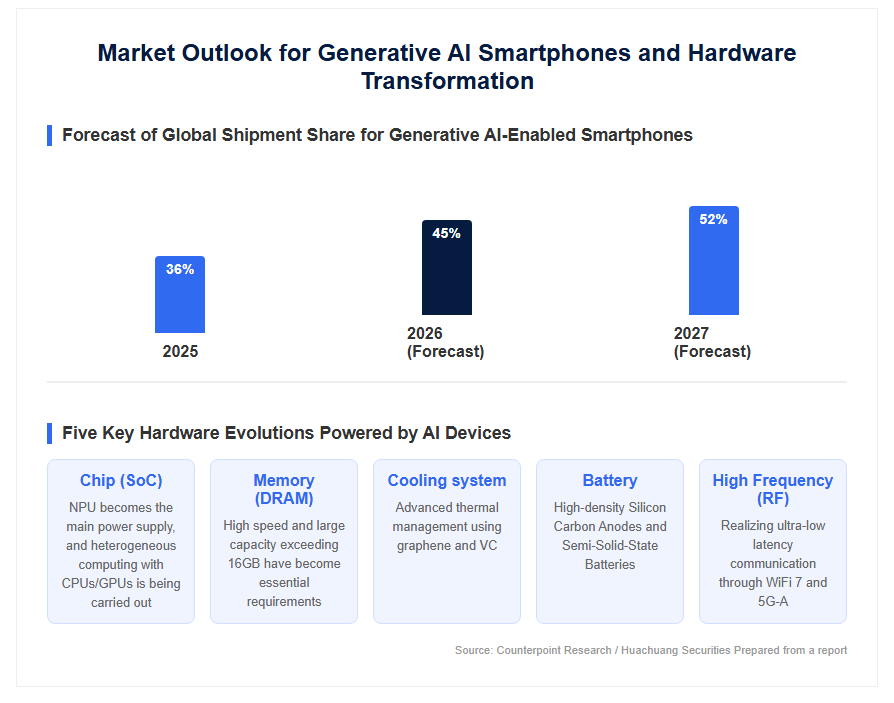
Market Share Forecast for 2026 and the Shadow of the Memory Supply Crisis
According to data from market research firms, it is predicted that by 2026, about 45% of smartphones shipped worldwide will be models equipped with generative AI capabilities. This represents a significant increase from 36% in 2025, and is expected to reach a majority of 52% by 2027. However, alongside this bright outlook, serious challenges have also emerged.
-
Due to the global memory supply crisis, there are concerns that total smartphone shipments in 2026 will fall 13.9% year-on-year to 1.08 billion units, hitting a record low
-
The rising DRAM costs due to the heavier AI models pose a barrier to adopting AI features in mid- to low-priced models (under $400).
-
Restrictions on the procurement of advanced AI chips due to US-China technical regulations, and the establishment of domestic chip alliances to counter them
To address these challenges, StepFun is accelerating the construction of its own autonomous ecosystem by strengthening the “Moxin Ecosystem Innovation Alliance” with domestic chips such as Huawei Ascend. The timing of the easing of memory supply issues will be a decisive turning point in whether generative AI truly becomes widespread in ordinary households.
Future Roadmap for AGI (Artificial General Intelligence)
StepFun positions the announcement of the AI agent smartphone as an important milestone toward realizing AGI (Artificial General Intelligence). The company’s five-stage roadmap aims to evolve from single-modal to multimodal, and now through autonomous agent functions, ultimately embodied intelligence with physical physical capabilities.
Specifically, we are accelerating the development of “super assistants” that visually understand the world through smartphone cameras and interact in real time with voice, running alongside users in every aspect of their lives. In the automotive sector, the scope of applications continues to expand beyond smartphones, such as collaborating with Geely Automobile to launch the smart cabin solution “AgentOS.” If a rumored listing on the Hong Kong Stock Exchange, rumored to happen within 2026, the future of AI becoming a true “personal partner” will become a reality sooner, backed by further financial strength. The appearance of the world’s first AI agent smartphone is just the prologue to its grand story.
コメント