SpaceX has applied to the U.S. Federal Communications Commission (FCC) for permission to launch and operate up to 100,000 third-generation (Gen3) Starlink satellites. This massive constellation aims to build a global ultra-high-speed, low-latency communication infrastructure with an eye toward the arrival of the AI era.
- The communication network of the AI era envisioned by 100,000 satellites
- Shift to Very Low Earth Orbit (VLEO) and Larger Satellites
- Mass Transport Using the Next-Generation Rocket ‘Starship’
- The ‘Stalind’ Project and On-Orbit Operations
- The battle for supremacy with competitor Amazon Kuiper
- Goldman Sachs’ Bullish Growth Forecast
- Limits of orbital safety and the “territorial dispute in space”
The communication network of the AI era envisioned by 100,000 satellites
In July 2026, SpaceX applied to the FCC to deploy 100,000 third-generation Starlink satellites (Gen3), far surpassing previous scales. Currently, Starlink operates about 10,000 satellites, but the new system aims to be ten times larger. At the heart of this plan is not just providing internet connectivity, but building a global communications backbone that supports AI-powered devices deployed in the billions of units. SpaceX argues that uplink capacity far exceeds current levels for real-time decision-making and the exchange of high-definition data required for industrial automation. If approved, the first launches are expected to begin in the latter half of 2026.
Shift to Very Low Earth Orbit (VLEO) and Larger Satellites
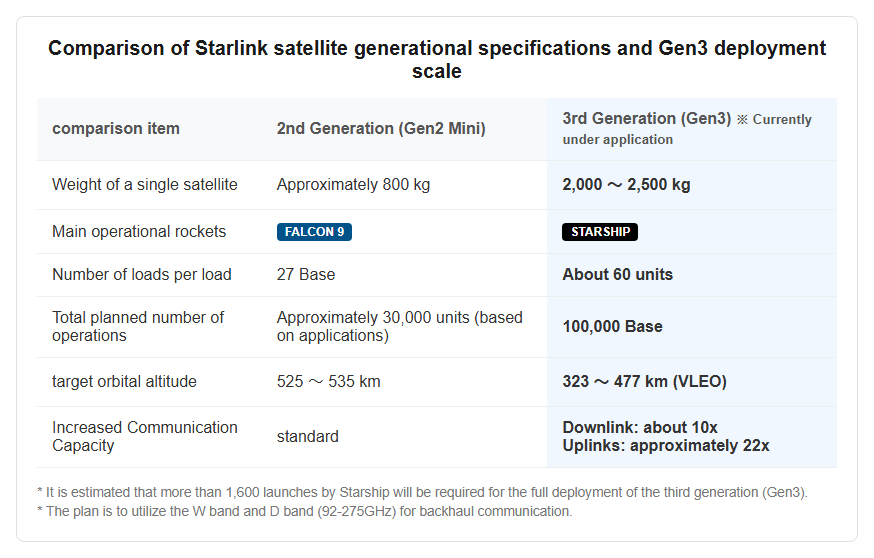
The Gen3 system is planned to operate in ultra-low Earth orbit (VLEO), even closer to Earth than conventional satellites. Specifically, a two-layer orbital shell at altitudes of 323–327.5 km and 473–477.5 km has been proposed, aiming to achieve multi-gigabit-class communication speeds and ultra-low latency like never before. Additionally, the weight per satellite will increase significantly from 2,000 kg to 2,500 kg. This is about three times the weight of the approximately 800kg Gen2 Mini, which is currently being launched as the main force. With this enlargement, downlink capacity is expected to increase by about 10 times, and uplink capacity by more than 20 times.
Mass Transport Using the Next-Generation Rocket ‘Starship’
To deliver the massive mass and number of Gen3 satellites into space, the existence of the currently developing super-large reusable rocket “Starship” is essential. The conventional Falcon 9 lacked sufficient transport capacity, and Starship was the only way to realize this 100,000-unit plan. Starship is designed to carry about 60 Gen3 satellites in a single flight, and it is estimated that deploying all planned satellites would require over 1,600 launches. The following image shows SpaceX’s vision of large-scale Starship deployment.
Background of Management Strategy and Space Data Center Concept
The ‘Stalind’ Project and On-Orbit Operations
SpaceX’s ambitions go beyond expanding its communications network. In addition to this 100,000-unit application, the company is also simultaneously advancing a space-based data center project called “Starmind,” which will use up to 1 million satellites. This is an extreme plan to place satellites equipped with AI processing units into orbit and build a computing empire in outer space. Elon Musk claims that space is weather-dependent and can generate solar power 24 hours a day, efficiently collecting about five times the energy of Earth. Gen3 systems also serve as infrastructure to rapidly connect these orbital data centers with users on the ground.
The battle for supremacy with competitor Amazon Kuiper
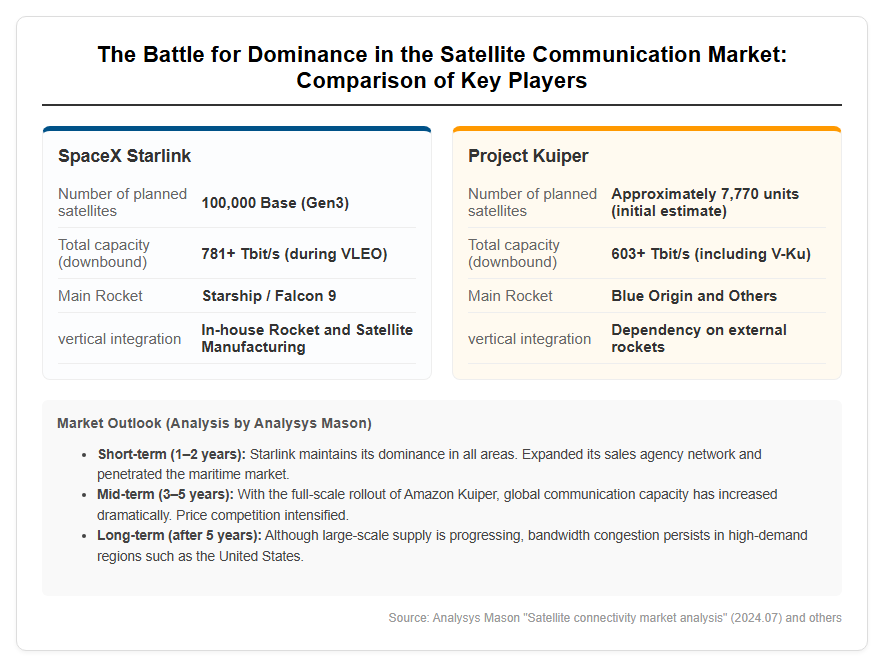
In the satellite communications market, strong competitors such as Amazon’s Project Kuiper are emerging, but SpaceX aims to dominate the market with overwhelming volume and a vertically integrated model. Amazon plans to deploy more than 3,200 satellites within a few years, making it a strong short-term rival to Starlink. However, SpaceX aims to raise the entry barrier to a level that competitors cannot match by applying for its overwhelming cost advantage with its rockets and the exceptionally large scale of 100,000 units. As shown in the chart below, the low Earth orbit satellite market is expected to become increasingly monopolized by the top two companies.
Economic Impact and Risks Faced
Goldman Sachs’ Bullish Growth Forecast
There are high expectations in the market for SpaceX’s shift toward AI and communication infrastructure. Goldman Sachs predicts that SpaceX’s AI-related revenue will explode about 100-fold, from $3.2 billion in 2025 to $322 billion (about 52 trillion yen) by 2030. The bank has set a target price of $205 for SpaceX, highly valuing its value as an AI infrastructure company. However, this evaluation assumes Starship’s commercialization proceeding as planned and that space-based AI computing becomes practical, leading to differing opinions among investors regarding its feasibility.
Limits of orbital safety and the “territorial dispute in space”
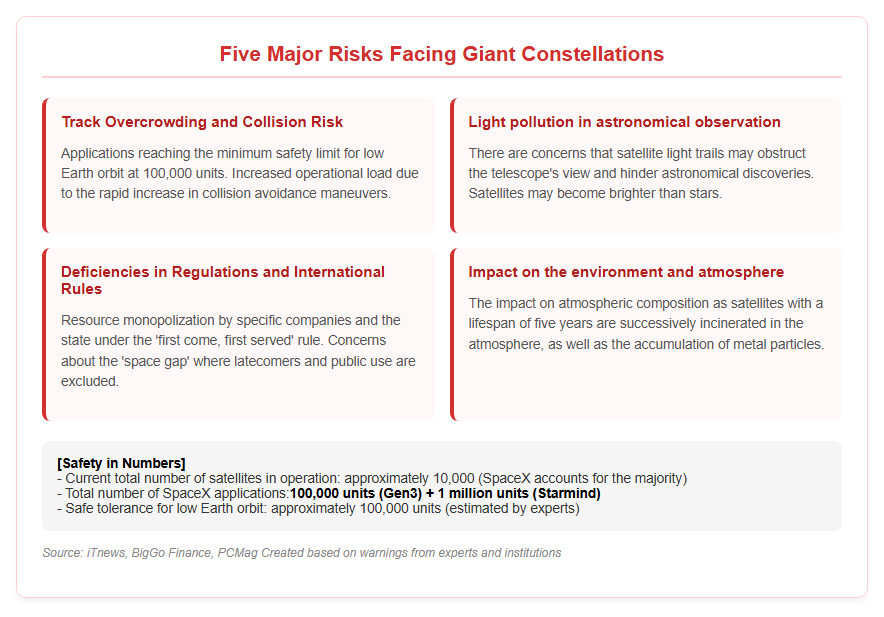
On the other hand, the massive deployment of 100,000 satellites also raises serious concerns. Experts say the safe capacity limit for low Earth orbit is about 100,000 spacecraft, and SpaceX’s application corresponds to this threshold. Astronomers have warned about the negative impact of light pollution on astronomical observation, and the risk of collisions between satellites is increasing exponentially. Because the international rule is ‘first come, first served’ (priority is given to those who secure a spot first), there are concerns about SpaceX monopolizing resources, and regulatory scrutiny is expected to be extremely strict.
Future Developments and Highlights
The authorization process for Gen3 satellites will continue over the coming months and years. In the short term, the main focus will be the test flight of the first V3 satellite, scheduled for late 2026, and the accompanying success rate of Starship. Additionally, at the first post-IPO earnings briefing scheduled for August 6, management is likely to discuss details of the application, specific outlooks for AI revenue, and the current state of Cashburn, making it a highly important event for investors.
[#SpaceX #Starlink #AIインフラ #宇宙ビジネス #イーロンマスク #経済ニュース #次世代通信 #スターシップ]


コメント