SBI VC Trade will begin offering lending services using the Japanese yen-denominated trust-type stablecoin “JPYSC” starting July 16, 2026. This first domestic initiative has attracted significant attention as a new asset-building option that integrates crypto assets with traditional finance.
- On July 16, 2026, a new asset management initiative began.
- The shock of a “3% annual rate” surpassing bank deposits
- The ‘1 million yen barrier’ to be lifted by Type 3 electronic payment methods
- Vertical integration of an independent economic zone envisioned by the SBI Group
- Notes on Separate Management and Tax Miscellaneous Income
- Future Developments: From Physical Store Payments to Global Remittances
On July 16, 2026, a new asset management initiative began.
SBI VC Trade Co., Ltd., a crypto asset exchange operator under the SBI Group, announced on July 13, 2026, that applications for the lending service “JPYSC Lending,” Japan’s first trust-type yen-denominated stablecoin, “JPYSC,” will begin on July 16, 2026. Actual lending operations are scheduled to begin on July 23, 2026, and users can lend their JPYSC holdings to the company and receive usage fees (rental fees) in return.
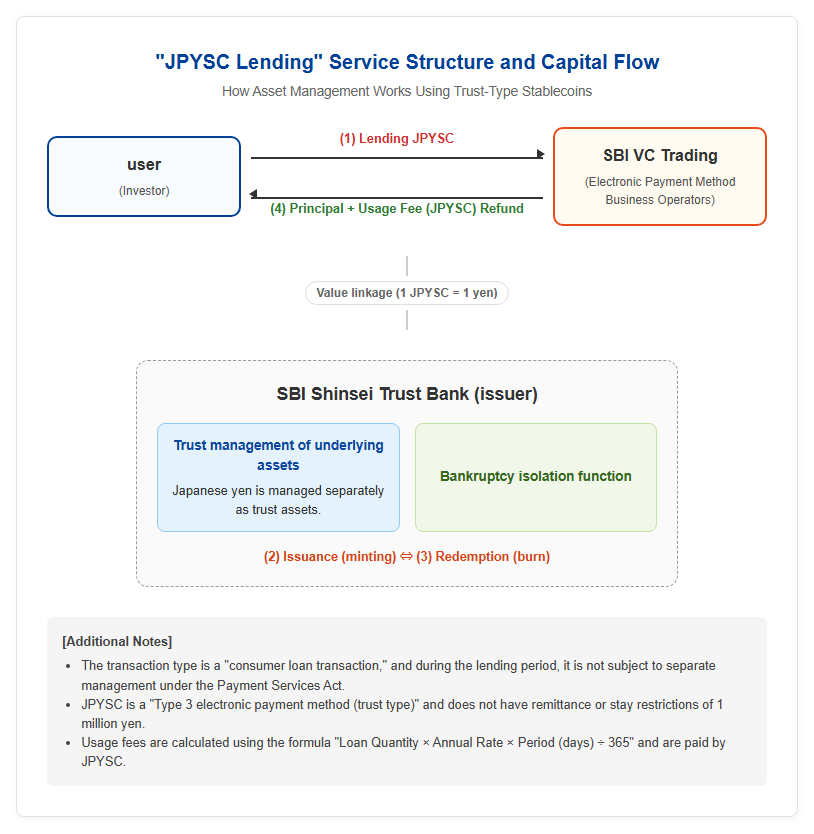
JPYSC is a “trust-type” yen-denominated stablecoin issued by SBI Shinsei Trust Bank, and it was available exclusively within SBI VC Trade accounts starting June 24, 2026. This lending service aims to utilize this new digital currency not just as a payment method, but as a tool for generating income and asset building. The offer is being conducted through SBI VC Trade’s “VCTRADE Service,” initially offering plans with a 12-week term. The diagram below shows the overall flow of this service.
This announcement is extremely significant as the first concrete commercial service based on the stablecoin legal framework established in Japan since the enforcement of the revised Payment Services Act in June 2023. Until now, lending of highly volatile crypto assets like Bitcoin has existed, but lending using legally defined “electronic payment methods” linked to the Japanese yen is the first of its kind in Japan, leading to a significant increase in interest from investors and the financial industry as a whole.
The shock of a “3% annual rate” surpassing bank deposits
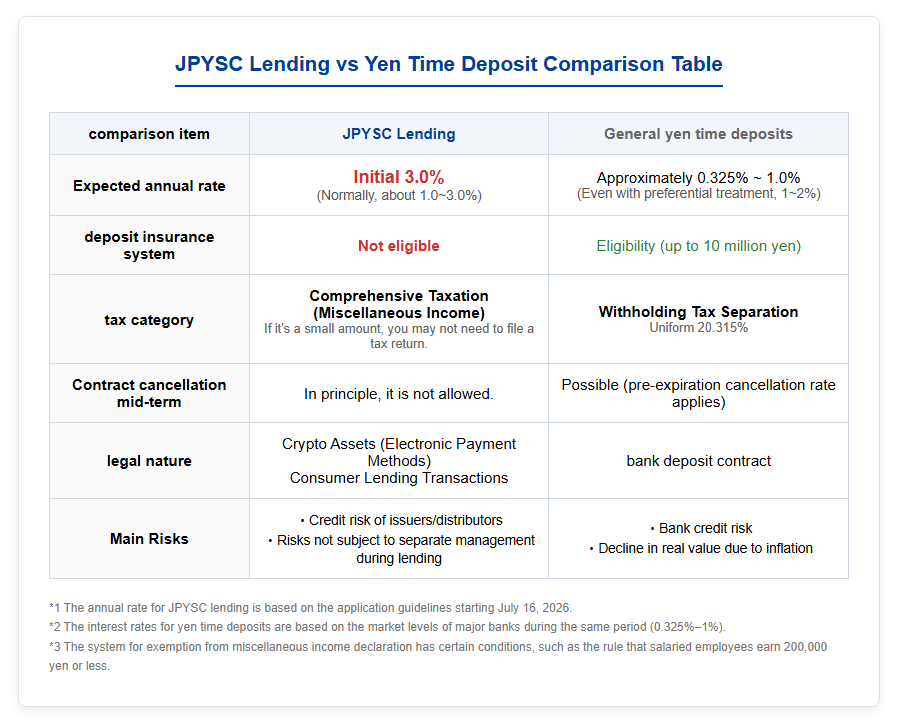
The biggest feature of this service is its high annual return rate of 3% for initial recruitment, offered to commemorate its launch. This is about three to nearly ten times higher than the annual rates of typical bank yen time deposits (about 0.325% to 1% as of July 2026), making it an extremely attractive option for those who want to manage as safe yen-denominated assets. Even during regular offerings, the annual rate is planned to be around 1% to 3%, aiming to provide outstanding yields in Japan’s ongoing low interest rate environment.
The usage fee is calculated based on the “loan quantity × annual rate × period (days) ÷365,” and at maturity, the total amount plus the usage fee is fully refunded by JPYSC. For example, if you lend JPYSC worth 1,000,000 yen at an annual rate of 3% for 12 weeks, at maturity you will receive about 6,900 yen in interest plus the refund. The background behind achieving such high yields is the SBI Group’s expertise in crypto asset management and its efficient management system through technical collaboration with the Startale Group.
On the other hand, it is also important to understand that these high yields come with corresponding mechanisms and constraints. Unlike bank deposits, lending generally cannot be canceled mid-term during the loan period. Also, since it is not covered by the deposit insurance system, it is important to note that the principal guarantee mechanism in case of an accident is fundamentally different from that of bank deposits. The table below compares the content of a typical yen time deposit with this service.
Trust-backed stablecoins are transforming the industry structure
The ‘1 million yen barrier’ to be lifted by Type 3 electronic payment methods
The “trust-type (Type 3 electronic payment instrument)” legal scheme adopted by JPYSC holds the potential to become a decisive turning point in Japan’s digital financial market. The “Type 1 electronic payment method (money transfer type)” (money transfer type), such as JPYC, had restrictions under the Payment Services Act limiting the issuance and remittance limit to 1 million yen per transaction. In contrast, Category 3 electronic payment methods where trust banks issue the payment system do not have legal limits on remittance or retention.
The removal of this cap paves the way for large-scale transactions by institutional investors and B2B payments between companies, going beyond small-scale payments for individuals. Since it will be possible to complete transfers of funds worth hundreds of millions of yen on the blockchain 24/7, 365 days a year, instantly, there is hope that this will fundamentally solve issues such as “next-business day deposits” and “high fees” found in traditional bank transfers. JPYSC is designed precisely to target this large-scale institutional investor use case.
Furthermore, the greatest advantage of being a trust-type asset is that the Japanese yen assets backed by the issuing entity, Shinsei Trust Bank, are strictly managed separately as ‘trust assets.’ In the unlikely event that the issuer or affiliated company goes bankrupt, the entrusted assets are protected by law, and the user’s asset return is guaranteed in this system. This is a robust model that brings the reliability of existing finance into the blockchain, setting it apart from unstable stablecoins such as algorithmic ones.
Vertical integration of an independent economic zone envisioned by the SBI Group
SBI Holdings places JPYSC not just as a single product but at the core of the group’s overall Web3 strategy as the “payment layer.” SBI is a comprehensive financial group that includes securities, banking, and cryptocurrency exchanges within the group, and by connecting the functions of each through a common digital currency called JPYSC, it plans to strongly promote the on-chain integration of existing finance.
Particularly noteworthy is the close collaboration with the Singapore-based Startale Group. SBI has made a significant investment in Startale, jointly developing its technology infrastructure, and is also considering collaboration with its own blockchain ‘Strium Network’ and Ethereum’s Layer 2 ‘Soneium.’ Through this, JPYSC will be introduced as the settlement currency for the buying and selling of tokenized stocks and bonds (RWA), aiming to realize “Delivery Versus Payment (DVP),” which completes asset transfers and payments entirely on the same infrastructure.
SBI’s moves signify the establishment of a “proprietary economic zone” distinct from the “Progmat Coin” alliance led by three megabanks such as Mitsubishi UFJ Bank. SBI’s Chairman Kitao has clearly rejected the convoy convoy system and is committed to creating world-class infrastructure through fair competition, with JPYSC serving as a weapon embodying this strategy. The domestic stablecoin market is now in full swing, with a three-way battle between JPYC, the leading firm, SBI’s independent path, and a megabank alliance.
Institutional risks investors should pay close attention to and the future of practical application
Notes on Separate Management and Tax Miscellaneous Income
When using JPYSC lending, the aspect investors should pay most attention to is risk management. Normally, JPYSC itself is managed separately under the Trust Act, but during the period when it is lent to SBI VC Trade as lending (consumer lending transactions), it is temporarily excluded from “management” under the Payment Services Act. In other words, it is important to fully recognize that if SBI VC Trade fails during the lending period, there is a risk that all or part of the lent JPYSC will not be repaid.
There are also significant differences in tax treatment compared to bank deposits. Interest on bank deposits is settled with a flat 20.315% separate withholding taxation, but usage fees earned from JPYSC lending are treated as “miscellaneous income” and subject to comprehensive taxation. This system combines the tax rate with other income such as salary income, but on the other hand, if annual miscellaneous income is 200,000 yen or less, tax returns may not be required, which can be an advantage for small investors. Because it is denominated in yen, it does not involve the complex exchange calculations typical of cryptocurrencies, making it easy for beginners to get started.
Furthermore, at present, this service is operated exclusively within SBI VC Trade accounts and does not support transfers to external public chains or self-managed wallets. In the future, they plan to wait for institutional improvements before aiming for distribution on public chains, but in the early stages, operations will be closed within SBI’s platform, which is another point to keep in mind from a convenience perspective.
Future Developments: From Physical Store Payments to Global Remittances
The move toward practical application of JPYSC is accelerating rapidly, not just in lending. In August 2026, a technology demonstration for stablecoin payments at physical stores is scheduled to be held at Lawson Takanawa Gateway City in collaboration with Lawson, HashPort, and KDDI. By linking with regular POS registers to verify payment processing times and operability, there is a growing trend to explore the possibility of future integration into everyday payments.
Additionally, Startale Group announced the Visa card “Startale Card,” which supports JPYSC payments, and is working to build an environment where users can earn yield from assets on Soneium while making direct payments at Visa merchants worldwide. This allows you to grow your assets through lending while instantly using it at the store when needed—truly demonstrating the true value of ‘programmable money.’
In the medium to long term, business-to-business payments and cross-border remittances will likely be the primary use cases. Instead of traditional international transfers via SWIFT that took several days, combining JPYSC with other countries’ stablecoins enables instant settlement 24/7, 365 days a year. The future of “on-chain finance” that SBI aims for is fundamentally redefining the nature of money—from individual asset building to massive inter-state capital flows—through this lending service.
[#JPYSC #ステーブルコイン #SBIVCトレード #資産形成 #レンディング #Web3 #暗号資産 #経済]


コメント