The Bank of Japan decided to raise its policy interest rate from around 1.0% to approximately 1.25% at its Monetary Policy Meeting. This rate hike stems from heightened concerns over upside inflation risks driven by elevated crude oil prices and a weak yen, as well as the spreading virtuous cycle between wages and prices.
- Announcement of Rate Hike to 1.25%, Reaching Highest Level in 31 Years
- Upside Inflation Risks and External Pressures Driving the Additional Rate Hike
- Rising Burden for Floating-Rate Borrowers and Implementation Time Lags
- Mechanisms of the 5-Year and 125% Rules and Unpaid Interest Risks
- Intergenerational Divide: Heavier Mortgage Burdens for the Young vs. Asset Effects for Seniors
- Rising Borrowing Costs for Businesses and Varying Sectoral Impacts
- Monetary Policy Outlook and Key Economic Indicators to Watch
Announcement of Rate Hike to 1.25%, Reaching Highest Level in 31 Years
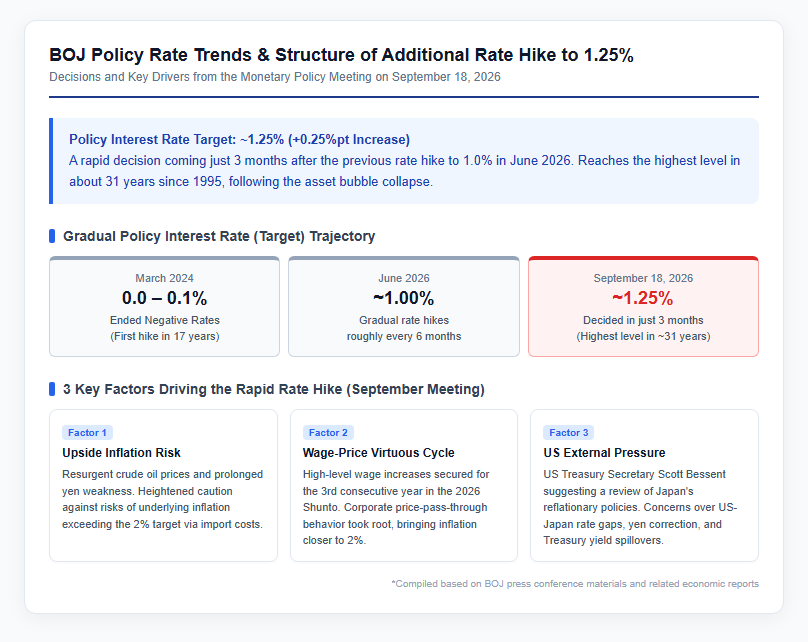
At its Monetary Policy Meeting on September 18, 2026, the Bank of Japan (BOJ) decided by a majority vote to raise its uncollateralized overnight call rate target from around 1.0% to approximately 1.25%. Coming just three months after the previous hike in June 2026, this move represents an unusually swift step toward monetary tightening. The policy rate of 1.25% marks the highest level since 1995, shortly after the collapse of Japan’s asset price bubble 31 years ago.
Governor Kazuo Ueda emphasized in a press conference that underlying inflation is approaching the central bank’s 2% target. Since ending its negative interest rate policy in March 2024, the BOJ had been raising rates roughly once every six months; however, this latest decision signals a clear acceleration in the pace of rate increases.
Key takeaways from the announcement include:
– A 0.25 percentage point increase in the policy rate target from 1.0% to approximately 1.25%.
– A commitment to continue raising policy rates further in accordance with economic, price, and financial conditions.
– Transitioning the Climate Change Response Operation’s lending rate to a floating rate, capped at 50 trillion yen.
The Japanese economy has fully exited its long-standing era of zero and negative interest rates, entering a historic shift toward a world with positive interest rates.
Upside Inflation Risks and External Pressures Driving the Additional Rate Hike
Three major factors accelerated this rapid rate increase. First, sustained high crude oil prices and prolonged yen weakness significantly heightened the risk of pushing domestic prices above projections via import costs. The BOJ remained deeply cautious regarding upside risks that could drive underlying inflation beyond its 2% target.
Second, a virtuous cycle connecting wages and inflation is taking firm root in the real economy. The 2026 spring labor wage negotiations (Shunto) secured a high level of wage increases for the third consecutive year, while corporate price-pass-through behaviors have become increasingly widespread. Third, external diplomatic and financial market pressures played a role; for instance, US Treasury Secretary Scott Bessent suggested a review of Japan’s reflationary policies in August 2026, increasing awareness around rate hikes to correct yen depreciation.
Please refer to the diagram below.
Raising the policy rate aims to curb domestic inflationary pressure while stabilizing exchange rates by narrowing the interest rate differential between Japan and the United States. The BOJ faces a delicate balancing act as it maintains careful communication with markets and gauges the level of the neutral interest rate.
Impact of Interest Rate Hikes on Mortgages and Households
Rising Burden for Floating-Rate Borrowers and Implementation Time Lags
The BOJ’s additional rate hike directly impacts many mortgage-holding households. Currently, approximately 77% of mortgage borrowers in Japan opt for floating-rate loans, raising concerns about higher monthly repayment obligations. Following the policy rate hike, financial institutions are raising short-term prime lending rates and over-the-counter benchmark rates.
However, a policy rate hike does not immediately increase monthly payments for existing borrowers due to inherent time lags between rate revisions and payment adjustments:
– June 2026 Rate Hike (to 1.0%): Following benchmark rate reviews in October 2026, payment increases will reflect starting in January 2027.
– September 2026 Rate Hike (to 1.25%): Following benchmark rate reviews in April 2027, payment increases will reflect starting in July 2027.
Major megabanks—including MUFG Bank, Sumitomo Mitsui Banking Corporation (SMBC), and Mizuho Bank—have announced increases in ordinary deposit rates from 0.4% to 0.5%, while simultaneously adjusting interest rates on new home loans. Borrowers need to closely monitor future applicable rate trends.
Mechanisms of the 5-Year and 125% Rules and Unpaid Interest Risks
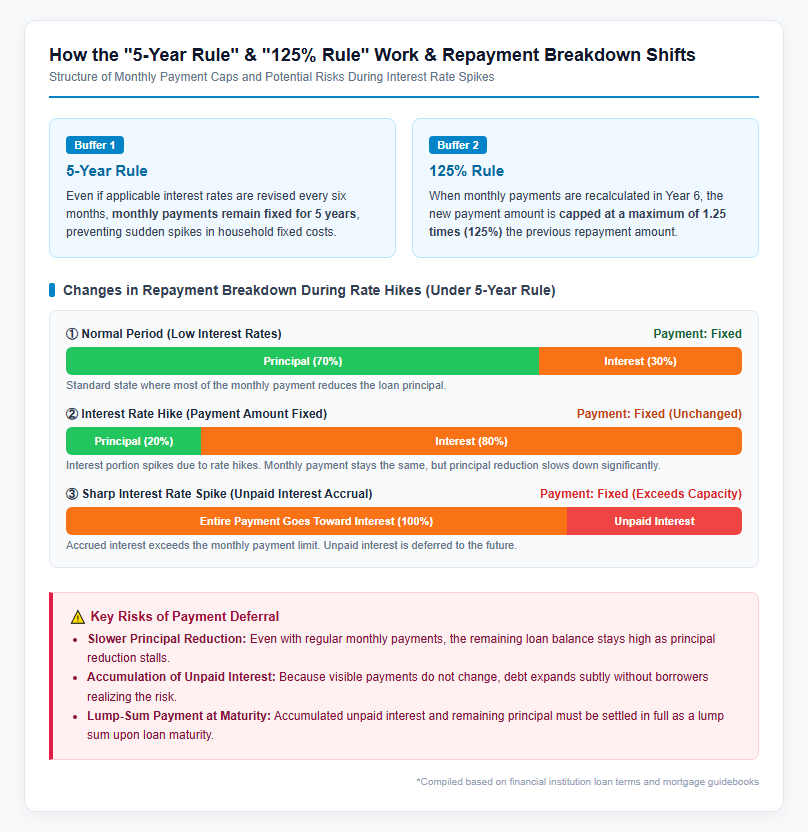
Many floating-rate mortgages incorporate the “5-Year Rule” and the “125% Rule” as protective buffers to shield households from abrupt payment surges when interest rates rise sharply. Under the 5-Year Rule, monthly repayment amounts remain fixed for five years regardless of benchmark rate increases. Meanwhile, the 125% Rule caps any new monthly payment amount at a maximum of 1.25 times the previous payment when revisions occur every five years.
Crucially, these rules do not waive interest obligations; they merely defer payments into the future. Even while monthly payment amounts remain capped, internal interest calculations continuously apply the new, higher rates.
Key implications for monthly repayments include:
– A larger portion of each payment goes toward interest, slowing the reduction of principal.
– If interest rates rise drastically, monthly payments may fail to cover accruing interest, resulting in unpaid interest.
– Accumulated unpaid interest and remaining principal must be settled in full as a lump-sum payment at the final maturity date.
Please refer to the diagram below.
While these safeguards prevent immediate household insolvencies, borrowers must fully understand the underlying risk of accumulating substantial long-term debt burdens.
Intergenerational Divide: Heavier Mortgage Burdens for the Young vs. Asset Effects for Seniors
Rising interest rates affect households differently depending on age and life stage. According to estimates by Mizuho Research & Technologies, the BOJ’s rate hike generates a net positive financial impact of approximately 400 billion yen annually for households nationwide. However, the distribution of this benefit reveals a stark generational divide.
Younger households, which tend to hold substantial new or growing mortgage debt, bear a direct financial blow. Households headed by individuals under 29 face an average annual interest burden increase of 22,000 yen, while those in their 30s face an increase of 23,000 yen per year. For families simultaneously managing education expenses and eldercare costs, higher fixed housing payments necessitate tighter consumer spending.
Conversely, elderly households holding significant financial assets and bank deposits (excluding equities) benefit from rising rates:
– Households in their 60s: Average net annual gain of 20,000 yen due to increased interest income.
– Households aged 70 and older: Average net annual gain of 21,000 yen due to increased interest income.
While seniors enjoy asset effects after decades of ultra-low deposit yields, the disproportionate burden placed on younger, working-generation families presents a growing societal challenge.
Corporate Resilience to Rate Hikes and Economic Outlook
Rising Borrowing Costs for Businesses and Varying Sectoral Impacts
The transition to a world with positive interest rates represents a critical juncture for corporate borrowing and financial management. A survey by Teikoku Databank reveals that if corporate borrowing rates (interest on interest-bearing debt) rise by 0.25 percentage points, annual interest expenses for roughly 100,000 analyzed firms nationwide will increase by an average of 640,000 yen per company.
This additional interest expense reduces ordinary profit by an average of 2.0%, potentially pushing approximately 1,700 companies (1.6% of those surveyed) into net ordinary losses. If borrowing rates were to rise by 1.0 percentage point, annual interest costs would increase by 1.28 million yen per firm, expanding the proportion of newly unprofitable businesses to 3.3%.
Impact severity varies significantly across industries:
– Real Estate: High reliance on debt financing leads to an average interest cost increase of 2.76 million yen per firm under a 0.25% rate hike, depressing ordinary profit by 5.1%.
– Construction: Comparatively minor impact, with ordinary profit declining by just 1.3% under a 0.25% rate hike.
Nevertheless, analysis by Mitsubishi UFJ Research and Consulting indicates that Japanese companies overall possess reasonable resilience against rate hikes, supported by improved equity ratios, ample cash reserves, and enhanced price-pass-through capabilities amidst ongoing inflation.
Monetary Policy Outlook and Key Economic Indicators to Watch
Looking ahead, market participants and private-sector economists increasingly expect the BOJ to pursue further gradual rate hikes. The baseline scenario projects the policy rate reaching 1.5% in December 2026, followed by a potential move toward a neutral rate of around 2.0% during 2027.
Crucial indicators and milestones to monitor include:
– Trends in yen exchange rates and crude oil prices, alongside potential upside pressures on Consumer Price Index (CPI) metrics.
– Securing sustainable wage growth during the 2027 Shunto negotiations and tracking broader consumer spending patterns.
– Shifts in the BOJ Policy Board composition when hawkish members complete their terms in July 2027.
Please refer to the diagram below.
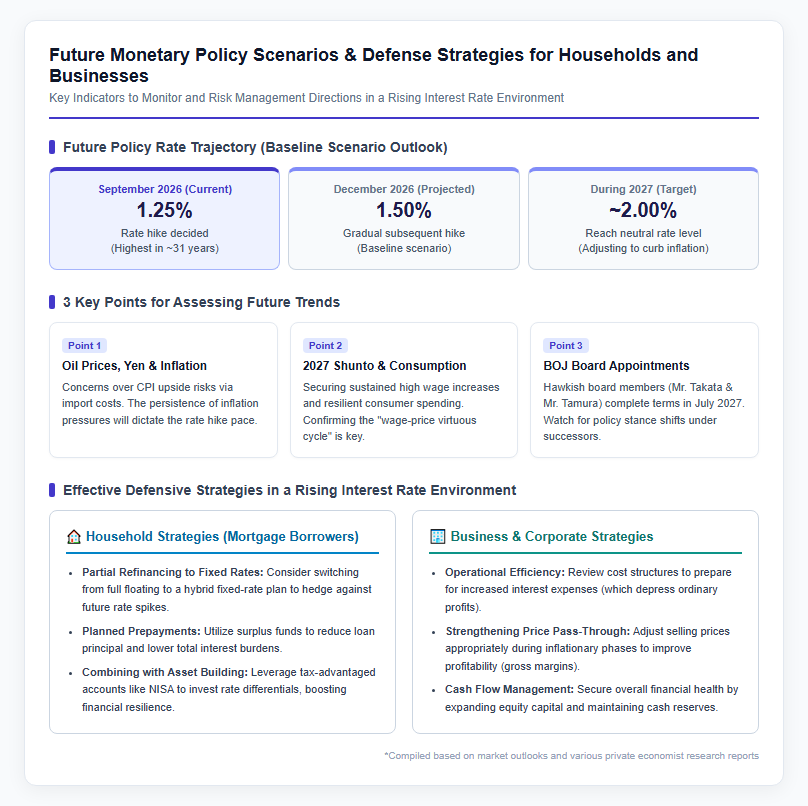
For mortgage holders, effective defensive strategies include partial refinancing into fixed-rate loans, planned prepayments, and combining debt management with asset building via tax-advantaged accounts like NISA. For businesses, enhancing operational efficiency and strengthening pricing power remain essential. In an environment of rising interest rates, rigorous risk management across both households and corporations will determine long-term financial resilience.
Reference Pages
- [Mizuho Research & Technologies] Impact of the September Rate Hike on Households and Corporations https://www.mizuhobank.co.jp/corporate/mhri/research/report/pdf/express-jp260910.pdf
- [Teikoku Databank, Ltd.] Survey on the Impact of the BOJ’s Additional Rate Hike on Corporations (December 2025) https://www.tdb.co.jp/report/industry/20251219-increase25y/
- [SBI Shinsei Bank, Limited] What are the 5-Year and 125% Rules for Floating-Rate Mortgages? https://www.sbishinseibank.co.jp/retail/housing/column/vol72.html
【#BankOfJapan #PolicyRate #Mortgage #FloatingRate #InterestRateHike #CorporateManagement #HouseholdImpact #EconomicNews】

コメント