On July 17, 2026, the European Commission presented new policy guidelines to strengthen the competitiveness of the EU banking sector and deepen the single market. This policy aims to build a strong banking sector that supports the growth and strategic autonomy of the European economy through regulatory simplification and market fragmentation.
- Policy Background and Three Major Challenges
- Simplified regulations and reduced administrative burdens
- Implementation of International Standards and EU-Specific Particularities
- Market fragmentation and domestic border barriers
- Profitability and Market Cap Gap with the United States
- Completion of the Banking Union and the Deposit Insurance System
- 2027 legislative package and implementation schedule
- Cultural Transformation and Digitalization in the Banking Sector
Policy Background and Three Major Challenges
On July 17, 2026, the European Commission adopted a “Communication (Policy Document)” on the competitiveness of the EU banking sector and the single market. This policy forms a pillar of the “Savings and Investment Alliance (SIU)” strategy announced in 2025, aiming to enhance funding capacity for strategic priorities such as innovation, clean transition, and defense. The European Commission analyzes that the current banking sector faces three major challenges in effectively supporting the EU economy. The first challenge is that markets are excessively fragmented along domestic borders, hindering economies of scale and efficient resource utilization. Second, there is a lack of consideration for the EU’s unique particularities and proportionality in introducing international regulatory standards. Third, there was an awareness that the regulatory framework itself is excessively complex and burdensome, and that simplification is necessary. European Commission President Ursula von der Leyen stated that facilitating capital flows is essential for Europe’s growth, and that it is time to readjust the approach to risk while maintaining financial stability.
Simplified regulations and reduced administrative burdens
One of the central pillars of this policy is to eliminate regulatory complexity for banks and reduce administrative costs. The annual cost of reporting for EU banks is estimated to reach about 11.2 billion euros, and this burden is a factor undermining competitiveness. As a concrete measure, the European Commission proposes increasing transparency in the design and operation of “Pillar 2” (additional capital requirements per individual bank), and proposing more targeted application. Additionally, the policy is to streamline and reduce the types of capital buffers related to macroprudential (stability of the entire financial system), and improve design and calibration to ensure consistency across the entire framework. Please refer to the diagram below.
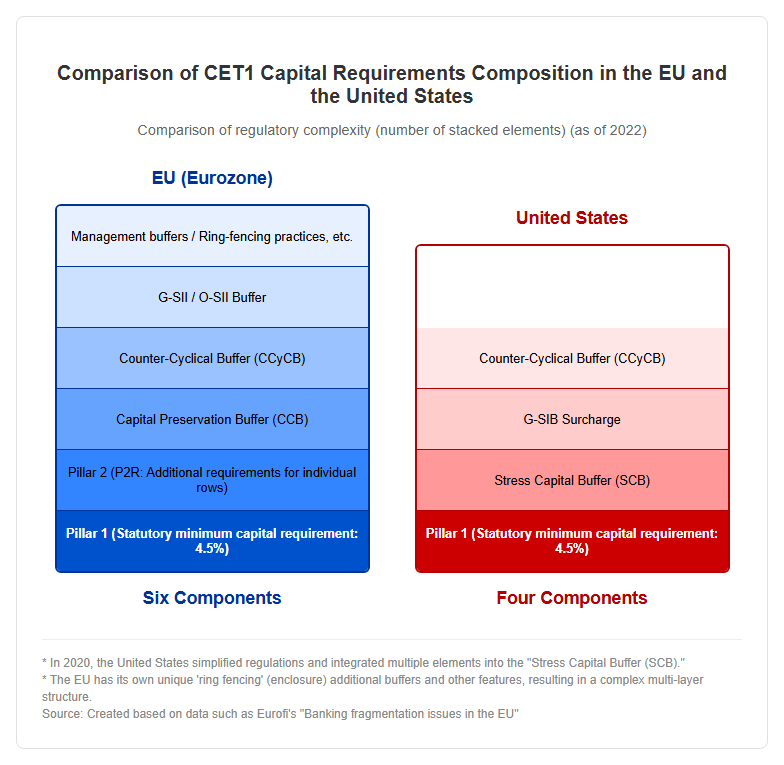
Furthermore, organizations such as the European Banking Federation (EBF) have criticized the current situation of banks operating with concerns about further regulatory hikes, calling it “unsustainable” and strongly calling for the elimination of overlapping regulations. Strengthening the authority of the European Banking Authority (EBA) is also being considered to further simplify and automate reporting operations and ensure proportionality at the technical level.
Implementation of International Standards and EU-Specific Particularities
While the EU maintains compliance with international standards set by the Basel Committee on Banking Supervision, it aims for flexible application tailored to the actual conditions of the EU banking sector. Unlike other countries, the EU applied international standards not only to large international banks but to all about 4,500 banks, resulting in a disproportionate burden on small and medium-sized banks. The new policy aims to reassess whether international standards limit the lending capacity of EU banks. Specifically, clear proposals will be made regarding the transition measures for the “output floor” for lending to unrated companies and mortgages, and the impact these will have on banks’ competitiveness. Regulatory treatment of infrastructure projects, specialized lending for energy transition, and trade finance will also be evaluated from the perspective of supporting European companies and strengthening supply chain security. Furthermore, research into soundness regulations on investment in software assets is underway, aiming to build incentive structures that encourage investment in digital transformation and cyber resilience.
Industry Structure and Barriers to Integration
Market fragmentation and domestic border barriers
The EU banking market remains fragmented at the national level, which is the biggest barrier to banks scaling up and improving efficiency. Even now, with the establishment of banking alliances, cross-border corporate lending within the region accounts for only about 16% of all corporate loans. A main cause of this fragmentation is identified as the practice of “ring fencing” practiced by member states to protect their own capital and liquidity. European central banks and regulators estimate that removing these domestic border constraints could unlock about €230 billion in high-quality liquid assets. The European Commission plans to propose measures to make capital and liquidity allocation more efficient within cross-border groups, aiming to strengthen supervisory authority so that parent companies can allocate resources to subsidiaries in a timely manner, including during crises. However, this requires proper safeguards for depositor protection and financial stability, with trust-building among member states being key.
Profitability and Market Cap Gap with the United States
The European banking sector lags significantly behind its U.S. competitors in both profitability and market capitalization. According to data from January 2023, the top five banks in the US hold about 40% of the domestic market, while the top five banks in the EU hold only 20% of the market share within the Eurozone, highlighting the market’s congestion. Regarding profitability indicators, the return on equity (RoE) ratio is also showing improvement for EU banks, reaching about 10% by 2025, but still not matching that of the U.S. market. Please refer to the comparison chart below.
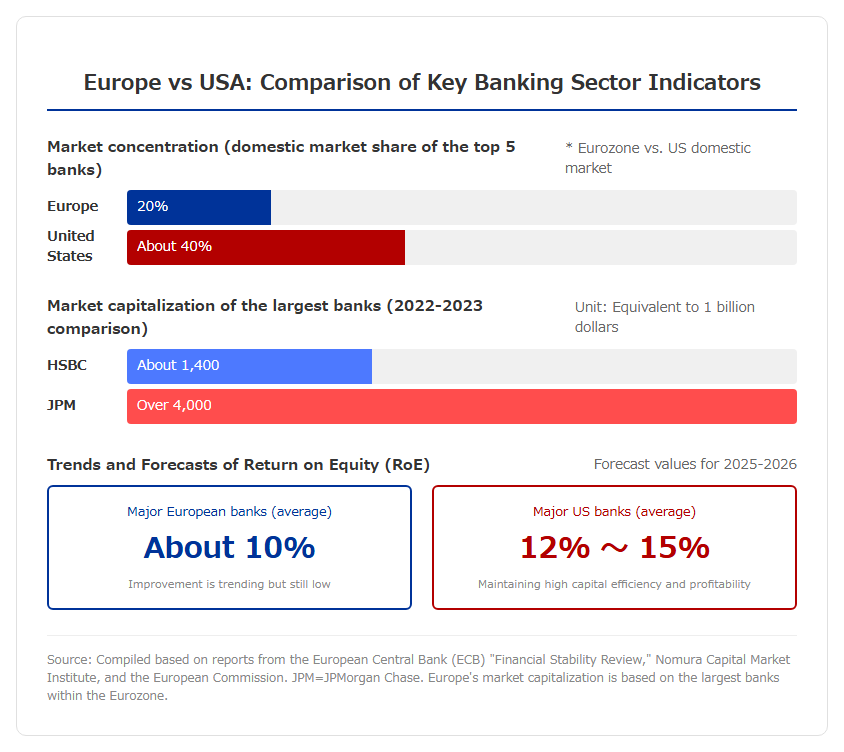
Behind this disparity lie structural issues such as the underdeveloped securitization market in Europe and excessive reliance on bank lending. While the U.S. securitization market accounts for about 18% of GDP, Europe’s is only about 1%. Furthermore, in Europe, bank mergers and acquisitions (M&A) are heavily concentrated in domestic deals, and the lack of cross-border restructuring is hindering the emergence of internationally competitive “megabanks.” This situation threatens Europe’s “strategic autonomy” and increases the risk that major financial services within the region will depend on foreign investment banks such as those affiliated with the U.S.
Completion of the Banking Union and the Deposit Insurance System
The European Commission has repeatedly emphasized that completing the banking union is essential for strengthening competitiveness. In particular, new proposals are planned to be made toward the long-standing issue of establishing the European Deposit Insurance System (EDIS). The new proposal aims to strengthen deposit protection, reflecting regulatory and institutional progress over the past decade, regardless of whether banks are resolved or subject to domestic bankruptcy proceedings. The incompleteness of the banking alliance has fostered mutual distrust among member states, creating a vicious cycle that leads to the continuation of ring fencing practices. Additionally, the framework for crisis management and deposit insurance (CMDI) is being reviewed to enable small and medium-sized banks to utilize domestic deposit insurance funds more flexibly and effectively when facing management crises. Once the banking alliance is completed and a common safety net is established, banks will be able to provide services more smoothly across the entire single market, achieving both optimal resource allocation and the strengthening of the financial system simultaneously.
Future Outlook and Key Points
2027 legislative package and implementation schedule
The European Commission plans to propose a large-scale legislative package in the first quarter of 2027 to translate the policy guidelines presented this time into specific regulations. This schedule aligns with the goals of the “One Europe, One Market” roadmap and presents an opportunity to fundamentally revise the banking regulatory framework. In the coming months, the European Commission will continue to solicit input from stakeholders and conduct detailed impact assessments on regulatory simplification and realignment of capital requirements. Meanwhile, the European Commission is urging member states, supervisory authorities, and the banking sector to continue their own efforts without waiting for the legislation to be completed. This includes strengthening “enforcement” to ensure strict compliance with existing EU laws and eliminate unjust interventions that hinder the free movement of capital.
Cultural Transformation and Digitalization in the Banking Sector
Strengthening competitiveness requires not just rule changes, but a “cultural shift” for all stakeholders. Supervisory authorities are required to shift from a strict focus on compliance to a “risk-based approach” focused on material and substantial risks. At the same time, it has been pointed out that banks themselves need to change their stance of demanding excessive guidance to completely eliminate legal ambiguity and adopt a responsible attitude in applying the law based on their own judgment. Moreover, digitalization and the use of artificial intelligence (AI) have the potential to transform the competitive landscape. While the tokenization of digital assets and advances in open banking present opportunities for new business models, ensuring cyber resilience has become a more important macroprudential priority than ever. Whether European banks can adapt to these changes and achieve efficient capital allocation will determine the fate of the European economy in the coming years.
[#EU #銀行規制 #金融市場 #欧州委員会 #経済政策 #銀行同盟 #競争力強化 #経済ニュース]


コメント