A paper from NTT Social Information Research Institute was selected for the challenging international conference FAccT 2026, which addresses fairness, accountability, and transparency in AI. This study, which analyzes the impact of underlying stereotypes in decision-making in large language models (LLMs), marks an important step toward the safe social implementation of AI. ,
- Paper acceptance for challenging conferences and the academic value of research
- Identifying new ethical risks arising from the spread of LLMs
- Limitations of Traditional Measures Based on ‘Information Deletion’
- Reproduction of Historical Discrimination and Discovery of New Forms of Discrimination
- Ethical Practices Based on the NTT Group AI Charter
- Incorporating expertise into our in-house developed LLM “tsuzumi”
- Contributing to sustainable research and development and global rulemaking
- Maximizing Well-being through Social Implementation
Paper acceptance for challenging conferences and the academic value of research
From June 25 to June 28, 2026, the prestigious international conference on AI equity, accountability, and transparency, “The 2026 ACM Conference on Fairness, Accountability, and Transparency (FAccT 2026),” was held in Montreal, Canada. This conference is known as a challenging interdisciplinary field, with a total of 985 papers submitted from around the world in 2026. After rigorous peer review, 325 papers were accepted, resulting in a narrow acceptance rate of about 33 percent.
Overcoming this challenge and having a paper from the NTT Social Information Research Institute accepted is a first for the NTT Group. , The accepted paper is titled “Does It Lead to Prejudice or Discrimination?” An Assessment of Stereotypes in LLM Decision-Making,” written by Tatsuhiro Aoshima and Mitsuaki Akiyama (Senior Research Fellow), among others. , As large language models (LLMs) rapidly permeate society and begin to have a significant impact on people’s thinking and judgment, the academic value of this research in analyzing the biases and discrimination contained in their outputs is extremely high. NTT has had numerous papers accepted at challenging conferences in the field of deep learning, such as the ICLR, but its acceptance at this conference, which specializes in AI ethics, demonstrates that its research and development have reached a new level not only in improving technical accuracy but also in ensuring social fairness.
Identifying new ethical risks arising from the spread of LLMs
With the emergence of generative AI (GenAI), represented by ChatGPT, the convenience of our daily lives and work has dramatically improved. However, on the other hand, there has always been a risk that AI-generated responses may contain biases or stereotypes against certain attributes. NTT has long prioritized this issue and has expressed concerns about AI’s behavior leading to unintended discrimination and unfair behavioral restrictions.
The theme addressed in this accepted paper is precisely the risks hidden deep within this “AI-driven decision-making.” As AI becomes the infrastructure supporting people’s lives, fair judgment becomes an absolute requirement for earning social trust. , Please refer to the diagram below.
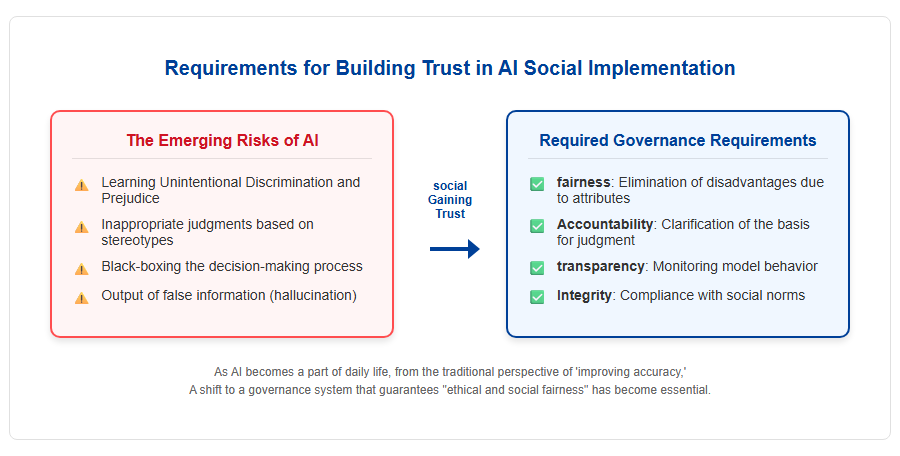
Through its research, NTT has clarified that the measures AI developers have implemented with good intentions are not sufficient. Specifically, simply removing sensitive information such as race and gender from training data cannot completely eliminate the influence of stereotypes on LLM decision-making. This discovery holds the potential to redefine the guidelines for improving safety in future AI development. This research goes beyond merely solving technical challenges, presenting the theoretical basis for AI to be a member of society who is both “integrity” and “trustworthy.” ,
Research Methodology and Analysis Results: The Impact of Stereotypes
Limitations of Traditional Measures Based on ‘Information Deletion’
Until now, in AI development, a common method to prevent discrimination has been to remove information about specific personal attributes such as race, gender, and nationality from instructions or questions given to AI, or to avoid considering these factors. This is based on the naive premise that physically removing unjust elements from the materials underlying judgment will also make the resulting answer fair.
However, after NTT’s research team conducted detailed response analyses using multiple LLMs, they revealed that this method has clear limitations. , AI indirectly infers stereotypes from context and related keywords without explicit attribute information, and reflects them in decision-making. In other words, measures that merely filter superficial information are not sufficient solutions to realize trustworthy AI. Please refer to the diagram below.
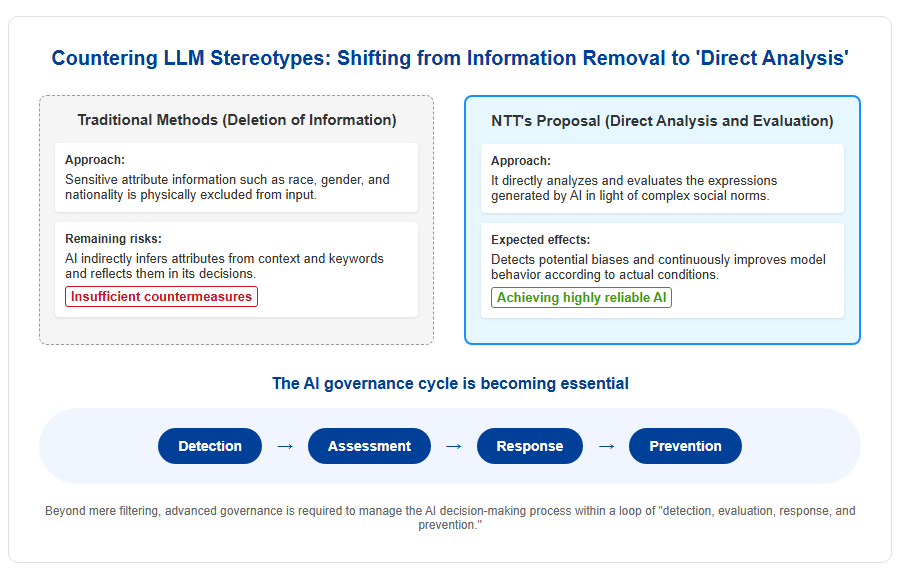
The study concluded that it is essential to directly analyze and evaluate expressions that lead to bias and discrimination contained in responses, and to continuously improve them. This reaffirms the importance of the “detection, evaluation, response, and prevention” cycle in AI governance, and has significantly shifted the priority of technology development. AI providers are required to have advanced governance capabilities to monitor model behavior more deeply and adjust outputs against complex social norms. ,
Reproduction of Historical Discrimination and Discovery of New Forms of Discrimination
A notable aspect of this study is that, in addition to the typical discrimination already highlighted by current laws and existing research, it has identified ‘new issues to watch for’ unique to LLMs. The analysis revealed that LLM responses tended to distort specific discussions by bringing historical discrimination into context excessively. This contrasts with the attitude of not forgetting past pain, and suggests the risk of reproducing past conflicts in ways that do not fit the current context.
An even more serious finding was that expressions that could be interpreted as “refraining from speaking” were generated for people who had not previously been clearly defined as targets of discrimination, based on race, gender, and other reasons. This highlighted the paradoxical disadvantage of AI algorithms that overreact in an effort to ensure fairness, unfairly restricting the freedom of expression and participation opportunities of people with certain attributes. These events mean that AI is not just repeating old biases, but can also create new forms of social distortion through its own logic. NTT Social Information Research Institute aims to further develop research starting from these complex phenomena and contribute to the implementation of a safe and secure society.
NTT’s AI Strategy and Governance Implementation
Ethical Practices Based on the NTT Group AI Charter
Looking ahead to a future where AI deeply permeates human society, the NTT Group has established the “NTT Group AI Charter” as a fundamental principle that all employees must always keep in mind. This charter upholds values such as sustainable development, human leadership, fairness, safety, privacy, and co-creation with society. ,,, Please refer to the diagram below.
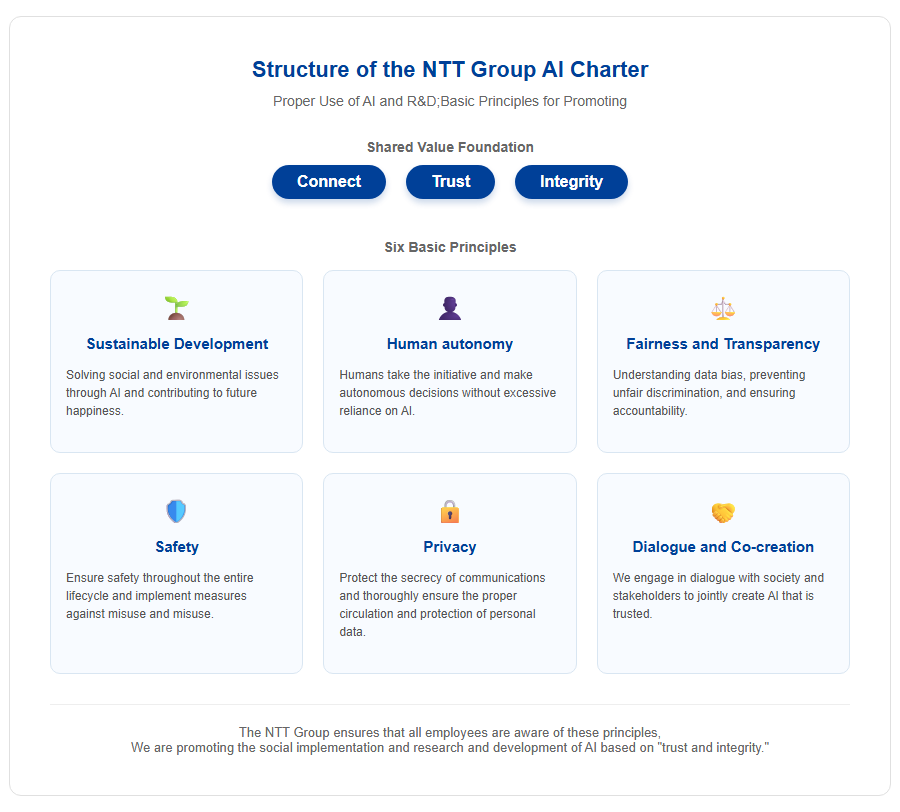
The acceptance of papers at FAccT 2026 can be said to embody the abstract ideals of “ensuring fairness” and “enhancing transparency” set forth in this charter, through concrete academic research. ,
To keep the charter as nothing more than a slogan, NTT has established an organized governance structure. , The holding company has a Co-CAIO (Co-Chief AI Officer) to ensure leadership in overseeing AI risk management across the entire group. Each unit has an AI risk management officer, and a system is in place to incorporate the latest insights, such as the results of this research, into practical work. NTT’s strategy is to advance both “proactive utilization” to pursue AI convenience and “thorough governance” to control risks. This balanced approach forms the foundation for this advanced ethical research and forms the foundation for AI development with the company’s advocated “Trust and Integrity.” ,
Incorporating expertise into our in-house developed LLM “tsuzumi”
In the social implementation of research results, NTT’s independently developed lightweight LLM “tsuzumi” plays a significant role. , while models like GPT-4, which require massive computational resources, tsuzumi significantly reduces the number of parameters while achieving high Japanese performance and flexible customization. This feature of being “lightweight and flexible” also brings significant benefits from the perspective of AI governance. ,
When training as a “specialized LLM” tailored to specific industries or companies, applying the stereotype analysis methods obtained in this study makes it possible to build models that generate more transparent and secure responses. , Please refer to the diagram below.
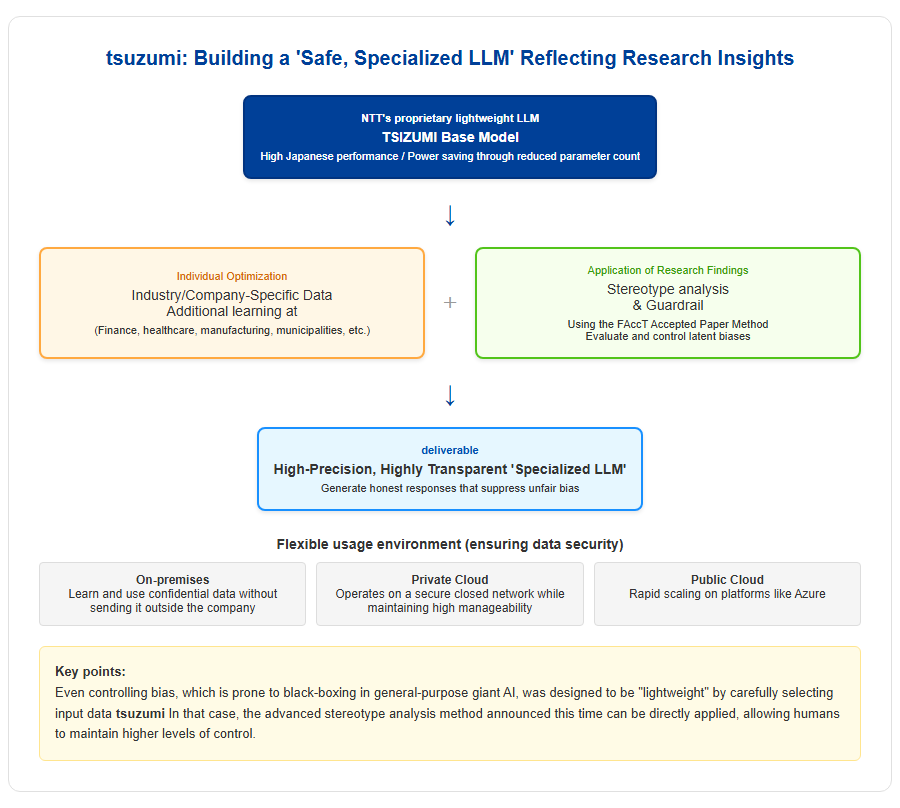
Even the control of bias, which tends to turn into a black box in general-purpose giant AI, can be controlled by models like tsuzumi, which can carefully select input data, allowing humans to maintain higher control. Such research insights are also utilized in NTT Data’s “AI Governance Consulting Service.” , Through specialized support from the AI Red Team, we identify risks unique to Japanese and ethical issues specific to each business, and by implementing guardrails, we provide client companies with an environment where they can safely adopt AI. ,,
Future Developments: Co-creation of a Safe and Secure AI Society
Contributing to sustainable research and development and global rulemaking
NTT Social Information Research Institute plans to further accelerate research and development toward AI bias assessment and improvement, starting from the achievements of FAccT 2026. Since scientific progress cannot be achieved by the efforts of a single company alone, the company is strengthening its collaboration with world-class research institutions. For example, in partnership with the Harvard University Brain Science Center in the United States, it supports a new field called “Physics of Intelligence,” which integrates computer science, neuroscience, and psychology, working to uncover the fundamental mechanisms of intelligence.
Alongside technological development, it also plays a leading role in shaping international rules. NTT has emerged as one of the world’s first test sites in the monitoring mechanism for the “Hiroshima AI Process Code of Conduct” approved by the G7 countries, contributing to the creation of an international framework to promote the safe and reliable use of generative AI. Please refer to the diagram below.
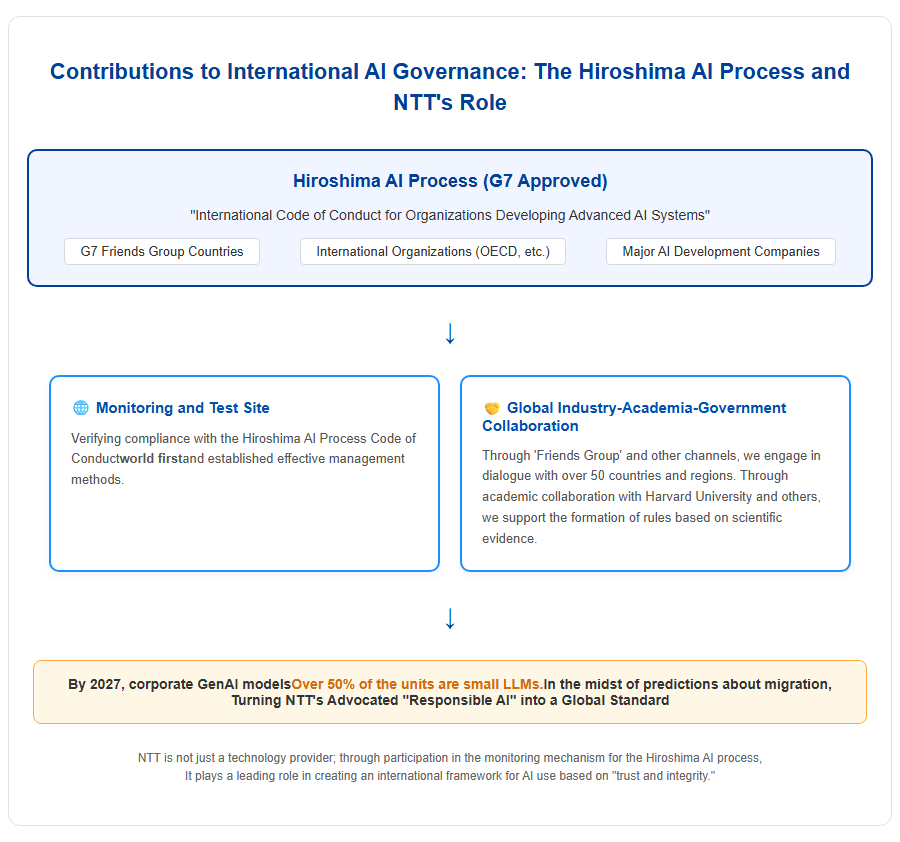
With more than half of the generative AI models used in companies expected to be small LLMs by fiscal year 2027, NTT’s proposed “responsible AI” model has the potential to become the global standard. By publishing its research findings and continuing to engage in international debates, the company aims to establish itself as a player supporting the ethical foundation of AI society, beyond being a mere technology vendor. ,
Maximizing Well-being through Social Implementation
NTT’s ultimate goal is to maximize people’s “well-being” through AI technology. This means not simply pursuing efficiency, but realizing a “paraconsistent” society where AI embraces diverse values and everyone can confidently enjoy the benefits of technology. The research results on stereotype analysis this time will serve as a key piece for respecting human rights in the digital space and realizing inclusive services where no one is left behind. ,
Going forward, AI agents like tsuzumi are expected to play an active role in all public and industrial sectors, including education, healthcare, transportation, and municipalities. , Please refer to the diagram below.
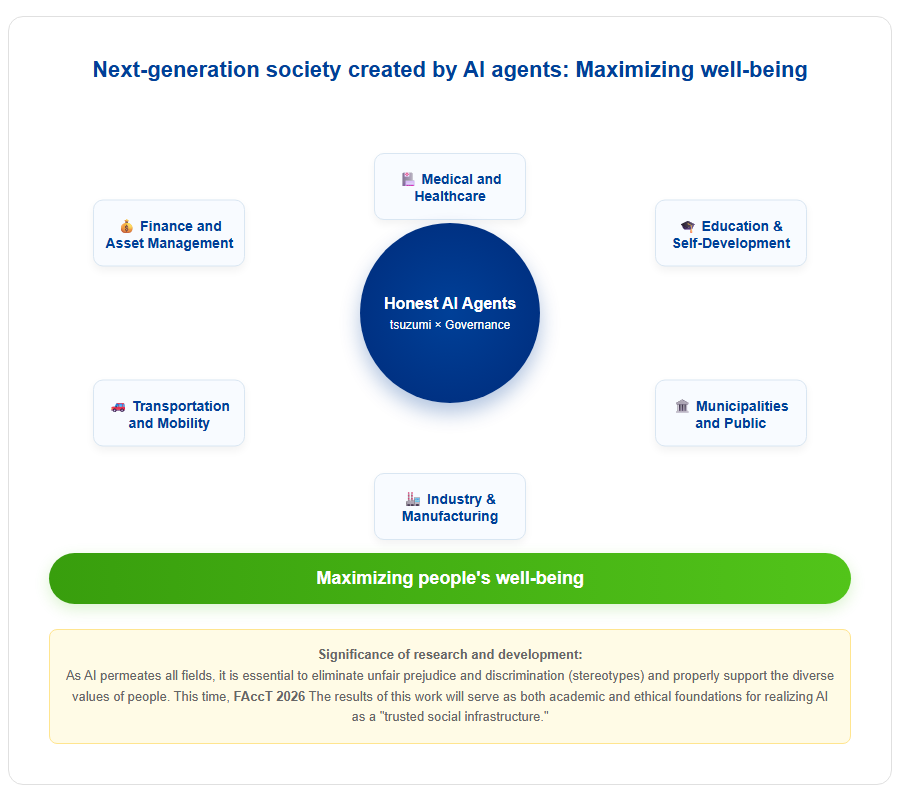
Whether AI can properly support people’s judgments without spreading unjust biases depends on the steady and advanced accumulation of research like this one. The NTT Group aims to co-create a sustainable AI society that expands human potential while minimizing environmental impact by combining low-power infrastructure powered by IOWN (Innovative Optical Network) with sincere AI governance. The company’s mission is to continue responding to a society that welcomes the future brought by AI evolution with both anticipation and anxiety, with solid research results and transparent governance. ,
Reference Page
-
[NTT’s first paper accepted at FAccT 2026, a challenging international conference on AI fairness, accountability, and transparency https://group.ntt/jp/topics/2026/07/23/facct2026.html
-
[NTT Group AI Charter]https://group.ntt/jp/group/ai/charter.html
[#AI倫理 #NTT #大規模言語モデル #公平性 #AIガバナンス #FAccT2026 #テクノロジー #サイエンス]

コメント