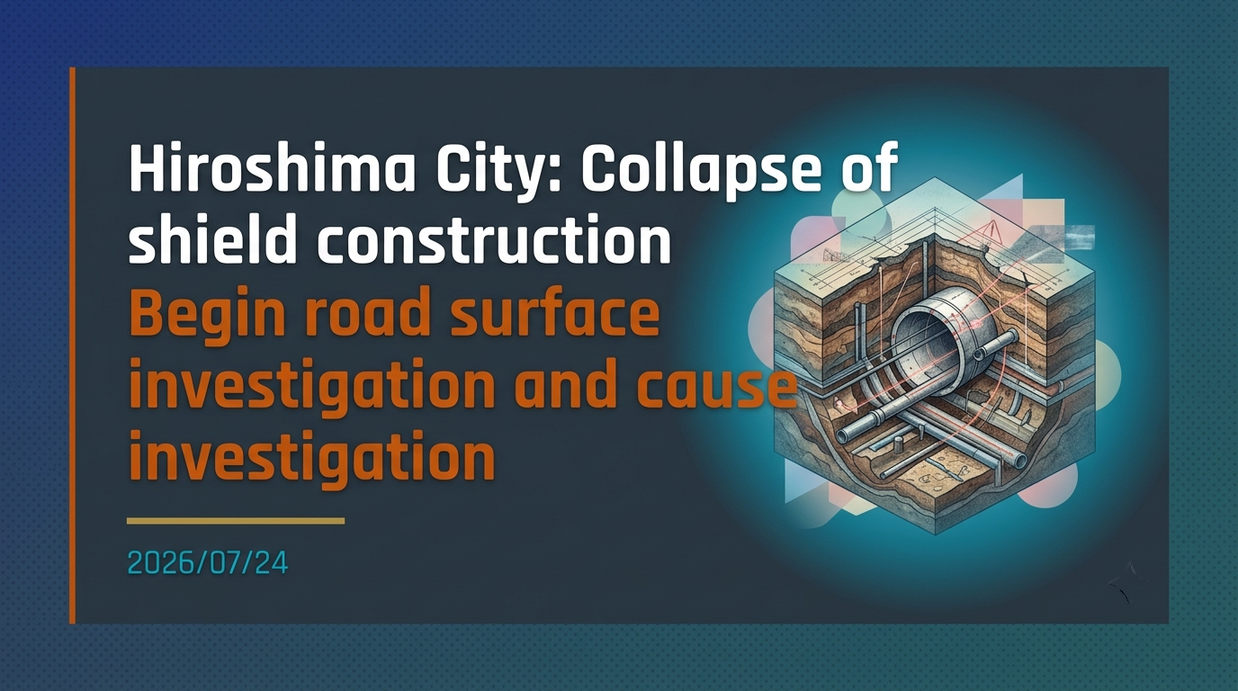
As nearly two years pass since the large-scale road subsidence accident that occurred in Nishi Ward, Hiroshima City, preparations are in full swing for investigating the inside of the shield machine, which directly triggered the accident. This accident once again highlights the risks of large-diameter shielding work in urban areas and the impact of prolonged recovery and investigation processes on local communities.
- Background of Occurrence and Abnormal Situation Inside the Shield Aircraft
- Scale of subsidence and severe impact on surrounding infrastructure
- Damage to 19 buildings and evacuation measures
- Preliminary assessment of extremely hazardous terrain
- Estimation of the subsidence mechanism due to aquifer breach
- Limitations of shielding work in urban areas
- A two-year preparation process for the internal machine inspection
- Additional costs and costs exceeding 8 billion yen
- Continued Compensation and Support for Disaster-Affected Residents
- Key Points of the Internal Investigation Starting January 2027
- The Path to Restoring Trust in Urban Underground Construction
Background of Occurrence and Abnormal Situation Inside the Shield Aircraft
At around 8:45 a.m. on September 26, 2024, an abnormality occurred during the construction of the ‘Kannon District Sewerage Construction No. 3-1 Project’ near Fukushima-cho 2-chome, Nishi Ward, Hiroshima City, to install rainwater pipes. The incident began when a sudden abnormal water outflow was confirmed inside a 5,000mm inner diameter shield machine that was being excavated about 30 meters underground. Just minutes after this flooding, the ground road directly above the machine suddenly collapsed, creating a shocking scene of a massive amount of water overflowing onto the road. According to surveillance footage from the time, the water was likely near the shield aircraft’s chamber, but such abnormal water from inside the aircraft during excavation had never occurred before, and technically, it was considered unthinkable. Please refer to the location map below.
Scale of subsidence and severe impact on surrounding infrastructure
The scale of subsidence on the surface ranged from about 40 meters east-west to 30 meters north-south, with a maximum depth of about 2 meters. This large-scale ground deformation dealt a devastating blow to the surrounding living infrastructure. Specifically, in addition to damage to sewer pipes, water pipes, and gas pipes, electrical wires, communication cables, and even traffic signals were also damaged. In particular, for the sewer system, major existing main lines with inner diameters of 2,000mm, 1,800mm, and 900mm were damaged, and it took a year until the restoration work was completed in September 2025. Furthermore, immediately after the accident, widespread water outages, leaks, and gas supply stoppages occurred, instantly destroying the foundation that supports the daily lives of local residents.
Damage to 19 buildings and evacuation measures
Within a restricted area within a 50-meter radius of the collapse site, extensive physical damage was also suffered by surrounding buildings. According to a hazard assessment survey conducted by Hiroshima City, damage was confirmed in a total of 19 buildings, of which 9 were classified as ‘dangerous’ and 3 as ‘caution’. Among these are two municipal housing buildings, and ultimately, 11 buildings were forced to undergo demolition, with demolition completed by July 2025. Although there were no human casualties, it developed into an extremely serious social problem, with 86 residents from 46 households forced to temporarily evacuate. Even one year after the outbreak, many households continue living in temporary housing, making the journey to regain their daily routines difficult.
Challenges in preliminary geological risk assessment and construction management
Preliminary assessment of extremely hazardous terrain
One of the major focuses that emerged after the accident was the handling of geological survey results before construction began. In the soil survey report from May 2021, it was evaluated that the “alluvial sand and gravel layer” about 30 meters underground, where the shield machine excavates, contains few fine particles that provide adhesive strength to the soil and is prone to collapse due to high groundwater pressure. Although the report strongly warned that “it is necessary to recognize the extremely dangerous terrain,” this specific wording was not explicitly stated in the first explanatory materials of the accident investigation committee, prior resident briefings, or the council meeting. Hiroshima City explained that while numerical data was provided, verbal findings were briefly omitted during the process, leaving issues regarding how information is shared.
Estimation of the subsidence mechanism due to aquifer breach
Regarding the mechanism of the accident, it is believed that the presence of an underground aquifer is deeply involved. It has been suggested that sufficient boring surveys may have not been conducted in advance at the sinkhole site, and it is believed that the shield machine unintentionally broke through the aquifer, causing high-pressure groundwater to gush into the cabin. The water eruption rapidly dragged surrounding earth and sand toward the machine, creating a huge underground cavity that led to surface subsidence within just a few minutes. Thus, the combination of the sealed shield method’s characteristics and complex geological conditions, which makes it difficult to detect invisible changes underground early on, has been analyzed as a factor in the accident.
Limitations of shielding work in urban areas
This accident once again exposed the difficulty of utilizing underground spaces in overcrowded large cities. Under major roads, water and sewage systems, gas, and subways are congested, so from the perspective of securing land, excavation must proceed with deeper, longer, and larger cross-sections under strict construction constraints. Shield work is heavily influenced by “experiential engineering,” and when unexpected ground changes or abnormal water outflow like this occur, it is extremely difficult for even skilled technicians to respond quickly without being able to visually inspect the condition of the face face. In the construction industry, which struggles with labor shortages, maintaining advanced multifaceted construction management and ensuring residents’ peace of mind is a shared sense of crisis across the entire industry.
The Process Toward the Investigation and the Mounting Financial Burden
A two-year preparation process for the internal machine inspection
Direct investigation of the shield machine is an essential step in ultimately identifying the cause of the accident and formulating recurrence prevention measures for reopening. However, entering a plane filled with water and sediment requires an extremely careful and lengthy preparation period. As a specific step, it is necessary to solidify the ground around the site and complete water-blocking measures through the installation of frozen pipes and the frozen soil development work that began in October 2025. After these water-stop measures were completed, water drainage and soil removal inside the machine finally began in September 2026, and the actual internal investigation is expected to begin in January 2027, about two years and four months after the accident. The fact that it takes such a long time to determine the cause of an accident has become a new lesson in the safety assessment of public works.
Additional costs and costs exceeding 8 billion yen
The financial impact of the accident is extremely significant, and Hiroshima City expects at least 8 billion yen (some sources say 8.2 billion yen) in additional costs in addition to the initial construction cost of about 19.4 billion yen. The breakdown of this enormous cost includes about 4 billion yen for backfilling subsidence and countermeasures for subsidence in subsidence areas, about 1.2 billion yen for compensation to affected residents and businesses, and about 3 billion yen for internal investigations of shielding machines. In particular, regarding the contract amendment related to the internal investigation of the shield machine, not only was the investigation fee increased, but the construction period was also extended by three years. The final share of these enormous costs will be discussed with the contractor (JV) after further investigation into the causes, but indirect impacts on the city’s finances and citizens’ lives are unavoidable. Please refer to the diagram below.
Continued Compensation and Support for Disaster-Affected Residents
Hiroshima City and the contractor are working together to continue responding to the affected residents. Specific support measures include paying 100,000 yen per household in condolence money, assistance with rent, accommodation, and meals during evacuation, and individual negotiations regarding compensation for damaged buildings and business operations. As of April 2026, 26 households with 49 people are still living in temporary housing, and some households aim to repair damaged buildings and return home. The city has established a consultation desk to handle daily life concerns, but residents who continue to live while worried about ground subsidence are urgently hoping for a swift restoration of daily life.
Future Developments and Highlights
Key Points of the Internal Investigation Starting January 2027
The biggest point of interest going forward is the planned on-site inspection inside the shield machine, scheduled from around January 2027 (Reiwa 9). This investigation directly identified the specific damage to the machine’s cutter head and chamber, clarifying the mechanism behind the abnormal water flow and how soil and sand flowed into the cabin based on physical evidence. This result marks a crucial turning point that supports the presumed causes currently being discussed by experts or uncovers new factors. Until these survey results are finalized, the timing for resuming construction remains undecided, and citizens are closely watching the process to uncover the full truth.
The Path to Restoring Trust in Urban Underground Construction
This accident shook trust in the safety of similar underground construction projects underway not only in Hiroshima City but across Japan. The key points of discussion going forward are improving the transparency of geological risk information and strengthening monitoring systems using the latest technologies. Based on the guidelines for shield tunnel construction formulated by the Ministry of Land, Infrastructure, Transport and Tourism, the question is how effectively and effectively providing appropriate information to nearby residents is being conducted. This accident has once again highlighted the importance of dialogue on how society as a whole can tolerate and manage the risks associated with using uncertain underground spaces, not just aiming for technical solutions.
Reference Page
-
[Road Subsidence Accident Due to Sewerage Construction]https://www.city.hiroshima.lg.jp/living/suido-gesuido/1005966/1043539/1030467.html
-
[Report of the Review Committee on Road Subsidence at the Fukuoka Subway Nanakuma Line Extension Construction Site https://www.pwri.go.jp/jpn/kentou-iinkai/fukuoka-nanakumaline/fukuoka-nanakumaline_hokokusho.pdf
[#道路陥没 #広島市 #シールド工法 #下水道工事 #インフラ事故 #地質調査 #住民補償 #公共事業]


コメント