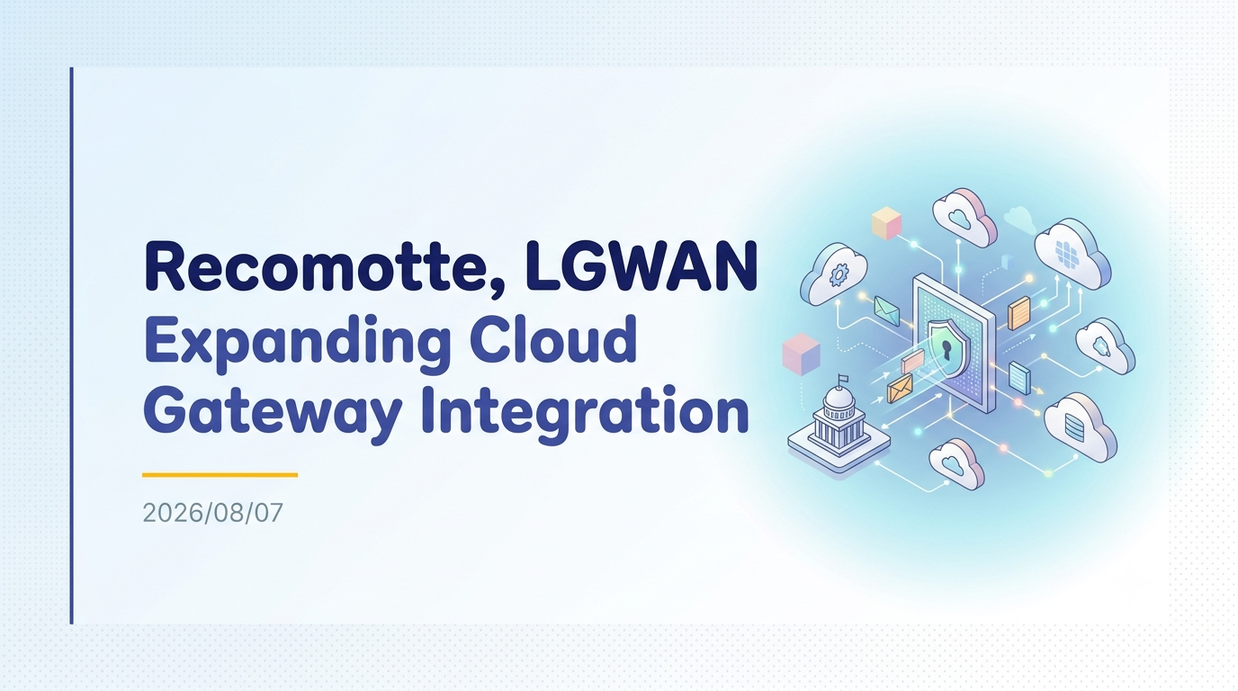
On August 4, 2026, Recomot Inc. in Japan announced the expansion of its moconavi LGWAN Cloud Gateway Service, which now supports a total of 102 different cloud services. This move comes as Japanese local governments seek to leverage versatile cloud applications while maintaining high levels of security within their dedicated network environments.
- Background of Service Expansion and Key Points
- Transition from Three-Tier Separation to the Alpha Dash Model
- File Sanitization and Sandbox Environment Construction
- Data-less Operation with the mocochro Secure Browser
- Adapting to Zero Trust Security Standards
- Achievements in Operational Efficiency from Case Studies
- Notable Trends for Digital Transformation Toward 2030
Background of Service Expansion and Key Points
Recomot Inc. announced on August 4, 2026, that it has added five new cloud services to its moconavi LGWAN Cloud Gateway Service. This expansion allows Japanese local government staff to safely access a total of 102 cloud-based applications directly from their secure network environments.
The Local Government Wide Area Network (LGWAN) is a dedicated Japanese administrative network physically separated from the internet to protect sensitive data like resident information and the My Number system. While LGWAN provides robust security, it traditionally prevents the direct use of popular Software as a Service (SaaS) tools such as Microsoft 365, kintone, or Garoon.
This expansion aims to support Japanese municipalities facing staff shortages and increasingly diverse administrative tasks by enabling them to use private-sector SaaS to improve efficiency without compromising security. Recomot CEO Tsuyoshi Togo has emphasized the company’s commitment to acting as a communication hub that utilizes technology to enhance social productivity in Japan. The following diagram illustrates the typical network connection image for Japanese municipalities.
Transition from Three-Tier Separation to the Alpha Dash Model
Following a major data breach in 2015, Japanese local governments adopted a Three-Tier Separation (Alpha Model) network architecture. This model strictly separates the My Number system, the LGWAN connection system, and the general internet connection system. While highly secure, this structure caused significant operational inefficiency as staff had to switch between different terminals for different tasks.
A 2023 survey by the Japanese Ministry of Internal Affairs and Communications (MIC) revealed that approximately 60 percent of prefectures and over 90 percent of municipalities still operate under this original Alpha Model. However, the push for Japanese local government Digital Transformation (DX), telework, and digital administrative procedures has increased interest in the Alpha Dash (α’) Model. This newer model allows direct access to specific cloud services from the LGWAN-connected system while maintaining the core principles of separation.
Recomot’s cloud gateway service is optimized for this Alpha Dash Model. It provides Japanese municipalities with a low-cost, rapid path to cloud utilization without requiring a complete and expensive overhaul of their existing network infrastructure.
Advanced Technology Supporting Secure Cloud Utilization
File Sanitization and Sandbox Environment Construction
When accessing cloud services from an LGWAN environment, the primary security risks in Japan involve external virus infections and unauthorized data extraction. Recomot addresses these threats through two key technologies: automatic sanitization and sandboxing.
First, an automatic sanitization process is executed whenever a file is downloaded from a cloud service. This process removes potentially malicious macros or converts files into safe formats like PDF, preventing harmful programs from entering the secure LGWAN environment. Furthermore, communications are strictly isolated to avoid any direct contact with the general internet system.
Second, the system creates a virtual, isolated area called a sandbox within the terminal. All data processed through moconavi is handled exclusively within this sandbox, ensuring that no data remains on the physical device or within the communication path. This data-less design philosophy means that even if a staff member’s device is lost or stolen, there is no risk of information leakage, making the adoption of Bring Your Own Device (BYOD) policies safe for Japanese administrative work.
Data-less Operation with the mocochro Secure Browser
The moconavi series features a high-performance secure browser called mocochro, which is built on the Chromium open-source codebase. This ensures that it provides a user experience similar to popular browsers like Google Chrome or Microsoft Edge, allowing Japanese local government staff to work without a steep learning curve. Despite its familiar interface, it integrates powerful security functions tailored for administrative tasks.
Key features of the mocochro browser include the following:
-
Watermark display: It displays the user’s name and other details on the screen to deter unauthorized data leaks through photography or screen captures.
-
Copy and paste control: It prevents the transfer of information from the secure environment to external applications.
-
Secure Office file editing: Staff can edit Office files within the sandbox and transfer the edited data directly back to cloud storage.
The growth from 77 compatible services in 2024 to over 100 in 2026 proves the high versatility of the API integration on this browser platform, allowing for the safe consolidation of diverse business applications. The operation screen of this browser is shown in the following figure.
Adapting to Zero Trust Security Standards
In recent years, the Japanese government and local authorities have moved toward a Zero Trust security framework. Unlike traditional perimeter-based security, Zero Trust assumes that internal networks are not inherently safe and requires constant verification of device security and user permissions. Japanese organizations like the Japan Local Government Data Systems (J-LIS) have indicated plans to eventually transition all municipality networks to a Zero Trust architecture.
The moconavi service plays a crucial role for Japanese municipalities in this transition period. It enables the identification of terminals and the termination of communication paths simply by installing an application, without the need for additional VPN hardware or terminal certificates. This significantly reduces the cost and administrative burden of implementation while meeting modern security standards.
Specifically, by combining Multi-Factor Authentication (MFA) with conditional access controls—such as IP address restrictions and time-based limits—the service achieves a balance between flexible working styles and ironclad security. This meets the ongoing need for enhanced security, which remains an area of stable demand in Japanese local government DX.
Progress of Japanese Municipality DX and Future Outlook
Achievements in Operational Efficiency from Case Studies
The practical benefits of the moconavi LGWAN Cloud Gateway Service have already been demonstrated across various Japanese municipalities. In a case study involving the Aomori Prefectural Government announced in January 2026, the service was adopted as part of the prefecture’s Aomori Transformation (AX) initiative.
Aomori Prefecture previously faced challenges where kintone plugins would not operate correctly within the secure LGWAN environment, limiting the effectiveness of their DX efforts. By implementing Recomot’s service, they resolved these technical issues. Since implementation, the prefecture has seen notable results:
-
Adoption: Approximately one-quarter of all prefecture staff have started using the service.
-
Application creation: Staff have independently created over 900 business applications.
-
Specific efficiencies: The digitization of food hygiene monitoring and infectious disease planning has significantly reduced human error in the field.
Additionally, the Yokohama City Government employs the service for approximately 10,000 staff members, using a dedicated support desk to promote BYOD and rapid information sharing. Prefectures like Akita and Yamaguchi have also used the service to establish remote work environments, which proved essential for maintaining communication during emergencies.
Notable Trends for Digital Transformation Toward 2030
A report released by the Yano Research Institute in June 2026 suggests that the standardization of core administrative systems in Japan is nearing completion. Consequently, Japanese municipal investment is expected to shift toward growth areas such as internal office DX and front-yard reforms for resident services. Notably, 94.0 percent of surveyed municipalities expressed a strong intent to focus on internal office DX, which includes the adoption of generative AI and the automation of business processes.
CAC Holdings, which has a capital and business alliance with Recomot, has outlined a CAC Vision 2030 strategy centered on AI Transformation to solve social issues. Under this vision, services for Japanese local governments are expected to evolve beyond mere connectivity to provide high-value decision support by integrating accumulated data with AI.
Looking ahead, Japanese municipalities aim to reach a full Zero Trust network environment through transitions such as the Alpha Dash and Beta Dash models. Recomot’s platform, which has achieved integration with over 100 cloud services, will become an increasingly vital infrastructure that allows local authorities to utilize the latest technologies for resident services without being hindered by security barriers.
Reference Page
-
[moconavi LGWAN Cloud Gateway Service Now Integrated with Five New Cloud Services! – Recomot Inc. Press Release] https://moconavi.jp/news/cat/pressrelease/20260804/
-
[Cloud Services Now Available on LGWAN Terminals! Recomot Launches moconavi LGWAN Cloud Gateway Service – Recomot Inc. Press Release] https://moconavi.jp/news/cat/pressrelease/20221227/
-
[Survey on Local Government DX (2026) – Yano ICT] https://www.yanoict.com/summary/show/id/794
-
[The Need to Review Japanese Local Government Networks in Anticipation of the Transition to Zero Trust – The Japan Research Institute, Limited] https://www.jri.co.jp/page.jsp?id=108535
【#MunicipalityDX #LGWAN #ZeroTrust #CloudUtilization #Recomot #Cybersecurity #WorkStyleReform #SaaS】
コメント