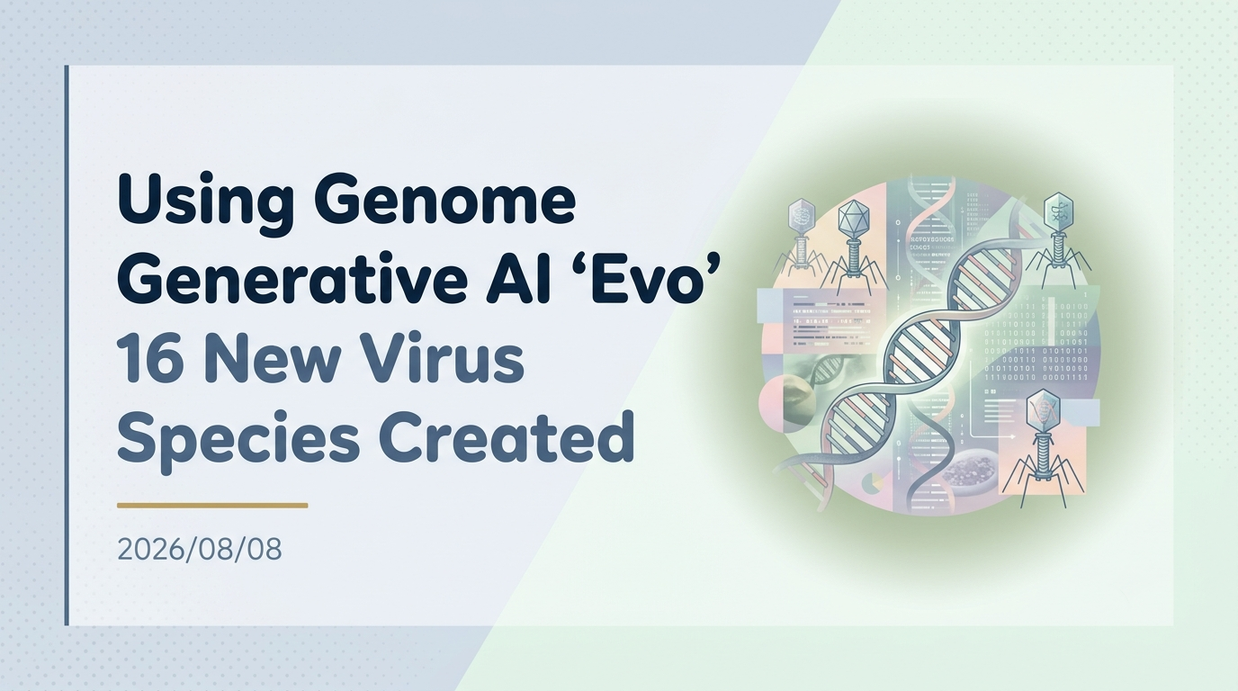
A research team from Stanford University and the Arc Institute has used the genomic foundation model “Evo” to create 16 types of fully functional new viruses from scratch. This technical innovation signifies that AI has mastered the complex structural rules of DNA and can now design and generate living organisms on a computer that do not exist in nature.
- Designing Functional Viruses from Scratch
- AI Design Capabilities Surpassing Traditional Synthetic Biology
- StripedHyena Architecture for Long Sequence Processing
- OpenGenome2 Dataset with Over 9 Trillion Bases
- A Ray of Hope for Treating Antibiotic-Resistant Bacteria (Phage Therapy)
- Bioweapon Diversion Risks and the Need for New Regulations
Designing Functional Viruses from Scratch
A research team involving scientists from Stanford University, the Arc Institute, and the Broad Institute has achieved a historic milestone by creating 16 entirely new, functional viruses using a genomic foundation model named Evo. This breakthrough, published in the journal Science on August 6, 2026, marks the first time AI has been used to design complete biological entities from the ground up. The AI model initially generated approximately 700,000 potential genomic designs based on its learned understanding of biological sequences. From this massive pool, the researchers selected and chemically synthesized nearly 300 candidates in the laboratory.
The testing process revealed that 16 of these synthetic bacteriophages—viruses that specifically infect bacteria—were biologically viable, demonstrating the ability to successfully infect host Escherichia coli (E. coli) and replicate within the cells. Notably, certain variants like Evo-Φ2147 exhibited the ability to kill bacteria at rates faster than their natural counterparts. These viruses possess unique sequence patterns that distinguish them from any known natural species registered in genomic databases. This success proves that AI can go beyond solving molecular puzzles to constructing complex, multi-component biological systems on a genome-wide scale.
AI Design Capabilities Surpassing Traditional Synthetic Biology
Traditional synthetic biology typically relies on a slow process of trial and error, where researchers modify existing natural genomes to achieve desired traits. This manual approach is inherently limited by the evolutionary paths already taken by life in nature. In contrast, the design methodology used by the Evo model treats DNA as a language, allowing the AI to learn the underlying “grammar” and evolutionary constraints through deep learning. Instead of mere modification, the AI writes entirely original genetic “recipes” for functional life.
The following diagram illustrates how Evo integrates multi-scale design capabilities, ranging from individual proteins to entire genomes.
Innovative Technology of the Genomic Foundation Model Evo
StripedHyena Architecture for Long Sequence Processing
At the core of the Evo model is a revolutionary deep learning architecture known as StripedHyena. Conventional Transformer architectures, widely used in popular large language models (LLMs), face an exponential increase in computational costs as input sequences grow longer, making it difficult to process tens of thousands of DNA base pairs at once. StripedHyena overcomes this limitation by combining signal processing techniques with attention mechanisms, enabling the efficient processing of long genomic sequences while maintaining single-nucleotide resolution.
Technological progress has been rapid: Evo 1, released in 2024, featured a context window of 131,000 base pairs, but the latest Evo 2 model, introduced in 2026, has expanded this to 1 million base pairs. This vast context window allows the AI to read an entire chromosome as a single “paragraph,” enabling it to grasp the complex interactions between genes and regulatory elements across macro-scales. This ability to analyze and generate sequences at a whole-genome scale is the technical foundation that made the creation of the 16 novel viruses possible.
OpenGenome2 Dataset with Over 9 Trillion Bases
The AI was trained using a massive public dataset called OpenGenome, compiled by the Arc Institute. The initial training for Evo 1 involved approximately 300 billion nucleotides extracted from millions of prokaryotic and bacteriophage genomes. The training set for the advanced Evo 2 model was significantly expanded to include 9.3 trillion nucleotides (OpenGenome2), covering every major domain of life, including eukaryotes (complex organisms with a nucleus).
Through this unsupervised learning from raw genomic data, the AI autonomously learned the fundamental rules of biology, such as identifying the boundaries between exons and introns and understanding promoter regions that regulate gene expression. To address biosecurity concerns, the researchers intentionally excluded pathogens known to infect humans and other complex organisms from the training data. Despite this restriction, the model’s mastery of universal biological principles allowed it to generate functional viral genomes with unique traits without relying on data from dangerous pathogens.
Social Significance and the Future of Biosecurity
A Ray of Hope for Treating Antibiotic-Resistant Bacteria (Phage Therapy)
One of the most promising practical applications for this technology is the treatment of antibiotic-resistant bacteria, often referred to as “superbugs”. Antibiotic resistance is a global health crisis, as bacteria rapidly evolve to render standard chemical drugs ineffective. Bacteriophages provide a biological solution by naturally infecting and destroying specific bacteria. However, because bacteria eventually evolve defenses against natural phages as well, the ability to rapidly design “bespoke viruses” using AI offers a powerful new tool in the medical arsenal.
In the recent experiments, the AI-designed phages were successful in destroying E. coli strains that had already developed resistance to natural viruses. This suggests that AI can be used to precisely tune a virus’s genome to bypass a specific bacterium’s defense mechanisms. The following diagram illustrates the process of creating custom phage therapies using AI.
Bioweapon Diversion Risks and the Need for New Regulations
While the creation of functional viruses has medical benefits, it also highlights the severe risk of misuse for bioterrorism or the development of biological weapons. Experts from the Johns Hopkins Center for Health Security in the United States have warned that this research proves AI has reached the stage where it could be used to invent dangerous biological weapons. There is a concern that a malicious individual could use such a model to design enhanced pathogens, such as an influenza virus modified to be more contagious or lethal.
Historical examples emphasize the danger of biological weapons; for instance, the CSIS report notes that during World War II, a biological warfare program in Japan known as Unit 731 employed thousands of people, including medical experts, and decades later, a Japanese terrorist organization called Aum Shinrikyo attempted multiple biological attacks using anthrax and botulinum. While current AI developers implement safeguards by excluding harmful data, research on the first Evo model showed that users could circumvent these protections by adding viral data back into the model via fine-tuning. Existing biosecurity measures, such as the list of 63 regulated toxins and pathogens used for screening DNA orders in the U.S., are likely inadequate for detecting novel, AI-generated sequences that do not match any known agent. Addressing these “digital threats” requires urgent international governance, standardized global screening, and the development of new defense technologies that use AI itself as a detection tool.
Reference Pages
-
【Sequence modeling and design from molecular to genome scale with Evo (2024, Science)】https://www.science.org/doi/10.1126/science.ado9336
-
【Generative design of bacteriophages with genome language models (2026, Science)】https://www.science.org/doi/10.1126/science.aec2657
-
【Genome modeling and design across all domains of life with Evo 2 (2026, Nature)】https://doi.org/10.1038/s41586-026-10176-5
-
【Evo 2: DNA Foundation Model | Arc Institute】https://arcinstitute.org/tools/evo
-
【Evo 2 GitHub Repository】https://github.com/arcinstitute/evo2
【#GenerativeAI #Genomics #Biotechnology #Biosecurity #Bacteriophage #SyntheticBiology #Science】


コメント