
On August 15, 2026, U.S. Commerce Secretary Howard Lutnick directly informed Apple of his opposition to sourcing semiconductor memory from China. This is symbolic of the geopolitical friction arising as Apple seeks to diversify its supply sources against the backdrop of a severe memory shortage driven by surging AI demand.
- Secretary Ratcliffe’s Opposition and Apple’s Current Situation
- The Legal Boundaries of National Security Lists and Regulations
- Extreme shortage of generative AI demand and general-purpose memory
- Technological Breakthroughs of Chinese Companies: The Rise of YMTC and CXMT
- Managing domestic opposition and geopolitical risks in the US
- Dual Supply Chain Structure and Future Outlook
Secretary Ratcliffe’s Opposition and Apple’s Current Situation
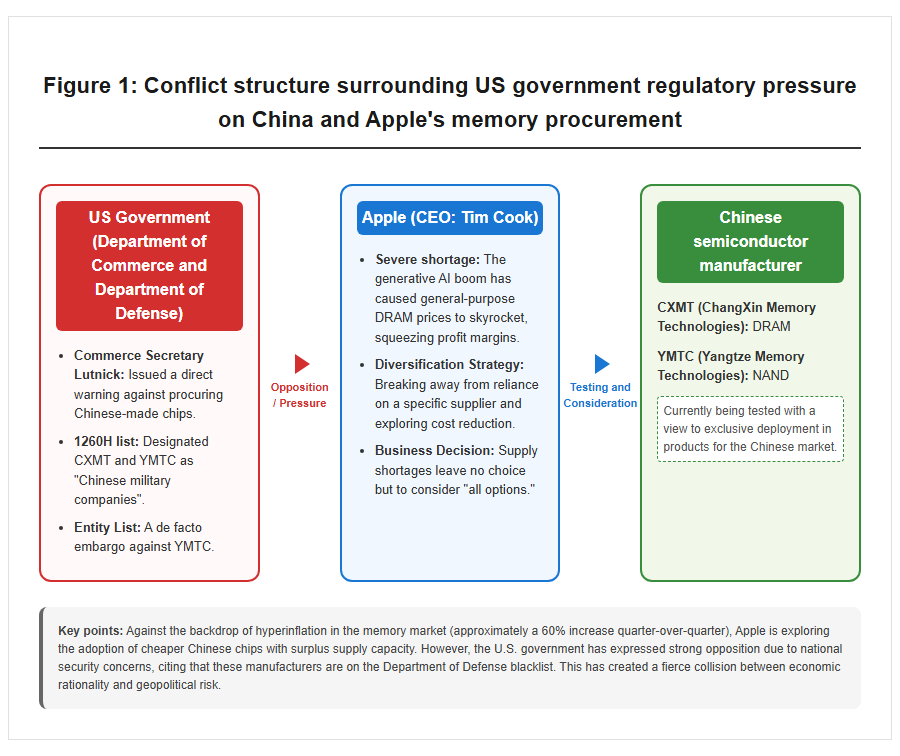
In August 2026, Trump administration Commerce Secretary Howard Lutnick expressed clear opposition to Apple’s procurement of memory chips from Chinese manufacturers. Pointing to the U.S. government’s ongoing push to expand domestic semiconductor production, Lutnick conveyed to Apple that it is undesirable for major U.S. companies to adopt Chinese-made memory. Apple is reportedly testing products from major Chinese makers such as ChangXin Memory Technologies (CXMT) and Yangtze Memory Technologies Corp. (YMTC) with a view to incorporating them into devices for the Chinese market. While avoiding a direct confirmation of the tests, Apple Chief Operating Officer (COO) Sabih Khan stated that facing the current extremely severe supply crunch, “all options must be considered.” Please refer to the figure below.
The Legal Boundaries of National Security Lists and Regulations
Behind this request is the fact that the target Chinese companies are included on U.S. government restriction lists. CXMT and YMTC are designated as “Chinese military companies” (the 1260H list) by the U.S. Department of Defense, and the U.S. government views them as significant national security threats. YMTC, in particular, was added to the U.S. Department of Commerce’s Entity List in December 2022, strictly restricting the export of products containing U.S. technology. While CXMT is not currently on the Entity List, it remains on the Pentagon’s list, prompting concerns at Apple over potential future tightening of regulations. The essence of Apple’s lobbying efforts in Washington is not to challenge the legality of procuring from CXMT itself, but rather to seek “assurance” against the risk of supply chain disruptions from future list additions.
Why Apple is turning to Chinese chips now
Extreme shortage of generative AI demand and general-purpose memory
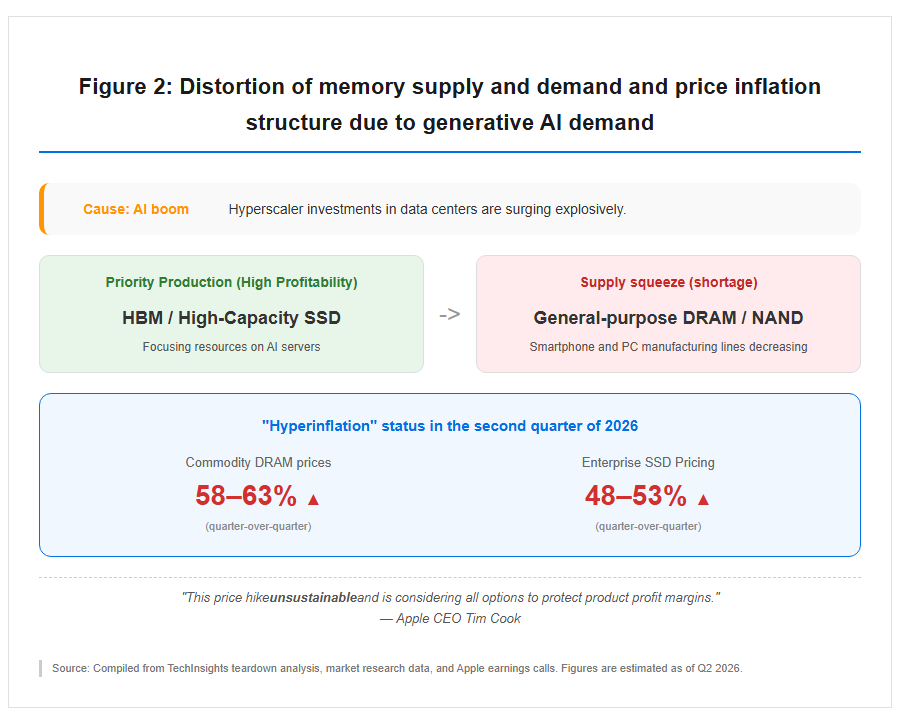
Behind Apple’s willingness to take political risks to consider Chinese-made chips is a global shortage of memory semiconductors driven by the rapid adoption of generative AI. Major memory manufacturers such as Samsung Electronics, SK Hynix, and Micron are currently focusing their production capacity on highly lucrative High Bandwidth Memory (HBM) and enterprise SSDs for AI servers. As a result, the supply capacity for mobile DRAM and commodity NAND flash—essential for smartphones and PCs—has been severely squeezed, leading to extreme shortages in the market. In the second quarter of 2026, unprecedented hyperinflation occurred, with contract prices for commodity DRAM surging 58% to 63% quarter-on-quarter. CEO Tim Cook has called the price hikes “unsustainable,” forcing the company to explore options outside its existing suppliers to maintain its product margins. Please refer to the figure below.
Technological Breakthroughs of Chinese Companies: The Rise of YMTC and CXMT
Apple’s interest in Chinese-made memory is driven not only by pricing, but also by the fact that their technological capabilities have reached an undeniable level. For instance, in 2022 YMTC became the industry’s first to mass-produce 232-layer NAND flash featuring its proprietary “Xtacking” architecture, achieving a bit density that surpasses competitors such as Samsung. Meanwhile, in the DRAM sector, CXMT is rapidly expanding its production lines backed by massive government support, acting as a rare “bottleneck-relieving valve” as supplies from established makers dry up amid soaring AI infrastructure investments. Despite import restrictions on cutting-edge lithography equipment, these Chinese companies are forging unique technological advantages by concentrating resources on back-end and advanced packaging technologies. The market views the mere fact that Apple—notoriously strict about quality standards—is testing these components as a testament to the technological reliability of Chinese-made memory.
Supply Chain Fragmentation and Future Outlook
Managing domestic opposition and geopolitical risks in the US
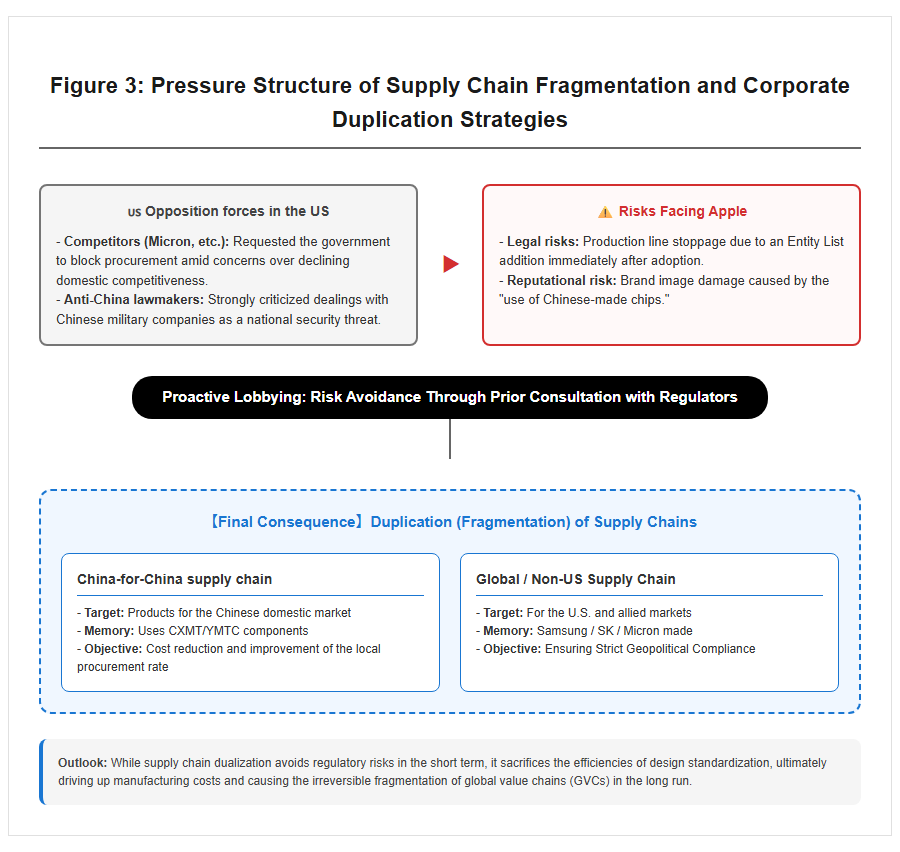
Apple’s move has triggered strong backlash within the United States. Micron Technology, a major U.S. memory chipmaker, argues that allowing procurement from Chinese companies would undermine the competitiveness of the U.S. memory industry, and is strongly urging the government to block it. Furthermore, lawmakers from states with memory production facilities sent a letter to CEO Tim Cook, stating that cooperating with Chinese military-linked companies is a grave mistake. The worst-case scenario for Apple is that legal sanctions, such as addition to the Entity List, are imposed right after Chinese chips are integrated into product design, halting production lines with no alternative sourcing available. As a result, Apple is forced to engage in “preventative lobbying”—holding discussions with the administration beyond legal requirements to preemptively mitigate political backlash. Please refer to the figure below.
Dual Supply Chain Structure and Future Outlook
Moving forward, global companies are expected to accelerate their transition toward a completely bifurcated supply chain structure. Specifically, this is the “China for China” strategy: using cost-competitive Chinese-made memory for products destined for the Chinese market, while continuing to use products from traditional Western manufacturers for the US and its allies. While this kind of supply chain fragmentation mitigates legal risks in the short term, it compromises efficiencies gained from standardized designs and will ultimately act as a factor that permanently drives up manufacturing costs. The US government’s policy decisions—whether to grant limited procurement waivers to help domestic companies maintain their competitiveness, or to prioritize national security above all and maintain a total embargo—will determine the future direction of the global electronics market. Apple’s latest decision will serve as a touchstone for how other high-tech companies balance political risk with economic rationality.
Reference Page
-
【A Seismic Shift: The New U.S. Semiconductor Export Controls and the Implications for U.S. Firms, Allies, and the Innovation Ecosystem – CSIS】https://www.csis.org/analysis/seismic-shift-new-us-semiconductor-export-controls-and-implications-us-firms-allies-and
-
【Letter to Apple CEO Tim Cook re PRC Memory Producers】https://www.finance.senate.gov/imo/media/doc/2026-07-29%20Letter%20to%20Apple%20CEO%20Tim%20Cook%20re%20PRC%20Memory%20Producers.pdf
-
【1260H List – U.S. Department of Defense】https://www.defense.gov/News/Releases/Release/Article/3663440/dod-releases-list-of-peoples-republic-of-china-prc-military-companies-in-accord/
【#Semiconductors #Apple #GeopoliticalRisk #AI #SupplyChain #USEconomy #ChineseTech #NationalSecurity】

コメント