US Treasury Secretary Scott Bessent announced that the buyback program for long-term government bonds will be doubled and that a new fiscal consolidation plan will be released soon. However, deep-rooted concerns in the market over massive fiscal deficits approaching the $2 trillion scale mean that the effect of suppressing long-term interest rates has remained only temporary.
- US Long-Term Bond Buyback Scale Doubled
- The Disconnect from Fundamentals Argued by the Treasury Secretary
- Preview of a New Fiscal Consolidation Initiative
- The Congressional Budget Office Projects Widening Structural Deficits
- Transfer of Pressure from the Bond Market to the Foreign Exchange Market
- The Risk of a Asian Currency Crisis Replay Facing the Japanese Market
US Long-Term Bond Buyback Scale Doubled
On August 19, 2026, the U.S. Department of the Treasury announced that it would double the per-operation buyback cap for nominal coupon-bearing securities with remaining maturities of 10 to 20 years and 20 to 30 years from the previous $2 billion to at least $4 billion, with the aim of supporting liquidity in the Treasury market. This announcement came at an exceptionally unusual time, just two weeks after the release of the previous plan. Just prior, on August 18, 2026, the U.S. 30-year Treasury yield briefly hit 5.337%, marking its highest level in about 19 years since 2007. This led to a widespread view among market participants that the Treasury had acted to prevent a sharp rise in long-term interest rates. In fact, immediately after the announcement of the buyback increase, the 30-year Treasury yield fell by approximately 8 basis points and the 10-year Treasury yield by about 5 basis points, causing the yield curve to flatten. This firm stance by the Treasury was communicated to the market as a strong message that it would not overlook the rise in U.S. long-term interest rates, and alongside the decline in interest rates, the US dollar-yen exchange rate briefly plunged into the 157 yen range in the foreign exchange market.
The Disconnect from Fundamentals Argued by the Treasury Secretary
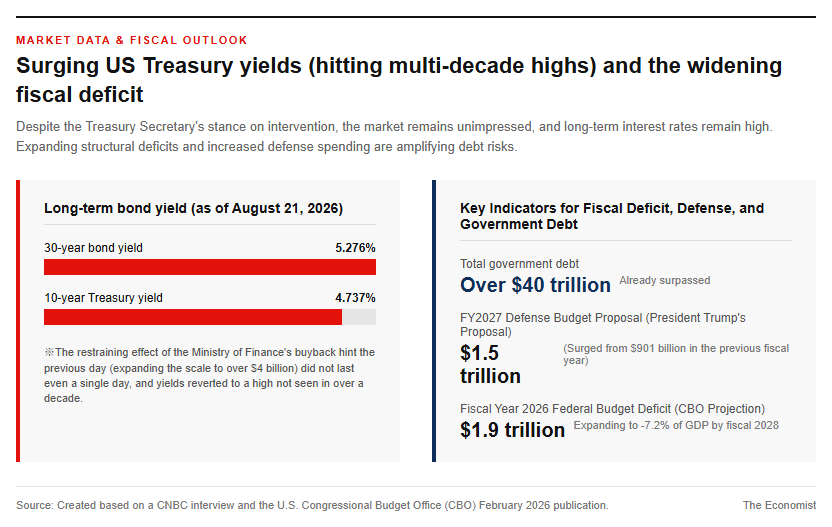
Following intervention by the U.S. Treasury Department, Treasury Secretary Scott Bessent stated in an August 20, 2026 interview with CNBC that the current surge in Treasury yields “does not reflect underlying economic fundamentals,” strongly rejecting the validity of the interest rate rise. Bessent noted that the Treasury plays a “market-making” role in supplying liquidity to the long-term debt market, and mentioned that he is prepared to expand the scale of individual buybacks to over $4 billion if necessary. Furthermore, he adopted a bullish stance, asserting that the Treasury possesses a “large toolkit” to drive down interest rates. However, contrary to the Treasury Secretary’s optimism, the market’s reaction was exceptionally lukewarm. The yield-suppressing effect did not last even a single day, and long-term yields surged again the very next day, August 21, 2026. The 10-year Treasury yield rose to 4.737% and the 30-year yield reached 5.276%, reverting to highs not seen in over a decade. Countering Bessent’s assertion that all market movements are merely noise, this proved that the market’s underlying distrust of the fiscal deficit cannot be easily erased.
Upcoming Announcement of Fiscal Consolidation Measures and Ballooning Fiscal Deficits
Preview of a New Fiscal Consolidation Initiative
On August 20, 2026, Treasury Secretary Bessent promised to soon announce a new fiscal consolidation plan to ease market concerns regarding the fiscal outlook. This plan is being developed jointly with President Donald Trump and Office of Management and Budget (OMB) Director Russell Vought, and is scheduled to be released between late August and early September 2026. Bessent stated that he is examining both government spending and revenue, and asserted that hundreds of billions of dollars in savings can be achieved, particularly by cutting wastefully allocated programs distributed to state governments and by establishing an anti-fraud task force. He also indicated his intention to swiftly restore revenues by introducing new tariffs based on a different legal foundation regarding the tariff measures program currently facing constitutional challenges in the U.S. Supreme Court. Bessent expressed confidence that, under the Trump administration, the U.S. fiscal deficit has already likely peaked, and that future robust economic growth will enable the country to work its way out of its current massive government debt.
The Congressional Budget Office Projects Widening Structural Deficits
In stark contrast to the government’s optimistic stance, the U.S. fiscal deficit is likely to continue expanding due to structural factors. According to the “Budget and Economic Outlook: 2026 to 2036” released by the Congressional Budget Office (CBO) in February 2026, the federal budget deficit for fiscal year 2026 will reach $1.9 trillion. Due in part to the enactment in July 2025 of the One Big Beautiful Bill Act (OBBBA), which includes the permanent extension of the Trump tax cuts, the fiscal deficit is projected to expand to -7.2% of GDP by fiscal year 2028. Furthermore, a major factor preventing any halt to rising expenditures is the substantial increase in defense spending. In January 2026, President Trump insisted on a policy to dramatically raise the fiscal year 2027 defense budget from the previous year’s $901 billion to $1.5 trillion. The scale of this defense spending is comparable as a percentage of GDP to the levels seen during the Iraq War, and since tariff revenues alone cannot cover even 40% of the increase, the remainder will be financed through new government debt. Government debt has already surpassed $40 trillion, and long-term fiscal risks continue to mount. Please refer to the figure below.
Financial Market Concerns and Spillover Risks to Japan
Transfer of Pressure from the Bond Market to the Foreign Exchange Market
Financial institutions and experts have harshly criticized the Ministry of Finance’s repurchasing of long-term government bonds as merely a palliative measure. Analysts at JPMorgan Chase compared the strategy of buying back long-term bonds while simultaneously issuing short-term debt to paying off a mortgage with a credit card, pointing out that it does nothing to alter the fundamental debt burden. This stance by the Ministry of Finance, attempting to forcefully suppress interest rates through supply and demand adjustments, has been dubbed the “Bessent put.” However, this market intervention creates distortions in the bond market and leads to an increase in the premium demanded for interest rate risks. As a result, the adjustment pressure suppressed in the bond market shifted to the foreign exchange market, producing the side effect of rapidly driving down the U.S. dollar. In fact, the dollar index fell by about 1% in a single week, sinking to its lowest level since late May. Reflecting this stress in the government bond market, safe-haven buying of alternative assets has become active; gold prices have surged, and Bitcoin has skyrocketed past $77,000 into all-time-high territory.
The Risk of a Asian Currency Crisis Replay Facing the Japanese Market
The dysfunction of interest rate suppression policies in the United States poses significant spillover risks to the Japanese market as well. Minoru Matsuzawa, a macro strategist at Nomura Securities, warned that if Japan were to follow the U.S. lead in managing bond supply and suppressing long-term interest rates, the resulting adjustment pressure would be shifted entirely onto the foreign exchange market, triggering a sharp decline in the already weak yen. If policy failures were to spark a rapid outflow of capital, there is a risk of plunging into a severe situation similar to the 1997 Asian financial crisis. In early August 2026, U.S. and Japanese authorities had just stepped into a historic joint intervention, injecting approximately 13.8 trillion yen (about $870 billion) to prevent a depreciation of the yen, and Bessent himself has publicly noted the danger that sharp fluctuations in the yen could trigger a contagion effect on other Asian currencies. In the Japanese market that week, caution over the suppression of yields drove the decline in Japanese equities to a G3-worst negative 3.3%, far outstripping the selling pressure seen in U.S. stocks at negative 1.9% and European stocks at negative 1.1%. The distortions in the bond market have become an extremely serious vulnerability for the Japanese economy.
Reference Page
- 【The Budget and Economic Outlook: 2026 to 2036】https://www.cbo.gov/publication/61882
【#EconomyBusiness #USTreasuries #FiscalDeficit #LongTermYields #ForexMarket #Bessent #AsianFinancialCrisis #CBO】


コメント