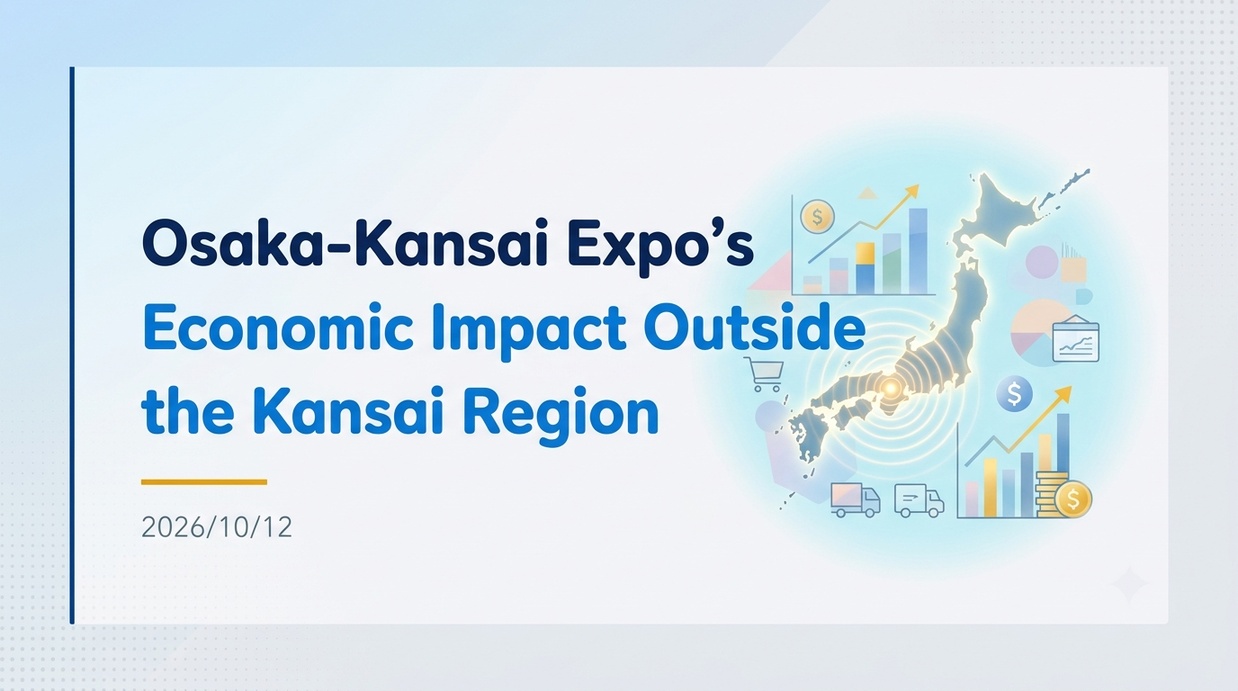
According to the final estimates released by the Asia Pacific Institute for Research, the economic ripple effect of the Osaka-Kansai Expo reached 3.5121 trillion yen, of which 829.9 billion yen spread to regions outside of Kansai. Driven by rising venue construction costs and surging inbound demand, the event has gone beyond a mere regional gathering to deliver a strong economic ripple effect on industries and tourism nationwide.
- Overview of the Estimation Results and Economic Effects Outside the Kansai Region
- Contribution Analysis of Business Expense Expansion and Visitor Spending
- Ripple Structures via Inter-Industry Relations and Impact on Major Industries
- Nationwide Wide-Area Touring and High-Value-Added Consumption by International Visitors to Japan
- Comparison with the Aichi Expo and Structural Differences
- Legacy Inheritance and Its Spillover Effects on Medium- to Long-Term Economic Growth
Overview of the Estimation Results and Economic Effects Outside the Kansai Region
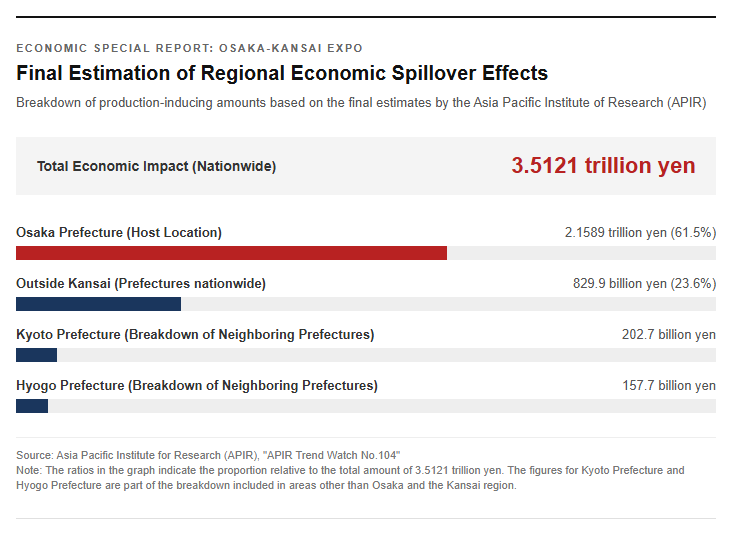
According to “APIR Trend Watch No.104” published on June 29, 2026, by the private think tank Asia Pacific Institute for Research (APIR), the final economic ripple effect of the Osaka-Kansai Expo will reach 3.5121 trillion yen nationwide. This estimate significantly exceeds the base case (2.7457 trillion yen) and the expanded expo case (3.3667 trillion yen) from 2024, demonstrating an economic impact on the same scale as the 3.6 trillion yen estimated by the Ministry of Economy, Trade and Industry. The most notable point is that this economic effect was not confined to the host prefecture of Osaka, but spread widely across all of Japan. Analyzing the production-inducing amounts by prefecture, the host prefecture of Osaka accounts for 2.1589 trillion yen, or 61.5% of the total, while regions outside the 2 urban prefectures and 8 prefectures of the Kansai region (Osaka, Kyoto, Hyogo, Shiga, Nara, Wakayama, Fukui, Mie, Tottori, and Tokushima) were impacted by 829.9 billion yen (23.6% of the total). In addition to effects on neighboring prefectures such as Kyoto Prefecture (202.7 billion yen) and Hyogo Prefecture (157.7 billion yen), the creation of a certain level of demand was also confirmed for industries outside the Kansai area, including the Kanto and Chubu regions. Compared to initial expectations (a 17.5% share outside Kansai), the contribution to the nation as a whole has increased significantly, proving that this Expo was a national-scale economic event. The following chart shows the ripple effects by region.
Contribution Analysis of Business Expense Expansion and Visitor Spending
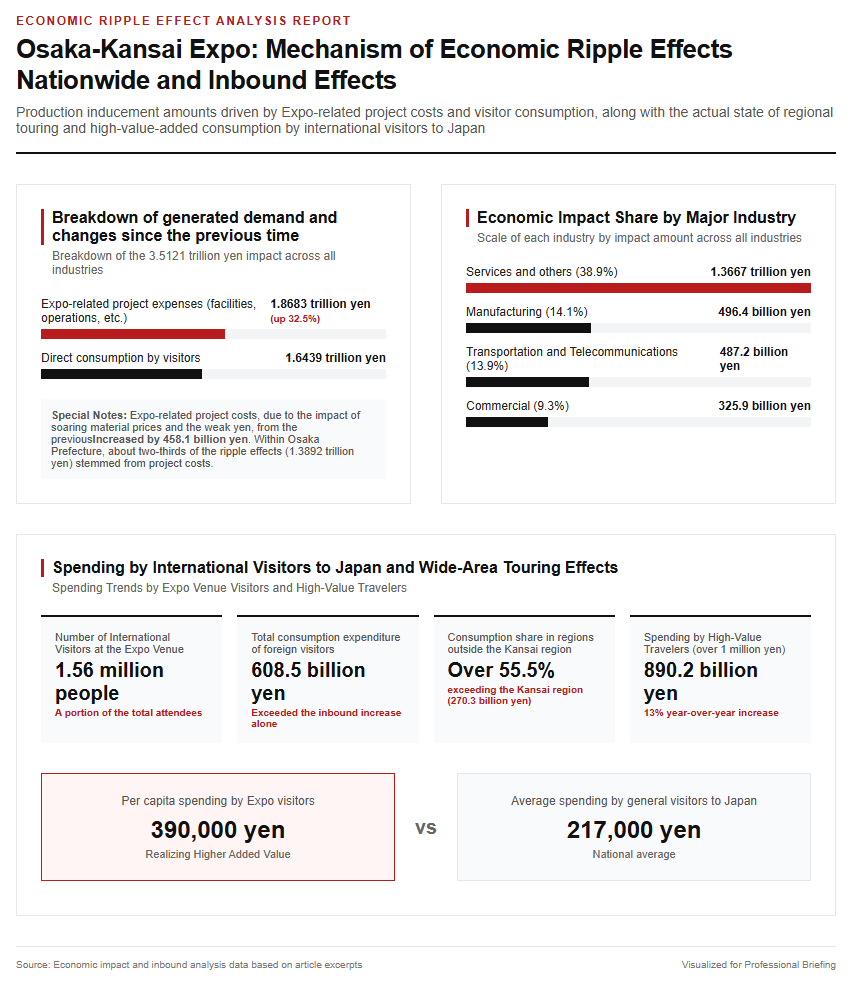
Behind the economic ripple effects exceeding the initial estimates lie two major factors: an increase in Expo-related project costs and a greater-than-expected expansion in visitor consumption. An analysis of the breakdown of generated demand reveals that production inducements resulting from Expo-related project costs, such as venue construction and operational expenses, amounted to 1.8683 trillion yen, while production inducements from direct visitor consumption reached 1.6439 trillion yen. Regarding Expo-related project costs, soaring material prices and rising pavilion construction costs driven by the weak yen led to a substantial increase of 458.1 billion yen (a 32.5% increase) from the previous estimate. Meanwhile, approximately two-thirds of the ripple effects in Osaka Prefecture (1.3892 trillion yen) originated from project costs, whereas visitor consumption serves as the primary driving force in regions outside Osaka Prefecture. Notably, out of the 829.9 billion yen in effects generated in areas outside Kansai, visitor consumption accounted for 496.4 billion yen, alongside 333.6 billion yen generated by project costs. This illustrates that the procurement of materials and services required for venue construction and operation was commissioned to manufacturers and service providers across the country, and that visitors gathered from all over the nation spent money on transportation, lodging, and other services in surrounding areas. Thus, the synergistic effect exerted by both project costs and consumer spending contributed to an overall economic boost.
The Mechanism of Nationwide Spillover and the Inbound Effect
Ripple Structures via Inter-Industry Relations and Impact on Major Industries
The demand generated by the Expo rippled across various industries through inter-industry relations, which are mutual transactions among sectors. Looking at the industry-by-industry share of the 3.5121 trillion yen total impact on all industries in the final estimates, the sector that benefited the most was “Services and others,” reaching 1.3667 trillion yen (38.9% of the total). This was followed by “Manufacturing” at 496.4 billion yen (14.1%) and “Transportation and Communications” at 487.2 billion yen (13.9%), creating a structure where the top three industries accounted for over two-thirds of the total. These are followed by “Commerce” at 325.9 billion yen (9.3%), “Construction” at 146.4 billion yen (4.5%), and “Real Estate” at 142.3 billion yen (4.1%). Within Osaka Prefecture, the ripple effects on the construction and local service industries are prominent, whereas in regions outside Osaka Prefecture, the demand spillovers to manufacturing (380.2 billion yen) and transportation and communications (244.9 billion yen) are exceptionally large. This clearly illustrates how the production of pavilion facilities and related materials, as well as transportation demand on a nationwide scale, rippled through to factories and logistics networks in other regions. It is thus substantiated that the staging of a single event like the Expo drove up operating rates at manufacturing sites and on transportation infrastructure across all of Japan through the raw materials supply chain.
Nationwide Wide-Area Touring and High-Value-Added Consumption by International Visitors to Japan
What is particularly noteworthy about this Expo is the nationwide diffusion of inbound consumption by foreign tourists visiting Japan. During the Expo period, the number of inbound foreign tourists reached 21.5 million, and total consumption within Japan swelled to 4.6606 trillion yen, a 14% increase compared to the same period last year. Of this, the spending by the 1.56 million foreign visitors who came to the Expo venue reached 608.5 billion yen, serving as an extraordinary driving force that single-handedly exceeded the increase in overall inbound consumption (579.7 billion yen). Even more interesting is the geographical distribution of this consumption. Of the 608.5 billion yen spent by foreign visitors, consumption in the Kansai region amounted to only 270.3 billion yen, with more than half being spent in regions outside Kansai. Notably, Tokyo accounted for 23.5% of the total, confirming that Expo visitors actively utilized wide-area touring routes covering Tokyo, Mt. Fuji, Kanazawa, and other destinations. Furthermore, spending per Expo visitor was 390,000 yen, significantly exceeding the average of 217,000 yen for general foreign visitors. The spending of high-value travelers who spent 1 million yen or more within Japan also reached 890.2 billion yen nationwide (a 13% increase year-on-year), bringing economic effects to the entire country in terms of both the “quantity” and “quality” of consumption. The diagram showing nationwide traffic lines is as follows.
Investing in the Future and Post-Closing Outlook
Comparison with the Aichi Expo and Structural Differences
Even in comparison with past mega-events, a clear characteristic can be seen in the economic spillover structure of the Osaka-Kansai Expo. In the 2005 World Exposition, Aichi, Japan (“Aichi Expo”), under the specialized case excluding wide-area transportation infrastructure development (Case II), approximately 68% of the economic impact (production-inducing effect of about 2.8 trillion yen) was concentrated in the Chubu region, the host location, while spillovers to other regions remained at 17% for Kanto and 7% for Kansai. In contrast, for this Osaka-Kansai Expo, the spillover effect to regions outside the two prefectures and eight prefectures of Kansai reached 23.6%, showing a strong tendency where regional concentration was mitigated and the effects diffused nationwide. Behind this lies a behavioral change among domestic visitors. According to a survey by the Jalan Research Center and a university research team, while the Kansai region accounted for 70% of the cumulative number of visitors, looking at the number of unique visitors excluding duplicates, participants from outside the region, such as Kanto and Chubu, accounted for about 50%. Even in a phase where nationwide travel demand showed signs of stabilizing, the Expo visitor demographic actively engaged in new overnight stays and regional sightseeing not only during the event period but also after its conclusion, producing a stronger wide-area touring effect than past expos.
Legacy Inheritance and Its Spillover Effects on Medium- to Long-Term Economic Growth
The true value of the Expo lies not merely in short-term demand creation (the demand side) during its run, but in whether it can be linked to sustainable economic growth on the supply side after its closure. In the “Osaka-Kansai Expo Declaration” announced by the Ministry of Economy, Trade and Industry (METI) in June 2026, strong emphasis is placed on the social implementation of cutting-edge technologies and systems demonstrated at the venue, in addition to the expansion of exchanges and the sharing of new values. Future focuses will include the commercialization of next-generation industries such as healthcare and flying cars, starting with the utilization of legacies such as the Grand Roof Ring and the Integrated Resort (IR) development underway on Yumeshima, the site of the Expo. An analysis by the Asia Pacific Institute also points out that while the Expo has planted the “seeds” for a turnaround in the Kansai and Japanese economies, policy support to make business matching effective and to back private companies’ aggressive investment appetite (entrepreneurial spirit) is indispensable. Using the short-term economic ripple effect of 3.5 trillion yen as a springboard, translating the created business opportunities and technological legacies into medium- to long-term innovation creation and investment expansion will be the key to boosting the growth potential of the entire Japanese economy.
Reference Page
- [General Incorporated Foundation Asia Pacific Institute for Research “APIR Trend Watch No.104”] https://www.apir.or.jp/research/post15681/
- 【Kobe University Graduate School and Doshisha University Joint Research Report: “Analysis of Regional Human Flow Ripple Effects Triggered by the Osaka-Kansai Expo”】https://jrc.jalan.net/wp-content/uploads/2026/03/expo2025_osaka_report.pdf
【#OsakaKansaiExpo #EconomicRippleEffect #AsiaPacificInstitute #Inbound #JapaneseEconomy #RegionalRevitalization】

コメント