
Japan’s Financial Services Agency (FSA) has finalized plans to tighten its monitoring of underwriting standards at banks offering ultra-long-term mortgages with repayment periods of 40 to 50 years. This regulatory shift is driven by growing concerns that rising interest rates and surging long-term yields are inflating borrowers’ total repayment burdens, potentially leading to excessive lending that surpasses their actual debt-servicing capacity.
- The FSA’s Investigative Push: Launching This Autumn
- Surging Interest Rates and the Risk of Over-Lending
- The Rise of 50-Year Mortgages Amid Skyrocketing Property Prices
- The Disconnect Between “Borrowing Capacity” and “Repayment Reality”
- The Double Burden on Households: Lessons from the UK and South Korea
- Underwriting Tightening and the Outlook for the Real Estate Market
The FSA’s Investigative Push: Launching This Autumn
On September 4, 2026, it was revealed that the Financial Services Agency (FSA) has finalized a policy to strengthen its monitoring of underwriting frameworks at banks offering ultra-long-term mortgages, such as 40- and 50-year loans. The agency plans to launch a comprehensive fact-finding inquiry as early as this autumn, targeting a wide range of financial institutions, including major commercial banks, regional banks, and online-only banks.
This regulatory clampdown is driven by the shift away from ultra-loose monetary policy and the subsequent rise in interest rates. The upcoming probe will focus heavily on how financial institutions explain critical risks to borrowers, including interest rate volatility, potential income drops, and declines in property asset values. Online-only banks, which operate without physical branches, are facing particular scrutiny. Because these lenders allow customers to complete the entire process from application to contract via smartphone, regulators question whether borrowers fully comprehend the long-term financial risks of increased payment burdens. Consequently, the transparency of the digital contracting process and the adequacy of disclosure frameworks will undergo rigorous verification.
Surging Interest Rates and the Risk of Over-Lending
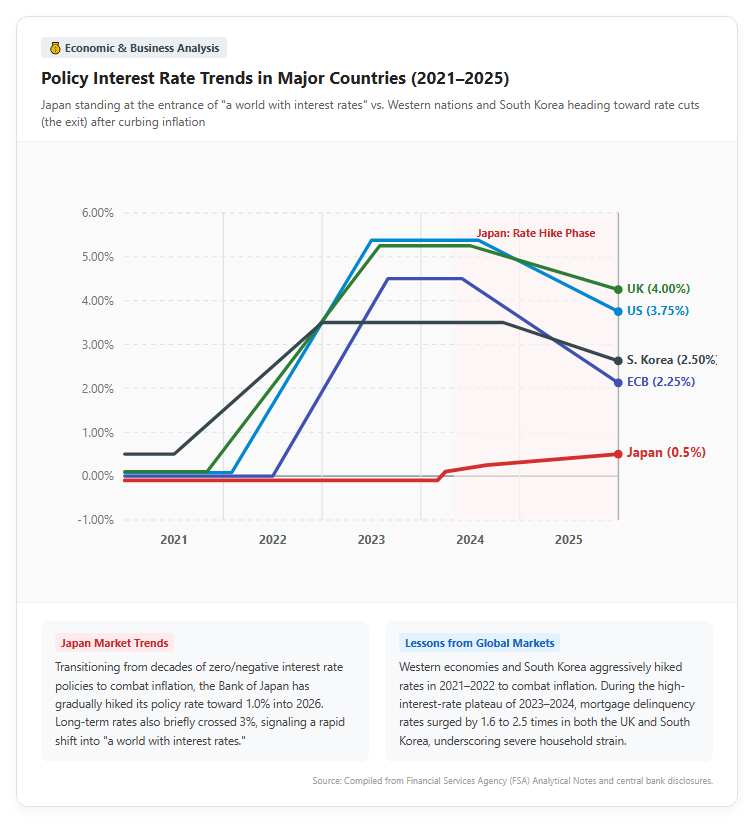
Japan’s financial landscape is currently undergoing a massive structural shift. On June 17, 2026, the Bank of Japan (BOJ) raised its policy interest rate to approximately 1.0%, signaling an increasingly hawkish stance. Concurrently, long-term interest rates surged past 3% for the first time in nearly 30 years. In such a rapidly rising interest rate environment, ultra-long-term mortgages are structurally vulnerable; because of their extended durations, interest payments constitute an exceptionally large portion of the total repayment, amplifying the impact of rate fluctuations.
The chart below illustrates the trajectory of policy interest rates in major economies.
Standard mortgage underwriting models used by most banks assess whether a borrower’s annual debt-to-income (DTI) ratio falls below a specific threshold. Ultra-long-term mortgages artificially lower the “monthly repayment” by stretching out the loan term, making it easier for borrowers to pass these initial screening criteria. However, because interest accrues over a much longer period, the final cumulative repayment amount swells enormously. The FSA is highly concerned that banks may be extending excessive credit that surpasses borrowers’ sustainable repayment capacities. The regulatory agency plans to strictly evaluate whether lenders are adequately integrating rising rate scenarios into their credit models, focusing on the execution and rigor of institutional stress tests.
The Expansion of Ultra-Long Loans and Household Risks
The Rise of 50-Year Mortgages Amid Skyrocketing Property Prices
The rapid expansion of ultra-long-term mortgages in recent years is closely tied to historically high housing prices. According to the Real Estate Economic Institute, the average price of a newly constructed condominium in the Tokyo metropolitan area reached 101.35 million yen in the first half of 2026, surpassing the 100-million-yen threshold for the first time in any half-year period. This represents a steep increase of 11.77 million yen (13.1%) compared to the same period in the previous year.
Consequently, even affluent dual-income households—often referred to in Japan as “power couples” with household incomes exceeding 10 million yen—struggle to purchase properties in prime urban locations, where loan amounts frequently top 100 million yen under conventional 35-year terms. To preserve monthly cash flow for other living expenses, an increasing number of households are pushed to opt for terms of 36 years or longer. A survey by Recruit revealed that the share of buyers opting for 36-year-plus mortgages on new condominiums in the Tokyo area skyrocketed from 11.6% in 2024 to 32.6% in 2025—an approximate 2.8-fold surge in just one year. This trend is deeply connected to data from the Ministry of Internal Affairs and Communications’ Family Income and Expenditure Survey, which showed that the homeownership rate among multi-person households aged 29 and under reached a record high of 40.7% in 2025.
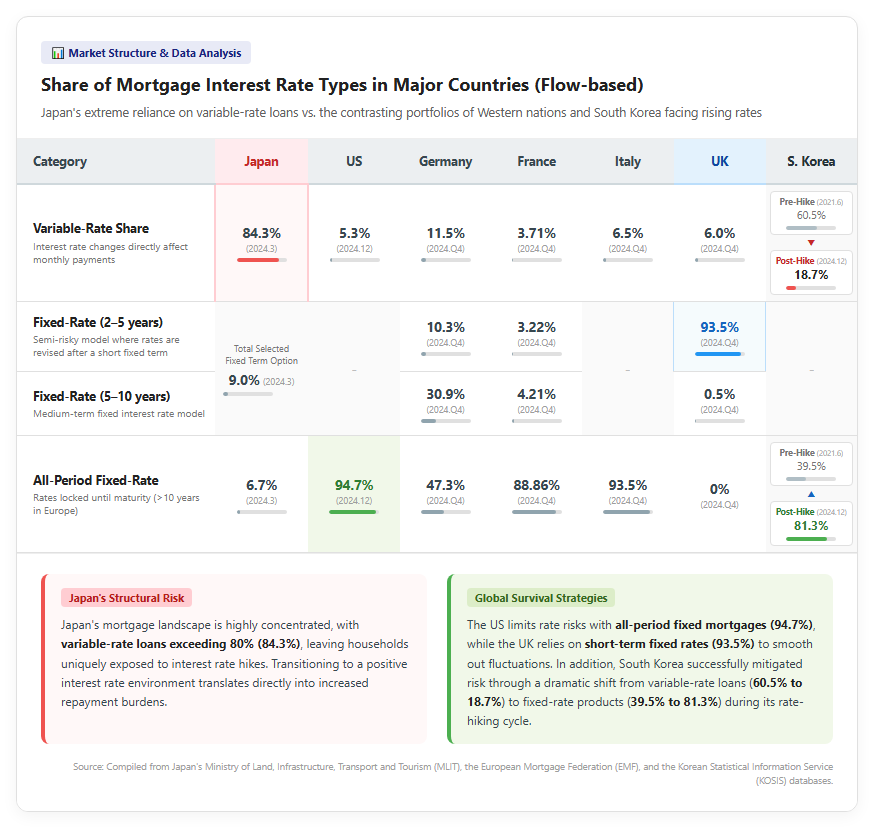
The distribution of mortgage interest rate types in major countries is shown below.
The Disconnect Between “Borrowing Capacity” and “Repayment Reality”
While the reduced monthly payments of ultra-long-term mortgages appear attractive, they hide a dangerous trap involving interest compounding and slow principal amortization. For instance, taking out a 50 million yen variable-rate loan over 50 years reduces monthly outlays by tens of thousands of yen compared to a 35-year term. However, the total interest paid balloons dramatically, inflating the lifetime cost of the loan by tens of millions of yen. A more insidious hazard is the extremely sluggish rate of principal reduction.
During the initial decades of an ultra-long loan, monthly payments are heavily weighted toward interest rather than principal. If a homeowner is forced to sell the property after 10 years due to life-altering events like a career change, divorce, or medical emergencies, they are highly likely to find themselves in “negative equity” (where the property value is lower than the remaining loan balance). This can lead to a nightmare scenario where the home is sold but the individual remains saddled with significant debt. Furthermore, standard bank assessments ignore peripheral costs such as fixed asset taxes and condominium maintenance fees. A Ministry of Land, Infrastructure, Transport and Tourism survey showed that the average monthly management and repair reserve fee stands at 30,481 yen. Considering the risk of these fees escalating over time, borrowing to the absolute limit of one’s credit capacity represents an incredibly risky financial strategy.
Lessons from Abroad and the Path Forward
The Double Burden on Households: Lessons from the UK and South Korea
The experience of major economies that underwent rapid monetary tightening and mortgage stress before Japan offers crucial lessons. According to analyses published in the FSA Analytical Notes, both the UK and South Korea saw mortgage delinquency rates surge during their respective rate-hiking cycles, climbing to 1.6 times and 2.5 times pre-tightening levels, respectively.
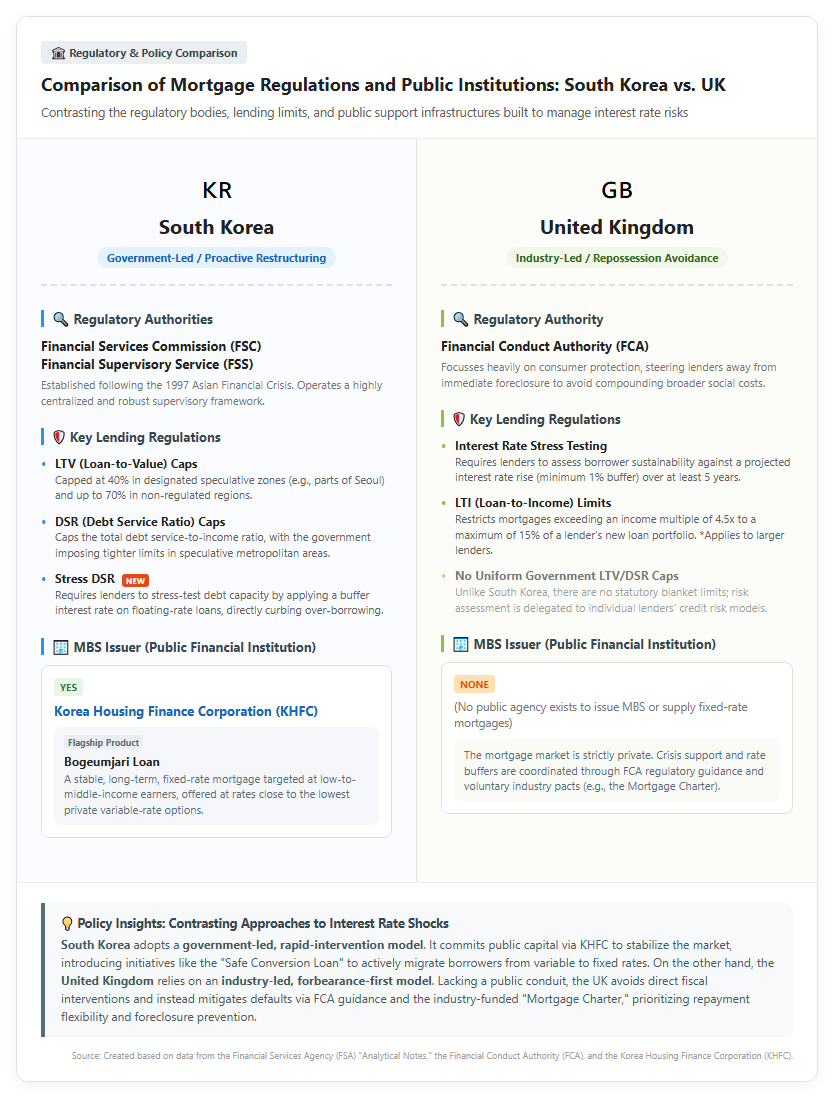
The table below outlines the regulatory structures and presence of public financial institutions in both nations.
The primary catalyst for this rise in defaults was a “double burden” on households: the simultaneous occurrence of escalating mortgage payments and declining real incomes due to inflation. In the UK, while nominal wages grew at an average rate of 5.8% during the tightening phase, the Consumer Price Index (CPI) rose by 6.3%, causing real wages to shrink. Similarly, in South Korea, nominal wage growth for employees at small and medium-sized enterprises (SMEs) averaged 2.7%, failing to keep pace with a 3.6% average CPI increase. As inflation eroded household purchasing power, rising mortgage rates squeezed cash flows even further, precipitating a sharp spike in delinquencies.
Underwriting Tightening and the Outlook for the Real Estate Market
The FSA’s upcoming inspection of underwriting systems is highly expected to trigger a tightening of credit standards among domestic financial institutions. Mortgage market analysts project that maximum borrowing limits, which previously reached up to eight times an applicant’s annual income, may be scaled back to around seven times. Some lenders have already begun suppressing loan volumes by raising their internal “stress rates” used during screening. This reduction in purchasing power is poised to cool demand in a housing market that has been characterized by unchecked price growth.
Furthermore, the FSA is increasingly vigilant regarding regional banks that concentrate mortgage lending on properties sold by specific real estate developers and subsequently attempt to “securitize” these loans to transfer credit risk off their balance sheets. To mitigate the systemic risk of subprime or high-default-risk assets circulating in investment markets, the regulator has initiated direct hearings with regional lenders. Looking ahead, suburban properties and high-end units priced above 150 million yen—sectors highly sensitive to lending constraints and rate hikes—are already showing signs of slowing demand and potential price corrections. Ultimately, the Japanese housing market is expected to witness an accelerated polarization, with prime central Tokyo locations maintaining their value while peripheral areas experience downward pressure.
References
- 【Ministry of Internal Affairs and Communications: “Family Income and Expenditure Survey” (2025 Detailed Results)】https://www.stat.go.jp/data/kakei/2025np/index.html
- 【Japan Housing Finance Agency: “【Flat 50】Terms of Use”】https://www.flat35.com/loan/lineup/flat50/conditions.html
- 【Japan Housing Finance Agency: “Flat 35 User Survey (FY2025)”】https://www.jhf.go.jp/about/research/loan_flat35.html
- 【Bank of Japan: “On Monetary Policy Decisions”】https://www.boj.or.jp/mopo/mpmdeci/mpr_2026/k260731a.pdf
- 【Financial Services Agency: “FSA Analytical Notes (January 2025) Vol. 2″】https://www.fsa.go.jp/common/about/kaikaku/fsaanalyticalnotes/20250121/01.pdf
- 【Ministry of Land, Infrastructure, Transport and Tourism: “FY2023 Comprehensive Condominium Survey”】https://www.mlit.go.jp/jutakukentiku/house/jutakukentiku_house_tk5_000058.html
【#MortgageRates #FinancialServicesAgency #InterestRates #50YearMortgage #RealEstateInvestment #HomeBuying #Inflation #RiskManagement】

コメント