In its rough estimate requests for the fiscal 2027 budget, the Ministry of Land, Infrastructure, Transport and Tourism (MLIT) has revised its item requests concerning the extension of planned Shinkansen lines to include wording that calls for consideration regarding local financial burdens. The background behind this includes strong concerns over the increasing financial burden on local governments due to soaring construction materials and labor costs, as well as political considerations reflecting those concerns.
- Revision of Itemized Requests and Exceptional Handling
- Outpouring of Objections at the LDP Land, Infrastructure, Transport and Tourism Division
- Current Basic Financial Resource Scheme and the Impact of Rising Prices
- JR companies show reluctance toward loan fee increases
- Current Status of the Hokuriku Shinkansen and Hokkaido Shinkansen
- Key Focal Points of Discussion for the FY2027 Budget Compilation
Revision of Itemized Requests and Exceptional Handling
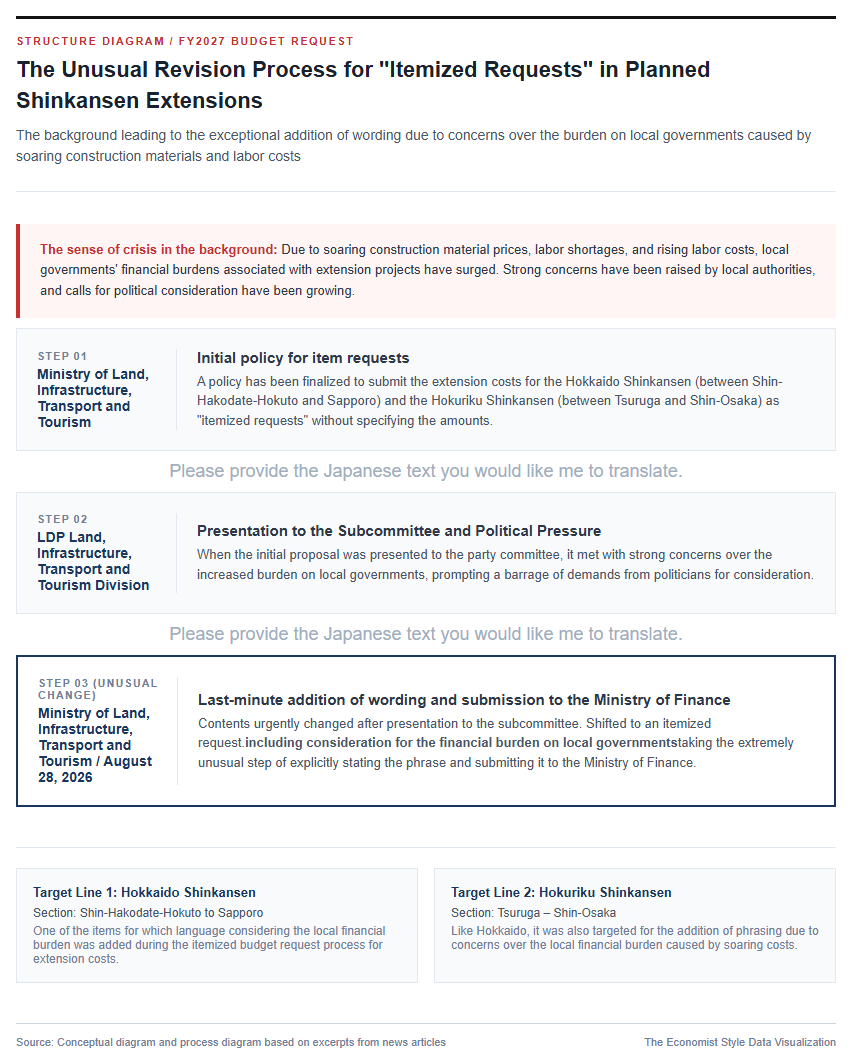
On August 28, 2026, the Ministry of Land, Infrastructure, Transport and Tourism (MLIT) decided to revise the wording of the itemized budget request related to the extension of Shinkansen bullet train lines in its rough budget request for fiscal 2027. An itemized request is a mechanism where specific amounts are not stated at the budget request stage, and the final amounts are determined through negotiations during the budget compilation process. MLIT had initially submitted itemized requests for the extension costs of the Hokkaido Shinkansen between Shin-Hakodate-Hokuto and Sapporo, and the Hokuriku Shinkansen between Tsuruga and Shin-Osaka, but abruptly decided to change the content it had once presented to the Liberal Democratic Party’s (LDP) Land, Infrastructure and Transport Division. The newly added phrase is “including consideration for local government financial burdens,” and the rough budget request will be submitted to the Ministry of Finance with this explicitly stated. Revising and resubmitting the content of an itemized request that was once presented to the division is an extremely unusual response, which has drawn significant attention within the central government’s budget request process. This unusual measure can be said to be a manifestation of the desperate cries of local governments regarding the planned Shinkansen extensions and the strong sense of crisis on the political side in response to them. Please refer to the figure below.
Outpouring of Objections at the LDP Land, Infrastructure, Transport and Tourism Division
The direct trigger for this wording revision was a meeting held on August 27, 2026, by the Liberal Democratic Party’s (LDP) Land, Infrastructure, Transport and Tourism Division and other bodies. At this meeting, attending LDP lawmakers voiced strong objections regarding the heavy financial burden placed on local governments along the routes due to the extension of planned Shinkansen lines. In particular, regions such as the Kansai region, which is awaiting the extension of the Hokuriku Shinkansen, and Hokkaido, which faces difficult construction work for the Hokkaido Shinkansen, expressed extremely strong concerns over the significant increase in municipal financial burdens driven by soaring material prices and other factors. A mid-ranking LDP lawmaker stated that “this is to show political will,” revealing that politicians intervened in bureaucrat-led budget requests to reflect local voices. Officials from the Ministry of Land, Infrastructure, Transport and Tourism also explained that, based on the discussions within the LDP, the wording was added to clarify consideration for regional areas within the budget-making discussions. As a result, this revised proposal was approved on August 28, 2026.
The Structure of the Fiscal Burden Surrounding Planned Shinkansen Lines
Current Basic Financial Resource Scheme and the Impact of Rising Prices
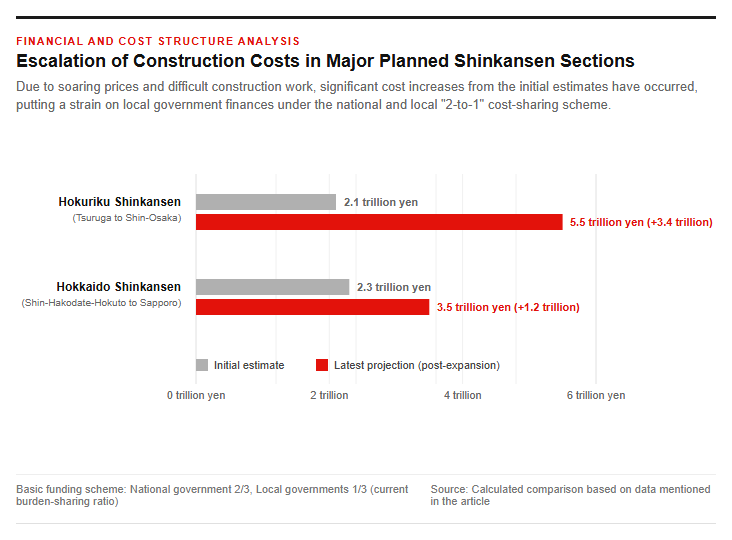
Regarding the burden of construction costs for planned Shinkansen lines, the basic financial resource scheme established by the agreement between the government and the ruling parties in January 1989 remains the current base. Under this system, rental fees paid by JR companies for the use of tracks and other facilities are allocated to construction costs, and the remaining amount is to be borne by the national government at a ratio of two-thirds and by local governments along the route at a ratio of one-third. However, due to recent rapid price increases and soaring labor costs, this burden structure is beginning to significantly strain the finances of local governments. For example, construction costs for the Hokuriku Shinkansen between Tsuruga and Shin-Osaka are estimated to swell from the conventional 2.1 trillion yen to 5.5 trillion yen. Furthermore, regarding the section of the Hokkaido Shinkansen between Shin-Hakodate-Hokuto and Sapporo, prospects indicate an expansion from the initial estimate of 2.3 trillion yen to 3.5 trillion yen. If the current burden-sharing ratio of 2 to 1 between the national and local governments is maintained as is, the amount that local governments must bear will increase on the scale of hundreds of billions of yen, raising concerns that the situation will become unsustainable. Please refer to the figure below.
JR companies show reluctance toward loan fee increases
The current funding scheme was designed under the fundamental philosophy of “preventing the birth of a second Japanese National Railways (JNR).” Learning from the lesson of JNR, which collapsed under 30 trillion yen in long-term debt due to debt-dependent new investments, the rules are set so that the JR companies bear only an amount as rental fees that does not exceed the scope of their benefits. From the Ministry of Finance and within the government—which wants to curb public spending—opinions have been raised that the rental fees paid by JR should be increased to cover the soaring construction costs. In response, operating entities such as JR West and JR Kyushu are strongly pushing back, stating that this represents a significant departure from the basic funding scheme and is unacceptable. The JR side argues that Shinkansen rental fees should be calculated based on the profits generated, and should not be increased in tandem with fluctuations in construction costs caused by external factors. Even within the ruling party’s project team, there are voices showing a certain level of understanding toward the JR side’s position, making the securing of a stable funding scheme an extremely difficult issue.
Impact and Outlook on Future Shinkansen Extensions
Current Status of the Hokuriku Shinkansen and Hokkaido Shinkansen
Behind this recent revision of the rough estimate request lies the severe stagnation plaguing the specific extension plans. Although construction is progressing on the Hokkaido Shinkansen section between Shin-Hakodate-Hokuto and Sapporo, issues such as construction delays and soaring construction costs caused by rising prices and difficult engineering works are being viewed with concern. Furthermore, regarding the Hokuriku Shinkansen section between Tsuruga and Shin-Osaka, although the ruling parties agreed on the Obama-Kyoto route in 2016, discussions have stalled for a long time due to concerns over the impact on groundwater and the environment within Kyoto Prefecture. While Fukui Prefecture and municipalities along the line had aimed for approval and the start of construction within fiscal 2026, the situation as of August 2026 makes starting construction within fiscal 2026 extremely difficult. The Fukui Prefectural Assembly and others have exerted pressure by declaring, “Even if a route other than the Obama-Kyoto route is decided, we have no intention whatsoever of paying the local financial burden,” and the tug-of-war toward deciding a route and reaching local agreement remains in extreme turmoil.
Key Focal Points of Discussion for the FY2027 Budget Compilation
In its budget request for fiscal 2027, the Ministry of Land, Infrastructure, Transport and Tourism has requested 80.4 billion yen for the construction of planned Shinkansen lines, keeping the amount flat for the seventh consecutive year. The biggest focal point will be how to increase and secure the massive construction costs required for the extensions of the Hokkaido and Hokuriku Shinkansen lines during year-end budget negotiations with the Ministry of Finance, on top of this limited baseline budget framework. Based on the newly added phrasing regarding consideration for local financial burdens, the government and the ruling coalition plan to initiate a review of the current burden-sharing ratios themselves. However, with the total general account budget request for fiscal 2027 reaching a record high of around 140 trillion yen, it is certain that the Ministry of Finance’s screening will become increasingly strict. The adjustment of competing interests among three parties—the Ministry of Finance seeking fiscal consolidation, local governments seeking lighter financial burdens, and JR companies demanding the establishment of formal financial resources—will kick into high gear ahead of the year-end budget compilation for 2026.
Reference Page
- [Subcommittee on the Future of Shinkansen Line Leasing – Ministry of Land, Infrastructure, Transport and Tourism] https://www.mlit.go.jp/policy/shingikai/s304_arikata03.html
【#PlannedShinkansen #MLIT #BudgetRequests #LocalShare #HokurikuShinkansen #HokkaidoShinkansen #BudgetCompilation #JR】


コメント