Moonshot AI, a Chinese artificial intelligence startup, is engaged in unprecedented negotiations with Microsoft, Amazon, and Google, seeking a revenue share of up to 30% to offer its massive AI models on major U.S. cloud platforms. This is set against a strategic backdrop where, amid ongoing U.S. tightening of export controls against China, low-cost, high-performance Chinese AI models are rapidly penetrating the global market.
- Unprecedented Revenue-Sharing Talks Underway with Three Major US Cloud Providers
- The Impact of “Kimi K3,” One of the World’s Largest 2.8 Trillion-Parameter Models
- The Million Threshold and the New Licensing Model
- Washington Investigates Allegations of Circumvention Training and Technology Theft
- Blacklist Warnings and Unresolved Audit Issues
- A B Valuation and the Scenario for a Hong Kong IPO
- The acceleration of commoditization and the questioning of infrastructure value
Unprecedented Revenue-Sharing Talks Underway with Three Major US Cloud Providers
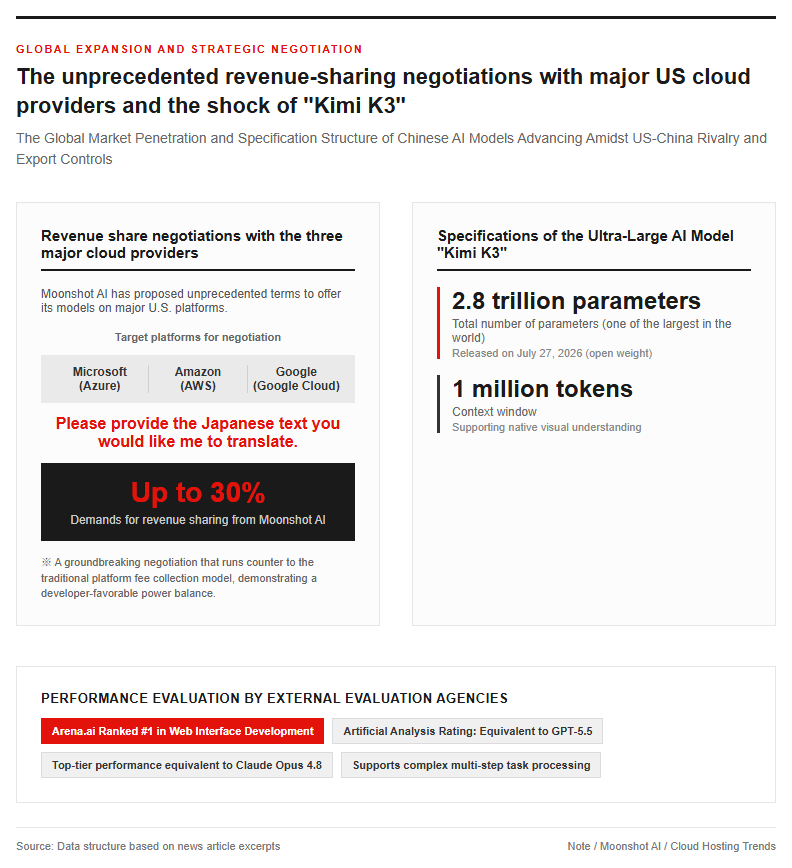
In August 2026, it was revealed that Moonshot AI, a Chinese artificial intelligence startup, is in close partnership negotiations with three of the leading U.S. cloud service providers: Microsoft Azure, Amazon Web Services, and Google Cloud, which is owned by Alphabet. The core of the negotiation is the conclusion of a revenue-sharing agreement in which the company’s developed large language model, Kimi K3, would be hosted on these three major cloud platforms, with up to 30% of the revenue generated from related services being distributed to Moonshot AI. If formally agreed upon, this would mark the first large-scale instance of a Chinese artificial intelligence company directly earning royalty revenues through major U.S. cloud infrastructure. Traditionally, the common business model has been for cloud operators to collect platform usage fees and commissions, but this time, the AI model developer is conversely demanding a large share of the sales, drawing high attention as a negotiation that shakes the industry’s power balance.
The Impact of “Kimi K3,” One of the World’s Largest 2.8 Trillion-Parameter Models
Kimi K3, which is currently the subject of negotiations, is a massive AI model whose base version was released as open-source (open-weight) by Moonshot AI on July 27, 2026. Its total parameter count reaches 2.8 trillion, boasting one of the largest scales in the world in terms of parameters. Additionally, it is equipped with a 1-million-token context window and natively supports visual comprehension. In benchmark tests conducted by the external performance evaluation organization Arena.ai, it captured first place in web interface building capabilities. Furthermore, according to evaluations by Artificial Analysis, it exhibits top-tier performance—on par with OpenAI’s GPT-5.5 and Anthropic’s Claude Opus 4.8—in tests processing complex, multi-step tasks. Please refer to the figure below.
However, the high-performance version of Kimi K3 remains closed-source and is available exclusively via API. Because running an immensely massive model with 2.8 trillion parameters individually on a company’s own infrastructure incurs astronomical computing costs, utilizing the API via major U.S. cloud providers is the only realistic option for many users.
The Million Threshold and the New Licensing Model
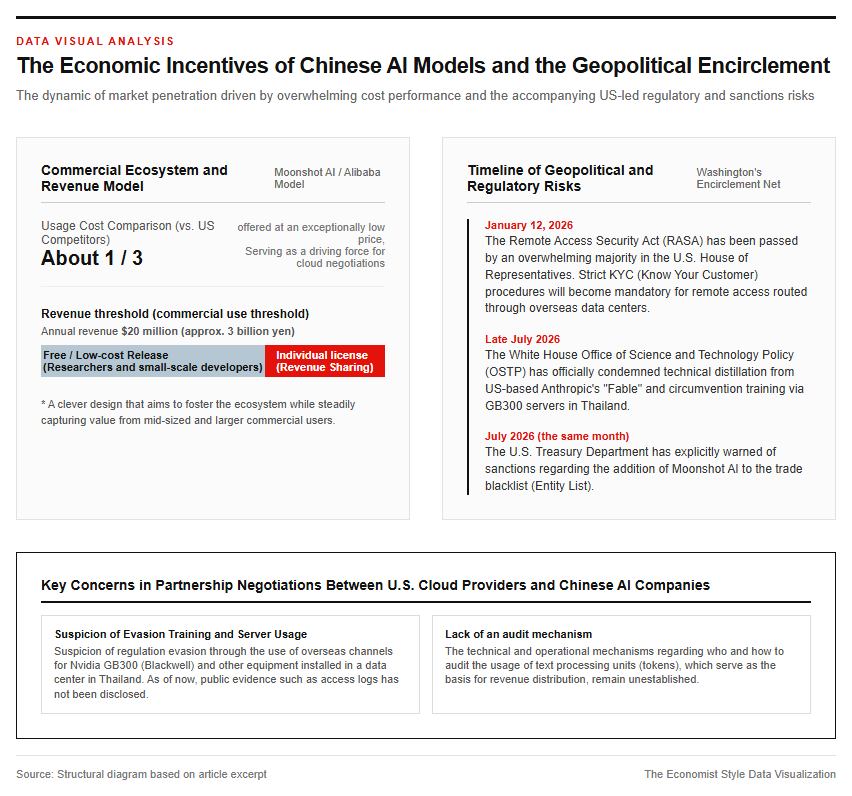
The licensing terms presented by Moonshot AI differ significantly from traditional software pricing models. Kimi K3 is made available to researchers and small-scale developers at an extremely low cost or for free. However, once a commercial user’s annual revenue exceeds the threshold of $20 million (approximately 3 billion yen), they are obligated to enter into a separate commercial licensing agreement with Moonshot AI and pay a portion of the generated revenue. This threshold is cleverly designed to protect hobbyists, academics, and early-stage startups to nurture the ecosystem, while reliably capturing value from mid-sized and larger commercial users. Furthermore, Chinese tech giant Alibaba is also planning to introduce a similar revenue-sharing framework for its latest model currently in development, Qwen3.8-Max. High-performance Chinese AI models are available at an exceptionally low price of about one-third of U.S. competitor models, and this overwhelming cost performance serves as the driving force that leads cloud providers to accept the stringent condition of revenue sharing.
Escalating National Security Regulations and Geopolitical Risks
Washington Investigates Allegations of Circumvention Training and Technology Theft
These negotiations are progressing amidst the U.S. government tightening export controls on advanced semiconductors to China on national security grounds, generating intense friction. In late July 2026, Michael Kratsios, Director of the White House Office of Science and Technology Policy, formally accused Moonshot AI of developing Kimi K3 by distilling technology from Fable, the premier model boasted by the U.S.-based company Anthropic. Furthermore, the company is suspected of illegally training its model while circumventing U.S. export controls by utilizing overseas channels such as Nvidia GB300 servers (Blackwell architecture) installed in a data center in Thailand. In response, Moonshot AI has completely denied these allegations, countering that the dramatic performance improvement of Kimi K3 is an independent achievement resulting from a self-devised change in its foundational architecture. At present, no public evidence such as server access logs indicating illegal server usage has been disclosed, but the intense scrutiny from Washington has become an extremely heavy shackle for U.S. cloud providers as they advance partnership negotiations.
Blacklist Warnings and Unresolved Audit Issues
What is further increasing the uncertainty of the negotiations are warnings of sanctions by U.S. authorities and unresolved issues concerning technical operational management. In July 2026, U.S. Treasury Secretary Scott Bessent explicitly warned of the possibility of sanctions to add Moonshot AI to the trade blacklist (Entity List). Furthermore, in the U.S. House of Representatives, the Remote Access Security Act (RASA)—which subjects remote access itself via overseas cloud data centers to export controls—was passed by an overwhelming majority on January 12, 2026, and thorough KYC (Know Your Customer) compliance is about to be mandated. In actual negotiations between the top three cloud providers and Moonshot AI, a mechanism has not been established regarding who and how to audit the usage of tokens, which are the units of text processing that form the basis of revenue. Please refer to the figure below.
Furthermore, privacy and national security concerns regarding the extent to which China’s Moonshot AI would have data access rights to AI models hosted on U.S. servers also remain unresolved, making prolonged negotiations inevitable.
The Global AI Market Landscape and Future Points of Focus
A B Valuation and the Scenario for a Hong Kong IPO
Since its establishment in 2023 by Yang Zhilin, a renowned researcher trained at Carnegie Mellon University, Moonshot AI has achieved rapid growth backed by massive financial support from companies such as Alibaba. The company completed its Series F funding round in July 2026, raising over $3.5 billion, which brought its post-money valuation to $35 billion. Furthermore, in August, it has been preparing to initiate investor discussions for a pre-IPO funding round assuming a pre-money valuation of $50 billion, aiming for a listing on the Hong Kong Stock Exchange within the next six months, between late 2026 and early 2027. Its annual recurring revenue surged threefold in just a few months, from $100 million in March 2026 to $300 million in June, and following the release of Kimi K3, daily sales leaped several times higher still. Establishing a global distribution network through major U.S. clouds has become a crucial commercial strategy to dramatically strengthen the company’s financial narrative ahead of its Hong Kong market listing.
The acceleration of commoditization and the questioning of infrastructure value
The trend of high-performance Chinese AI models being offered openly and at low prices is bringing about a tectonic shift in the global AI market and corporate business models. U.S. players such as OpenAI and Microsoft once generated huge profits through monthly subscriptions for expensive closed-source models, but price destruction by Chinese players is rapidly commoditizing AI models themselves. This has raised concerns about the recovery of massive infrastructure capital investments by major U.S. companies, temporarily leading to a decline in semiconductor-related stocks. However, the drop in the cost of running AI models has led to an explosive increase in the use of autonomous AI agents worldwide, and inference demand supporting processing is surging at an unprecedented pace. For major cloud providers, if they do not offer low-cost and attractive models to their customers, there is a risk that customers will flow out to external platforms. The decision of whether to host cutting-edge models like Kimi K3, even by accepting harsh conditions such as revenue sharing, will be a critical turning point that determines their future infrastructure defense strategies.
Reference page
- 【How U.S.-China competition is shaping AI advances and usage in science】https://doi.org/10.38105/spr.lxwm9ffjcf
【#MoonshotAI #KimiK3 #CloudComputing #Microsoft #AmazonWebServices #GoogleCloud #RevenueShare #ScienceAndTechnology】
コメント