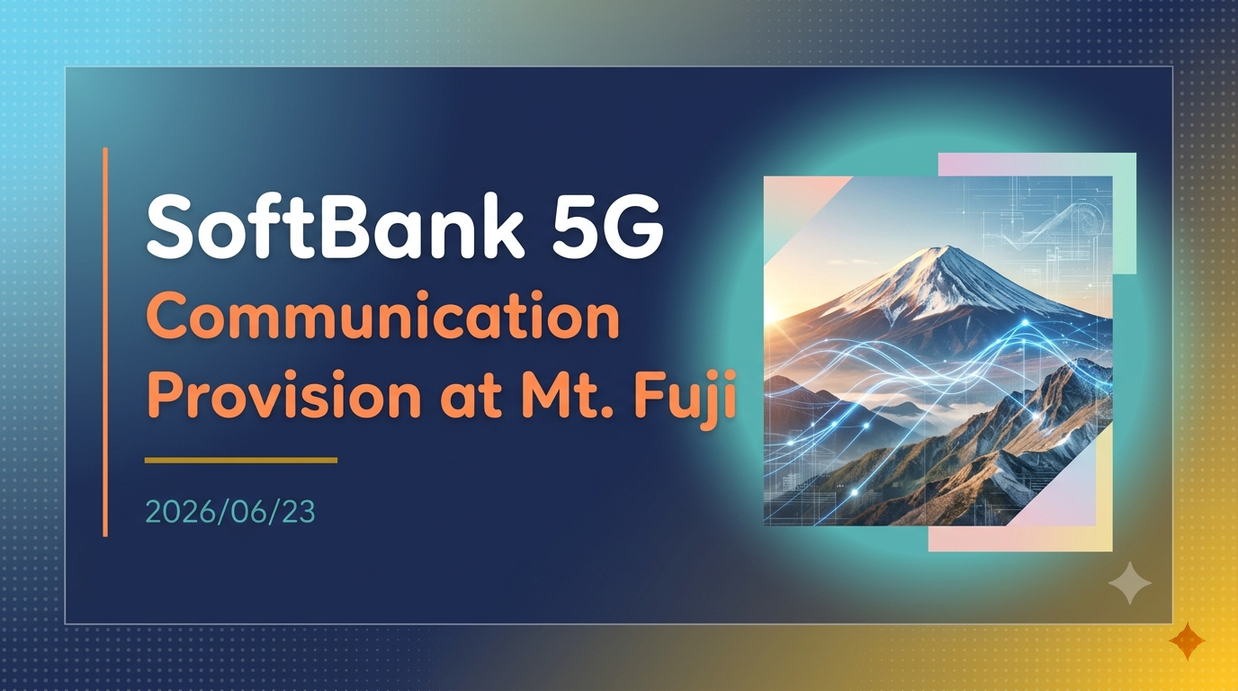
SoftBank has started offering “SoftBank 5G” and the high-quality “5G SA” system at the summit of Mt. Fuji. Behind this initiative lies the social mission of ensuring climbers’ safety and a management strategy to accelerate the construction of next-generation communication infrastructure utilizing AI.
- Provision of communication services and 5G SA deployment at the summit of Mt. Fuji
- Technical innovations and systems capable of withstanding harsh natural environments
- The Importance of Communication Infrastructure in Volcanic Disaster Prevention
- Promoting the “AI-RAN” Concept to Integrate AI and Communications
- Base Station Strategies and Market Share of the Four Major Mobile Carriers
- Satellite communication “Starlink Direct” and laying the groundwork for 6G
Provision of communication services and 5G SA deployment at the summit of Mt. Fuji
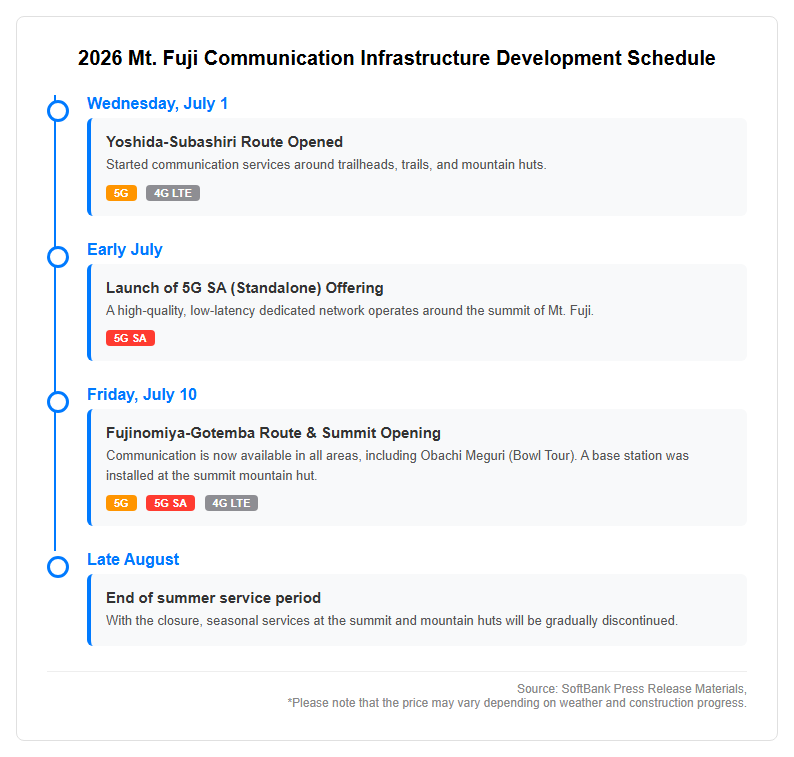
On June 22, 2026, SoftBank announced that it would offer “SoftBank 5G” and “SoftBank 4G LTE” services at the summit and around mountain huts during the peak of Mt. Fuji during the opening period. The service period is scheduled to run from early July to late August 2026. For Mt. Fuji in 2026, the Yoshida-Subashiri route is scheduled to open on July 1, and the Fujinomiya-Gotemba route and summit (Obachi-meguri) are scheduled to open on July 10, with communication infrastructure being improved to accommodate the increase in climbers. Particularly noteworthy is the launch of the 5G SA (standalone) mode, which will begin in early July. This system is built with 5G-specific technology from core equipment to base stations, enabling higher communication quality than conventional methods. By using this high-speed communication, climbers can share their summit excitement in real time as high-quality videos on social media and other platforms. Please refer to the diagram below.
Technical innovations and systems capable of withstanding harsh natural environments
Operating a base station at the summit of Mt. Fuji at an elevation of 3,776 meters is incomparably more challenging than in urban areas. SoftBank has installed dedicated antenna equipment to withstand severe weather such as strong winds and lightning, striving to improve user experience quality. Additionally, since the mountain hut is supplied by generators, it is extremely valuable, and equipment has been reviewed to minimize the increase in power consumption due to the introduction of 5G. These radio wave countermeasures are carried out in close collaboration among the ‘radio operators,’ ‘transmission managers,’ and ‘construction personnel.’ Once installed, frequent maintenance is not possible, requiring thorough preparation and speedy on-site work. Thanks to the accumulated experience of the technical team, the area where smartphones can be used has expanded year by year, and today, communication quality on major climbing routes is almost indistinguishable from urban areas.
Next-generation communications envisioned by safety and AI strategies
The Importance of Communication Infrastructure in Volcanic Disaster Prevention
Mount Fuji is an active volcano, and rapid information transmission in the event of an eruption or natural disaster is a lifeline. According to materials from the Ministry of Internal Affairs and Communications, it is difficult to predict when and where Mount Fuji will erupt, and the phenomenon progresses very rapidly. Therefore, it is important to provide accurate information in real time to on-site stakeholders such as mountain guides and mountain hut staff. SoftBank’s 5G SA deployment also makes a significant contribution to disaster prevention efforts. By leveraging 5G’s high-speed, low-latency characteristics, it is possible to analyze weather data and high-definition footage near mountain summits in real time, helping to prevent reckless climbs and improve the efficiency of rescue operations. Additionally, a robust communication system provides climbers with great peace of mind as an emergency contact method in case of injury or poor health.
Promoting the “AI-RAN” Concept to Integrate AI and Communications
SoftBank has launched the “AI-RAN” initiative, which aims to advance networks by leveraging artificial intelligence. This is a new architecture that integrates AI applications and Radio Access Network (RAN) on the same computer infrastructure. Even in places like Mount Fuji where communication load fluctuates rapidly, AI analyzes data traffic in real time and operates the network efficiently according to conditions, aiming to maintain stable communication quality. In fact, SoftBank is not only increasing the number of 5G base stations but also raising the proportion of SA support to almost all areas, leveraging SA’s characteristics such as low latency and priority control. This technology, which optimizes communication traffic with AI, forms the foundation for next-generation social infrastructure looking ahead to the future 6G era, and the demonstration at Mount Fuji is a key part of that effort.
Competitive Structure and Future Outlook in the Telecommunications Industry
Base Station Strategies and Market Share of the Four Major Mobile Carriers
The domestic base station market is shifting from merely competing over installation numbers to a phase of “how efficiently we process and turn it into value.” According to a survey as of the end of March 2025, SoftBank has over 100,000 5G base stations and is actively expanding its 5G coverage compared to competitors. In particular, it is strategically advancing the conversion of 4G frequencies to 5G (NR), achieving a significant performance in 5G data traffic volume that far surpasses NTT Docomo. Meanwhile, KDDI has been implementing 5G coverage early on Mount Fuji, providing year-round 4G from the trailhead to the summit, and launching 5G only in summer, thereby strengthening the appeal of leisure users. Each company is pursuing strategies to improve ARPU (Average Revenue per User) by combining 5G with financial, content, or corporate solutions.
Satellite communication “Starlink Direct” and laying the groundwork for 6G
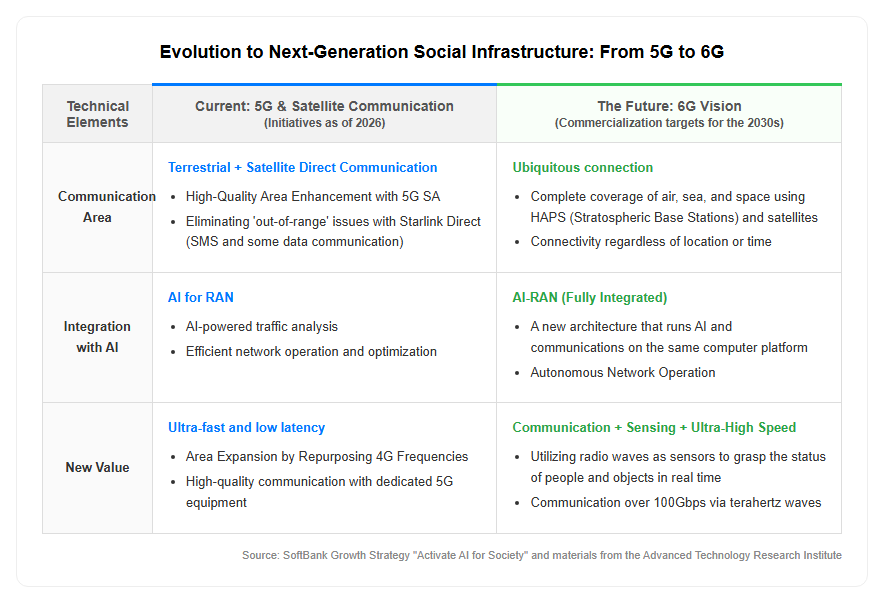
SoftBank is accelerating the use of non-terrestrial networks (NTN) by aiming for a “complete areaization” of mountainous and remote islands that ground base stations alone cannot cover. Starting April 10, 2026, “SoftBank Starlink Direct” was launched, allowing direct communication between satellites in space and smartphones. As a result, SMS and some apps will be available even in areas outside the usual zones, which is expected to help ensure safety outside the climbing routes of Mt. Fuji and during winter closures. Furthermore, the next-generation communication standard “6G,” aiming for commercialization in the 2030s, plans are underway to integrate communication and sensing, as well as to realize ubiquitous connections through flying base stations called “HAPS.” Experience building infrastructure in extreme environments like Mount Fuji will become valuable data for the practical use of these future communication technologies, and will serve as a source supporting SoftBank’s corporate value enhancement. Please refer to the diagram below.
[#ソフトバンク #5G #富士山 #通信インフラ #6G #経済 #ビジネス #DX]


コメント