Claudio Co., Ltd. announced the “SQUD Development and Maintenance Pack,” a new service for core systems that applies a proprietary AI-driven development methodology, on September 1, 2026. Behind this announcement are the challenges of suppressing costs in core system overhauls and add-on development, as well as maintaining consistent, high-level quality control through the post-implementation maintenance phase.
- Launch of New Service Implementing Proprietary Development Methodology
- Feature-based standard pricing and end-to-end support up to maintenance
- The Aim of Improving Development Efficiency to Support Small and Medium-Sized Enterprises
- 5 Values to Prevent Misalignment Between Clients and Developers
- Quality control combining AI efficiency and human judgment
- Expansion of Application Areas and Future System Modernization Strategies
Launch of New Service Implementing Proprietary Development Methodology
Claudio Co., Ltd., which engages in digital transformation consulting and system development, launched its new core system service, the SQUD Development and Maintenance Pack, on September 1, 2026. At the core of this service is SQUD, a proprietary AI-driven development methodology that combines the initials of Speed, QUality, and Delivery. In conventional system development, there has been a tendency to focus on how quickly program code can be generated using generative AI. In contrast, SQUD is not an approach aimed solely at high-speed code generation. Instead, it adopts a framework that builds a working prototype from the early stages of development to flesh out the client’s requirements, seamlessly transitioning into design, testing, and review processes that can withstand production use. Thus, rather than stopping at creation despite utilizing AI, the greatest novelty and technical value of this new methodology lie in its ability to reliably connect the specification and design processes established during development all the way through to post-implementation operation and maintenance.
Feature-based standard pricing and end-to-end support up to maintenance
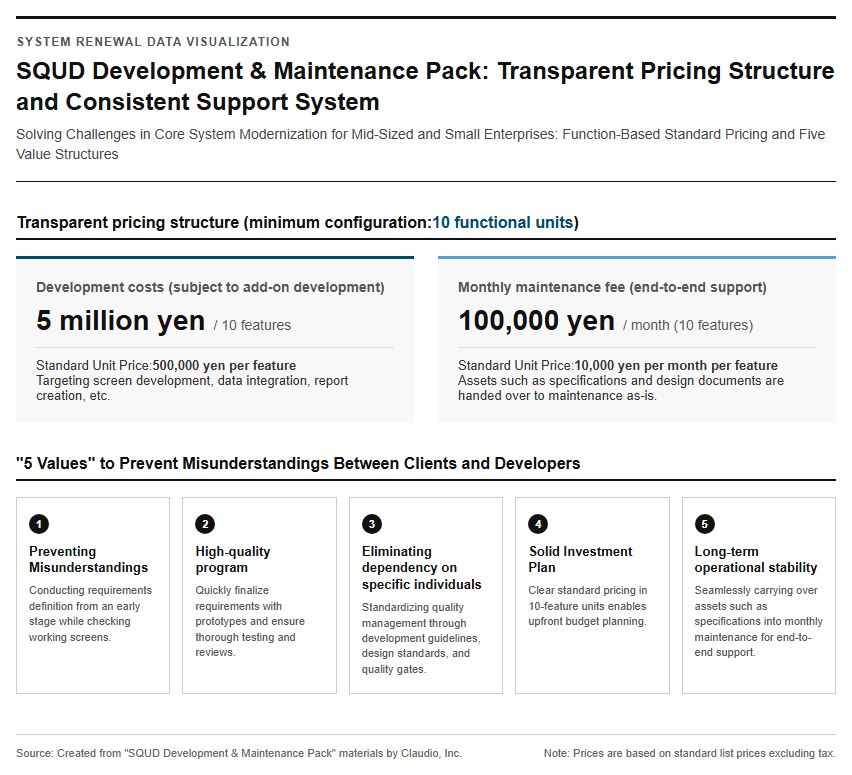
One of the factors that troubles mid-sized and small-to-medium enterprises in system development is opaque development budgets and expensive post-implementation operation and maintenance costs. To solve these financial challenges, the SQUD Development and Maintenance Pack adopts an extremely transparent pricing structure. Specifically, targeting add-on development such as screen development, data integration, and report creation, we have set clear standard prices of 500,000 yen per function for development and 10,000 yen per function per month for maintenance. This package is offered in units of 10 functions, and with the initial minimum configuration of 10 functions, you can begin using it for a development price of 5 million yen and a monthly maintenance price of 100,000 yen. This straightforward pricing based on the number of functions allows client companies to reliably plan their budgets in advance. Another key feature of this service is that deliverables created during system development—such as detailed specifications, design documents, and various guidelines—are consistently and seamlessly handed over to the monthly maintenance service, ensuring that the quality of post-implementation support is continuously guaranteed without relying on specific individuals.
Challenges in Core System Modernization and the Value Provided by SQUD
The Aim of Improving Development Efficiency to Support Small and Medium-Sized Enterprises
After launching a core business system, additional development continuously arises due to changes in business models, revisions to laws and regulations, and reviews of business processes, such as layout changes for screens and reports, or new data integration with other external systems. However, in many companies, every time such additional development is carried out, routine work processes such as preliminary preparation, creation of design documents, and quality management are individually and repeatedly executed, with their man-hours and costs becoming a burden on management. The developer, Claudio Inc., determined that it could dramatically streamline the entire system development cycle not only by providing automated program implementation support using generative AI, but also by standardizing procedures for creating various documents and judgment criteria for quality management—which are repeated for each project—as common rules in advance. By thoroughly eliminating wasteful development man-hours and redundant document creation through the introduction of SQUD, and directly reflecting those reduced costs into standard service pricing, the company aims to strongly support medium and small enterprises so they can concentrate their limited human resources and funds on their core businesses.
5 Values to Prevent Misalignment Between Clients and Developers
The innovations brought by the SQUD Development and Maintenance Package can be broadly summarized into five key values. First, by proceeding with requirement definition from early stages while checking actually functioning screens, it prevents misalignments in understanding between the ordering side and the development team. Second, after swiftly finalizing requirements using prototypes, it incorporates necessary testing and reviews to finish the product into a high-quality program. Third, by embedding the judgment criteria possessed by seasoned development experts into system-level development rules, design standards, documentation formats, and even quality gates in advance, it prevents quality management from depending on individual skills. Fourth, by presenting a clear standard price per 10-feature unit, it enables the calculation of a reliable investment plan prior to contract signing. And fifth, assets such as specifications created during the system construction process are seamlessly carried over to the monthly maintenance service, supporting long-term operational stability. Please refer to the figure below.
Through these systematic values, you can effortlessly transition away from one-off development and build a sustainable development framework that incorporates ongoing maintenance.
The Division of Roles Between AI and Humans and Future Outlook
Quality control combining AI efficiency and human judgment
One of the standout features of the SQUD Development and Maintenance Pack is that it clearly defines the boundary between the tasks that advanced generative AI excels at and the areas where human engineers must take responsibility. Repetitive system development tasks, such as coding and unit testing, are executed extremely rapidly by leveraging the power of generative AI. Furthermore, the designs and requirements fed into the AI are strictly managed as text documents, minimizing fluctuations in the AI’s output. However, while generative AI excels at generating syntactically correct code at high speed, it cannot fundamentally understand whether its processing truly fulfills a company’s complex business rules or exceptional operational requirements. Consequently, the SQUD process incorporates evaluation points known as “quality gates” at key development milestones. The division of roles ensures that humans are always responsible for confirming the suitability of final system specifications, checking code quality, and deciding whether or not to deploy to the production system. By fusing technological efficiency with human expertise at a high level, we ensure secure and reliable operations.
Expansion of Application Areas and Future System Modernization Strategies
As a first step, the SQUD Development and Maintenance Pack launched by Claudio Co., Ltd. will be applied to ERP add-on development projects centered on Microsoft Dynamics 365. It will use SQUD’s efficient approach to implement unique business requirements, screen adjustments, and data integration features that cannot be fully accommodated by standard ERP functions alone. Moving forward, the company plans to consolidate the know-how and improvement data gained from applying SQUD to actual ERP add-on development projects, sequentially expanding the scope of its supported technologies and applicable platforms. Additionally, the company has published a technical white paper for the general public detailing SQUD’s comprehensive development process, the operating principles of its speed and quality modes—which switch between prioritizing development speed and quality—and the criteria for dividing roles between AI and human teams. For companies struggling with the black-boxing and legacy state of their core systems, SQUD—which simultaneously achieves the assetization of specifications and the standardization of maintenance through AI utilization—will likely become a powerful option in core system renewal strategies from 2026 onward.
Reference Page
- [Claudio Inc. Official Website] https://www.claudio.co.jp/
- [SQUD Technical White Paper Publication Page] https://www.claudio.co.jp/whitepaper/squd-technical-specifications
[#SQUD #AIDrivenDevelopment #CoreSystems #ERP #DigitalTransformation #SystemDevelopment #Claudio #Dynamics365]
コメント