On June 30, 2026, the Ministry of Economy, Trade and Industry announced that it had selected Noetra, a new company funded by SoftBank and others, and the National Institute of Advanced Industrial Science and Technology, for the development of a domestic ‘physical AI’ infrastructure model project for robots and other devices to autonomously operate in real spaces. This project is planned to provide support totaling 1 trillion yen, aiming to reduce dependence on overseas AI models and strengthen the competitiveness of domestic industries.
- Key points of the Ministry of Economy, Trade and Industry’s adoption and overview of the development project
- Division of roles between Noetra and AIST leading development
- The significance of a five-year plan and an initial investment of 387.3 billion yen
- Definition of Physical AI and Its Impact on Manufacturing
- Economic Security and Risk Avoidance of Dependence on Overseas Models
- GX (Green Transformation) and the Pursuit of Power Efficiency
- Intermediary Goals for 2029 and Steps to Practical Application
- The ultimate goal for 2031 and realizing real-world native AI
- Future Highlights and Social Expansion
Key points of the Ministry of Economy, Trade and Industry’s adoption and overview of the development project
On June 30, 2026, the Ministry of Economy, Trade and Industry announced that it had selected a new company, Noetra, and the National Institute of Advanced Industrial Science and Technology (AIST) for the domestic foundational model development project for “physical AI” that autonomously operates robots and other devices in the real world. The official name of this project is the “Multimodal Platform Model Development Project for AI Robots and Physical AI,” based on a public call conducted by NEDO (New Energy and Industrial Technology Development Organization) from March to April 2026. According to a press conference held after the cabinet meeting by Minister of Economy, Trade and Industry Ryomasa Akazawa, it has been decided to support Noetra with 387.3 billion yen in development commission funds for fiscal year 2026. The project period is planned for five years, from fiscal 2026 to 2030, and the government has indicated plans to provide massive support totaling 1 trillion yen. This large-scale national policy project is positioned as part of a strategy to focus investments in areas where Japan can leverage its unique strengths amid the massive AI development race between the US and China.
Division of roles between Noetra and AIST leading development
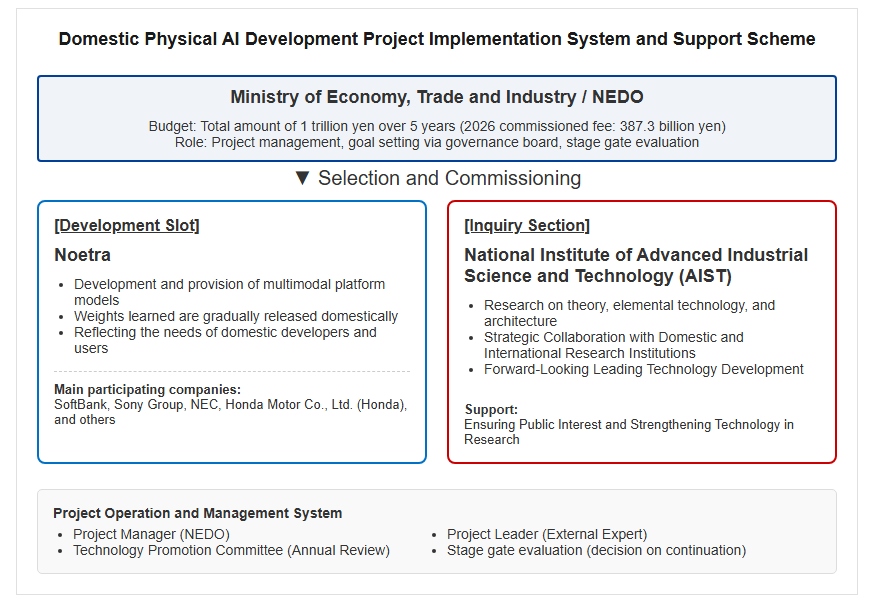
In this project, Noetra, a consortium of private companies, and AIST, a public research institution, will advance development by leveraging their respective strengths and responsibilities. Noetra is a new company established with investment from major domestic companies such as SoftBank, NEC, Sony Group, and Honda Motor Co., Ltd. (Honda). Noetra’s main role is to develop and provide internationally competitive multimodal foundation models that meet the needs of domestic model developers and utilization operators. Specifically, the trained weights of developed models will be sequentially released domestically during the project period to promote their widespread use. Meanwhile, AIST collaborates with domestic and international research institutions to conduct pioneering research on theory, elemental technology, and architecture. Looking at the relationship diagram, Noetra has established a cooperative framework through the NEDO project, where Noetra implements and provides services, while AIST reinforces research and ensures public interest.
The significance of a five-year plan and an initial investment of 387.3 billion yen
This project is designed as a five-year plan through fiscal year 2030, with an extremely large commission budget of 387.3 billion yen expected in the first year, fiscal year 2026. Behind such massive investments lies concerns that developing globally competitive AI foundational models requires the procurement of a vast number of GPUs (image processing semiconductors), making it difficult for domestic private companies alone to bear the initial investment burden. Moreover, AI technology innovates at an extremely fast pace, and it is necessary to advance in coordination with global development strategies, rather than limiting itself to specific companies or domestic expertise. Therefore, this project is being carried out as a commissioned project, with a strict management system in place for project leaders led by NEDO’s project managers and external experts. Furthermore, detailed management aimed at ensuring practical implementation will be implemented, such as judging whether to continue the project through annual stage gate evaluations.
The diagram below shows the implementation structure and support mechanisms for this project.
Why is the domestic production of “physical AI” important now?
Definition of Physical AI and Its Impact on Manufacturing
Physical AI refers to AI that autonomously judges and operates robots and machines in the physical space, unlike conventional generative AI that generates text and images in digital spaces. While traditional AI specialized in information processing, physical AI can understand physical characteristics of the real world through cameras and sensors, allowing it to select the optimal actions according to the situation. This technology has the potential to reduce on-site waste by shortening setup changes at manufacturing sites, preventing quality defects before they occur, and optimizing maintenance. Japan holds a high global share in the industrial robot sector, and combining this “on-site capability” with physical AI is regarded as one of the biggest winners in international competitiveness. According to strategic materials from the Cabinet Office, the market size in AI robotics, including physical AI, is projected to reach about 60 trillion yen by 2040, and it is expected to contribute to the social challenge of resolving structural labor shortages.
Economic Security and Risk Avoidance of Dependence on Overseas Models
One major reason Japan insists on developing domestic models is concerns about economic security. Currently, many domain-specific models in Japan rely on foundational models from overseas, but if things continue as they are, there is a risk that the use of AI in Japan will be limited by the business strategies, export controls, and geopolitical risks of developing countries. In fact, in the United States, there is a movement to treat top AI models as national security assets and to restrict access from abroad. Entrusting the entire foundation of physical AI—which can be called the “nervous system” supporting Japan’s critical infrastructure such as manufacturing and logistics—to overseas models poses a significant risk. Therefore, securing a domestically produced multimodal platform model that can be safely utilized in the future while protecting Japan’s industrial data has become an urgent priority. Having an AI infrastructure capable of autonomous development and utilization is extremely important from the perspective of preventing the expansion of digital deficits and securing technological sovereignty.
GX (Green Transformation) and the Pursuit of Power Efficiency
Domestic production of physical AI is an essential initiative from the perspective of GX, which aims to reduce environmental impact. Looking ahead to a future where AI utilization expands explosively, for Japan, where energy self-sufficiency is low, reducing power consumption through AI use is an even more urgent issue than in other countries. If we continue to rely on overseas models, there is a risk that we will not be able to determine the implementation level of low-power technologies suitable for Japan’s energy situation. The government’s “Basic Plan for Artificial Intelligence” also stipulates the realization of a “new technology-driven nation” and contributions to GX across society through research and development of energy-efficient AI foundational models. This project aims to realize GX by reducing energy load in manufacturing processes, and the development of highly efficient foundational models itself aims to become a new strength for Japan in international competitiveness.
Future Developments and Targets for 2031
Intermediary Goals for 2029 and Steps to Practical Application
March 2029 marks a key milestone in the interim evaluation of the project’s progress. The goal at this stage is to build a foundation capable of recognition and logical reasoning targeting not only language information but also images, videos, and audio information, and to generate and supply the “synthetic data” necessary for training corporate and high-efficiency models. The developed models will be widely available to Japanese model development and utilization businesses in parallel with the remaining period. This aims to accelerate the social implementation of physical AI in manufacturing and other settings. Furthermore, since AI technology advances rapidly, performance metrics are reviewed annually, and management is flexibly carried out in cooperation with the Ministry of Economy, Trade and Industry’s Governance Board to align with globally established major metrics.
The ultimate goal for 2031 and realizing real-world native AI
The ultimate goal of this project is to complete a multimodal foundational model by March 2031 that enables logical reasoning that integrates information about real space, including physical properties. This aims to be a “real-world native AI” capable of “real-world recognition, reproduction, and prediction,” aiming to enable AI to handle cyber and physical domains as an integrated entity. By equipping it with the ability to recognize physical space as a world-class foundational model, it forms the foundation for AI robots that autonomously perform complex tasks. The ultimate outcome is that by widely disseminating these results in domestic industries, it will contribute to further advancing and strengthening international competitiveness.
Future Highlights and Social Expansion
A key point to watch going forward is how Noetra will expand investment and partnerships from companies across diverse industries. Major companies such as Sony, SoftBank, and Honda have already participated, but going forward, they plan to receive investment not only from manufacturing but also from a wide range of industries promoting AI utilization, such as construction and transportation. We plan to build a system that covers everything from research and development to demonstration evaluation, as well as multilingual support and expansion to overseas bases. Furthermore, the fields where physical AI is used are expected to extend beyond industrial uses, as Minister Akazawa mentioned, to areas directly linked to solving issues in Japanese society, such as healthcare for the elderly, which is facing a declining birthrate and aging population. This project, which is investing about 1 trillion yen in national funds, is attracting great interest in how it will transform Japan’s industrial structure beyond mere technological development.
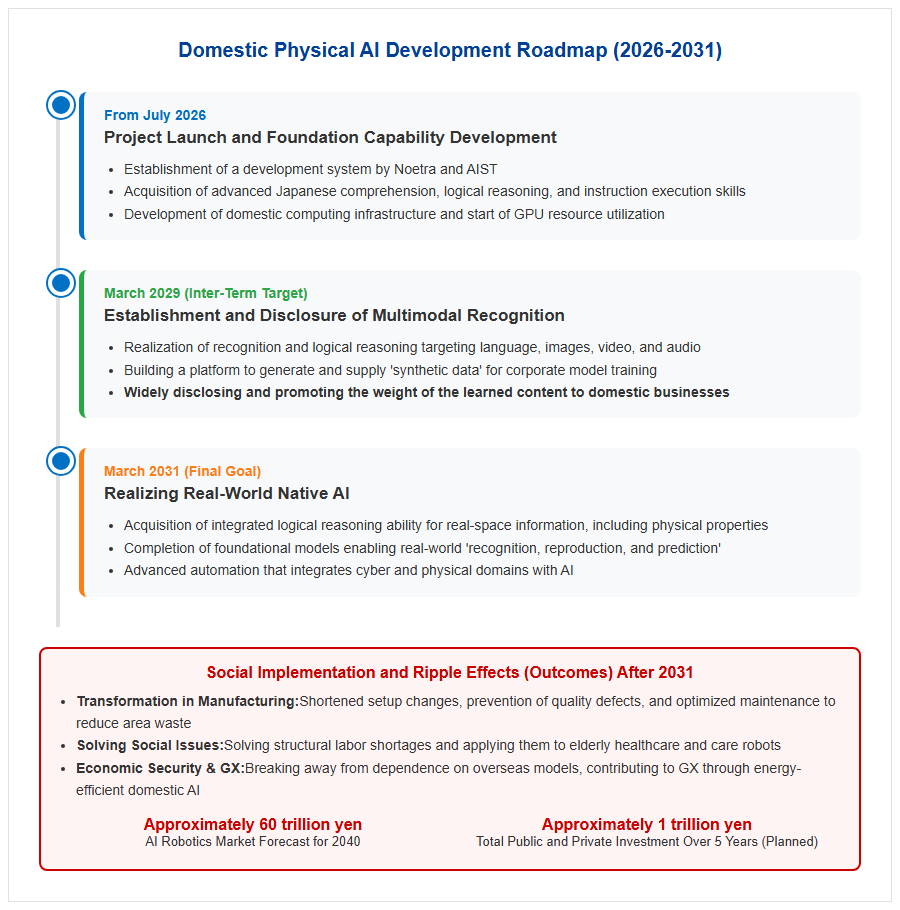
The diagram below shows the pathway toward future outcome goals.
[#生成AI #フィジカルAI #ロボティクス #経済安全保障 #GX #製造業DX #Noetra #産総研]

コメント