The Ministry of Land, Infrastructure, Transport and Tourism (MLIT) has begun revising the “Station Square Planning Guidelines” to accommodate new mobility options such as autonomous vehicles and unmanned delivery robots. This is driven by the need to update the conventional design philosophy maintained for a quarter of a century, and to integrate people-centric, walkable spaces and the latest logistics functions into urban spaces.
- Section 1-1: Background of the Committee’s Establishment and the First Guideline Revision in a Quarter of a Century
- Section 1-2: Diversifying Mobility and Acceptance of Logistics Entities
- Section 2-1: Reconstruction of Station Front Plazas Compatible with Autonomous Driving
- Section 2.2: Simulation of the Impact of Boarding and Alighting Space Design on Traffic Flow
- Section 3-1: Review Process in FY2026 and Future Developments
- Section 3-2: Coordination with Existing Operators and Establishing Rules for Space Allocation
Section 1-1: Background of the Committee’s Establishment and the First Guideline Revision in a Quarter of a Century
On August 28, 2026, the Ministry of Land, Infrastructure, Transport and Tourism announced the establishment of the “Station Square Planning Guidelines Review Committee” aimed at revising the “Station Square Planning Guidelines,” which serve as the standards for station square planning and design. Following this, the first committee meeting was held on September 1, 2026. The current guidelines position station squares as transportation nodes connecting railways and cities, defining them as facilities to manage the boarding, alighting, and lingering of buses, taxis, and private cars. However, approximately a quarter of a century has passed since these guidelines were formulated, and social conditions and urban policies have changed significantly. In recent years, opportunities to newly develop station squares have decreased, with the redevelopment of existing facilities becoming the mainstream. Moreover, urban policies now strongly demand consistency with the promotion of compact-plus-networks, comfortable and walkable urban development, and “station-city design” that views stations and cities in an integrated manner. Against this background, discussions have begun in earnest to update the basic philosophy regarding station square development to suit the times and to fundamentally review planning methods and design standards.
Section 1-2: Diversifying Mobility and Acceptance of Logistics Entities
The most noteworthy point in the consideration of this revision is that the anticipated users now directly include transportation and logistics operators premised on new technologies such as autonomous vehicles, ride-sharing, and shared mobility, as well as unmanned delivery robots and last-mile delivery. Conventional station plaza design guidelines were constructed based on the philosophy of allocating passenger circulation routes and pedestrian gathering spaces, primarily assuming the act of “humans getting in and out of vehicles.” However, today, driverless autonomous vehicles and last-mile logistics vehicles for cargo transshipment are appearing one after another in urban spaces, necessitating coexistence in the utilization of the same space. Treating logistics functions intended for cargo transshipment as explicit design requirements for station plazas is a completely new approach not seen in previous guidelines. By adding new non-human active entities into the limited physical space of the station plaza, the very design philosophy of how to manage spatial priorities and the intersection of traffic lines will be fundamentally rewritten by this revision.
Spatial Reorganization and Design Challenges for the Autonomous Driving Society
Section 2-1: Reconstruction of Station Front Plazas Compatible with Autonomous Driving
Looking ahead to an era where autonomous driving technology is fully implemented in society, securing drop-off and pick-up spaces as well as waiting areas in station forecourts will become a major challenge. This is because the spread of autonomous vehicles risks causing localized spikes in boarding and alighting demand, leading to vehicle congestion and traffic jams. To address this issue, the “Collection of Points for Utilizing Autonomous Driving Technology in Urban Spaces,” compiled by the Urban Bureau of the Ministry of Land, Infrastructure, Transport and Tourism (MLIT), proposes flexible space management. Specifically, a system is being considered to streamline how autonomous vehicles wait and to effectively utilize parking lots and unused vacant spaces in surrounding urban areas as remote waiting locations. By doing so, it is expected that drop-off and pick-up berths within station forecourts can be consolidated, transforming the resulting surplus space into walkable areas where pedestrians can relax. To achieve the shift from a car-centric space to a people-centric public space, appropriate control of incoming vehicles and the securing of a parking environment that leverages IT are becoming essential elements.
Section 2.2: Simulation of the Impact of Boarding and Alighting Space Design on Traffic Flow
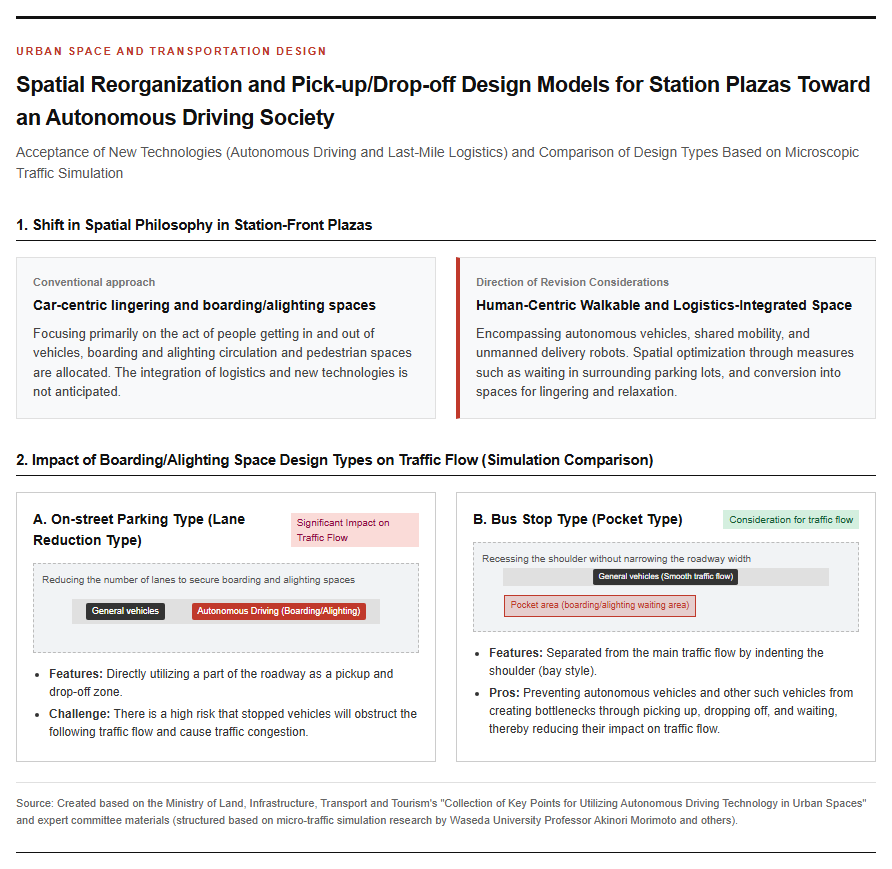
Quantitative research using microscopic traffic simulators is underway regarding how the pick-up and drop-off behavior of autonomous vehicles on streets in front of stations impacts the road traffic environment. A research group led by Professor Akinori Morimoto of Waseda University, who serves as the chair of this committee, analyzed the effects of pick-up and drop-off space design types on traffic flow. Specifically, they compared two types: an on-street parking type that secures pick-up and drop-off space by reducing the number of lanes, and a bus-stop type that recesses the shoulder without reducing the roadway width. A diagram showing the basic configuration of the pick-up and drop-off environment is inserted below.
As a result of simulations conducted on these two types, it was confirmed that the bus-stop type can significantly reduce the average delay per vehicle caused by an increase in parking frequency compared to the street-parking type. This is because, in the street-parking type, following vehicles are forced to slow down or stop every time the autonomous vehicle performs boarding and alighting maneuvers, whereas in the bus-stop type, they can smoothly bypass it by changing lanes. Please refer to the figure below regarding the patterns of the boarding/alighting space types and the configurations that take into account the impact of their design.
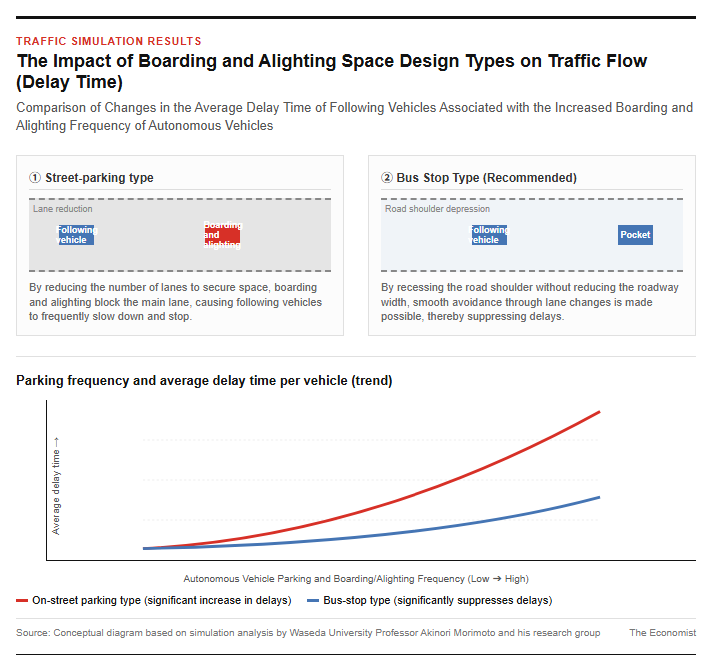
On the other hand, a trade-off has also become clear: while expanding the length of the boarding and alighting space from 40 meters to 100 meters increases the number of vehicles that can pick up and drop off passengers, it also increases the frequency with which following vehicles must slow down during entry or re-entry, thereby having a greater impact on the overall road environment. Therefore, in future station-front designs, it is necessary to carefully plan the appropriate scale and spatial allocation to match parking demand.
Future Schedule and Impact on Regional Transportation Policy
Section 3-1: Review Process in FY2026 and Future Developments
The Ministry of Land, Infrastructure, Transport and Tourism has outlined a schedule to advance discussions in this review committee during fiscal 2026 and compile the outline and direction for revising the guidelines. Specific draft revisions to the planning guidelines are expected to be published in 2027 and rolled out to local governments nationwide. Because the revised guidelines will be directly referenced in the design of station plazas to be newly established or renovated in the future, they will have strong practical effectiveness in actual urban planning. As discussed in symposia previously held by the Ministry of Land, Infrastructure, Transport and Tourism, many local governments cite “prospects for implementation” and “technical challenges” when positioning autonomous driving and new technologies within urban spaces. While upfront investment in corresponding infrastructure development is not easy, it is considered important to incorporate it into medium- to long-term plans and prevent stagnation of initiatives due to personnel transfers. Moving forward, the key will be a process of building an industry-academia-government network involving diverse stakeholders such as transport operators and universities, and cascading the revised guidelines into the field while sharing phased deployment scenarios.
Section 3-2: Coordination with Existing Operators and Establishing Rules for Space Allocation
The station square, an extremely limited urban space, has traditionally been fixed by forces responsible for transportation, such as local bus and taxi operators. The size of the parking spaces and waiting pools allocated to each operator is directly linked to their practical operating power and vested interests, making physical conflicts over them inevitable. Incorporating new rideshare pick-up/drop-off zones, transfer spaces for unmanned delivery robots, and even stops for autonomous shuttles into this environment means executing high-level interest adjustments to cut into existing parking spaces and carve them out for new entities. The question of what kind of mobility and logistics entities this revised guideline will provide with priority traffic lines and spaces will dictate the initial conditions of business competition in future local transportation. It goes beyond merely serving as a revision of technical standards; it takes on the character of an industrial policy that redesigns the region’s mobility portfolio, and fierce debates are expected to erupt in future coordination phases, such as regional public transportation councils in local governments.
Reference Page
- Initiating Discussions for the Revision of the “Station Square Planning Guidelines” – First Station Square Planning Guidelines Committee Meeting Held – Ministry of Land, Infrastructure, Transport and Tourism
- [Urban Planning: Station Plaza Planning Guidelines Review Committee – Ministry of Land, Infrastructure, Transport and Tourism] https://www.mlit.go.jp/toshi/city_plan/toshi_city_plan_tk_000143.html
- 【Realizing Safer and Smoother Mobility in an Autonomous Driving Society – Road Bureau, Ministry of Land, Infrastructure, Transport and Tourism】https://www.mlit.go.jp/jidosha/content/002005398.pdf
- [Key Points for the Utilization of Autonomous Driving Technology in Urban Spaces – Ministry of Land, Infrastructure, Transport and Tourism] https://www.mlit.go.jp/toshi/content/001890965.pdf
- 【Study Group on Measures for Utilizing Autonomous Driving Technology in Urban Transportation – Ministry of Land, Infrastructure, Transport and Tourism】https://www.mlit.go.jp/toshi/toshi_gairo_tk_000079.html
【#AutonomousDriving #UrbanPlanning #MLIT #StationSquare #LastMile #SmartCity #Mobility】


コメント