It has been revealed that the disaster recovery project carried out by Hiroshima Prefecture systematically forged official documents necessary for design change discussions. The background was the reality that overwork due to large-scale disaster response and inappropriate administrative procedures for subsidy receipts had become routine.
- The Beginning of the Discovery and File Name: The Shock of Lies
- The Reality of Organized Fraud Revealed by the Primary Investigation
- Unprecedented disasters and insufficient scrutiny due to efficiency assessments
- Gap in Perception Between the Technical Planning Section and the On-site Construction Office
- Fabricating false stories prioritizing subsidy securing
- Opaque approval processes and failures in mutual checking functions
- Compliance awareness that had become a mere formality
- Approximately 50 million yen in national fund repayments and economic compensation
- Conducting secondary investigations and formulating fundamental measures to prevent recurrence
- Shortage of Construction Consultants and Future Challenges
The Beginning of the Discovery and File Name: The Shock of Lies
This issue began when it was reported that during disaster recovery work handled by the Kure Branch of the Western Construction Office of the Hiroshima Prefectural Civil Engineering and Architecture Bureau, false consultation records had been prepared during design change negotiations with the national government. What shocked me most was the fact that the prefectural employee had written falsehoods in the file names of the meeting record data created and stored. Normally, when making design changes, documents based on substantive consultations with landowners and related organizations are required, but the branch office prepared false documents claiming that discussions had been held without consulting with landowners.
Initially, the issue was seen as an exceptional case involving a few staff, but as the internal investigation progressed, the seriousness of the situation became apparent. Of the 23 records in the Kure Branch Office’s jurisdiction, 20 were found to be false, and data labeled as false in file names was also found at the Hatsukaichi and Higashihiroshima branches, further strengthening the possibility that the fraud was not localized. The prefecture took the situation seriously and, in June 2025, established an investigation team led by the vice governor and launched a prefecture-wide investigation.
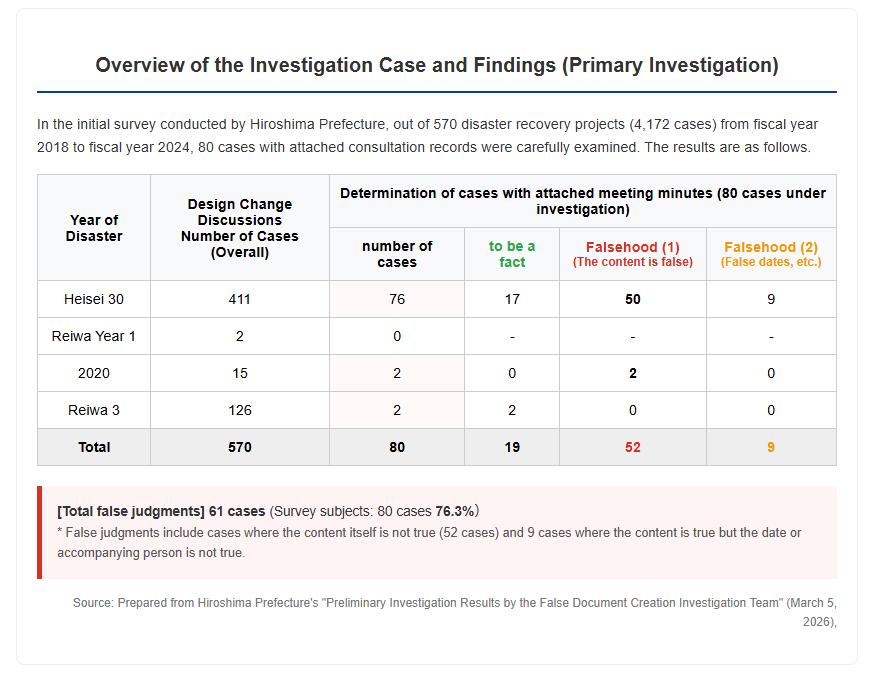
The following images outline the case under investigation.
The Reality of Organized Fraud Revealed by the Primary Investigation
In the initial survey conducted by Hiroshima Prefecture, 80 design change consultations with attached records were carefully examined from disaster recovery projects carried out between fiscal year 2018 and fiscal year 2024. As a result, 61 cases, or about 76% of the total, were found to be false meeting minutes. Breakdown, 52 cases were found to contain inaccurate discussions themselves, and 9 cases were found to be false dates or accompanying persons. This fraud spanned multiple construction offices in Kure, Seibu, Mihara, Higashihiroshima, and Hokubu, revealing widespread creation of false documents within the organization.
The main contents of the fabricated consultation records covered a wide range, including the installation of construction roads, changes to the disposal site for residual soil, and the addition of traffic guides. For example, despite a shortage of construction roads due to design errors and insufficient examination during the assessment, the government recorded in the meeting record a false reason to claim the route was changed because the landowner refused to use the land, and submitted it to the national government. Investigations confirmed many cases where false meeting minutes were deliberately prepared despite reasons for design changes, indicating that the mere formalization of documents was an objective.
Structural Background and Motivation That Triggered the Fraud
Unprecedented disasters and insufficient scrutiny due to efficiency assessments
The background to the creation of the false documents lies in the unprecedented large-scale disaster of the July 2018 heavy rain. Within Hiroshima Prefecture, there was a huge 2,523 disaster recovery projects that required rapid processing. To address this, the government has implemented measures to streamline disaster assessments, simplifying the process by making cases under 50 million yen eligible for desk assessments. However, these efficiency measures ultimately led to insufficient on-site inspection.
According to staff interviews, at the time, schedules were tight, and designs had to rely on aerial photographs and existing ledgers, resulting in many cases being evaluated without sufficient on-site investigation. As a result, design flaws were discovered after construction began, and situations where the original design could not be completed frequently occurred. Ideally, a legitimate design change should have been requested at this stage, but the psychological burden of admitting mistakes during appraisals and the time constraints caused by the massive workload led staff to make reckless fabrications.
Gap in Perception Between the Technical Planning Section and the On-site Construction Office
Communication failures within organizations were also a major factor promoting fraud. There was a significant misunderstanding regarding how design changes were handled between the Technical Planning Division, which oversees disaster recovery projects and negotiates with the national government, and the Construction Office, which actually handles the site. The construction office recognized that even if there were omissions due to efficiency assessments, they could be flexibly addressed in subsequent design change discussions.
However, the Technical Planning Division believed that even for simple assessments, strict principles (such as changes in circumstances after evaluation) should be applied to design changes after the assessment, and that omissions from the assessment could not be added later. This gap in perception put great pressure on the field. During the hearings, several field staff testified that the technical planning department staff suggested that ‘even if it’s a lie, we need meeting minutes,’ or strongly demanded a ‘story that could get government approval,’ indicating that the hierarchy between headquarters and the site could not reject corruption.
Fabricating false stories prioritizing subsidy securing
The costs of disaster recovery projects are covered by national treasury contributions, but obtaining the consent of the competent minister is required for this. Any changes that could not obtain national approval had to be borne solely by the prefecture, and for sites with strict budget constraints, passing the design change consultation was the highest priority. Officials judged that mere design errors and insufficient scrutiny could not obtain the government’s approval, and began fabricating false stories that met the country’s requirements.
Specifically, it is common to cite changes in circumstances after appraisal as the reason for the landowner’s change of heart. For example, even though the road design was actually inaccessible to large vehicles, the landowner refused to lease the land, so they fabricated a reasonable and false reason to switch to a small machine. Once such misconduct was discovered, it was shared within the organization as a collection of case studies and treated as a template in subsequent cases. As a result, the practice of prioritizing the consistency of documents for subsidy receipt over truthfulness became routine, a process that gave way to the cart before the horse.
Lack of organizational management and governance
Opaque approval processes and failures in mutual checking functions
In this case, the critical factor was that the organization’s checking function was not functioning at all. When preparing application materials for design change consultations, there were no clear rules for managers such as section chiefs or chief managers at each construction office to verify the authenticity of the content and approve it. The materials prepared by the person in charge were submitted to the Technical Planning Division without undergoing organizational verification, and there, only formal reviews were submitted to the national government.
Furthermore, it was found that it had become a habitual practice of leaving the seals of transferred employees in the department. Successor staff could easily use this seal to align the seals of their superiors or colleagues with false meeting records going back to past dates. Despite the presence of a seal section, it did not function as proof of fact, but rather became a tool to give false documents the appearance of legitimacy, indicating that Hiroshima Prefecture’s internal controls were extremely weak.
Compliance awareness that had become a mere formality
It must also be pointed out that among the staff of the Civil Engineering and Architecture Department, there was a significant lack of awareness of compliance (adherence to laws and regulations). Although compliance training was conducted in the prefecture, its content remained abstract and spiritual, and there was insufficient guidance on whether the creation of false official documents constitutes a criminal offense or the specific boundaries of illegal acts.
As a result, many employees have chosen fabrication carelessly for the sake of overwork or securing budgets. From the hearings, we see employees who recognized the wrongdoing as a bad thing but justified it by saying they had no choice but to do it to achieve organizational goals and avoid difficult situations. In recent years, the Hiroshima Prefectural Civil Engineering and Architecture Bureau has seen a series of inappropriate cases such as government bid-rigging and violations of the Forest Act and the Cultural Properties Protection Act, confirming the deep-rooted organizational culture of disregard for legal regulations.
Social Impact and Future Trust Restoration
Approximately 50 million yen in national fund repayments and economic compensation
As a result of the creation of false documents, Hiroshima Prefecture suffered significant economic losses and a loss of social credibility. Of the 61 cases found to be false in the initial survey, 21 cases were found to have impacts on national funds. The prefecture calculated the difference between the construction costs if properly handled and the actual costs paid based on false documents, announcing the impact of about 75.29 million yen, of which the national treasury contribution (domestic expenses) amounted to about 50.22 million yen.
The prefecture anticipates that the government will partially revoke the grant decision or issue a refund order for these national funds, in which case an additional fee equivalent to interest of approximately 23 million yen will be required. This has become an extremely unhealthy situation where the compensation exceeding the subsidies sought through fabrication is paid from prefectural taxes. There is also a possibility that early redemption of prefectural bonds may be necessary, raising concerns about the long-term impact on fiscal management.
Conducting secondary investigations and formulating fundamental measures to prevent recurrence
To fully understand the situation, the prefecture plans to continue conducting secondary investigations on the remaining approximately 570 design change consultations that were excluded from the initial survey. In the investigation, third-party lawyers will continue to participate and conduct objective verification. Previous investigations have suggested that even in cases where consultation minutes are not attached, applications may have been made for reasons that differ from the facts, and more in-depth investigations are needed, such as matching construction ledgers and construction plans.
To prevent recurrence, measures such as clarifying the rules for approving design change consultations, fundamentally reviewing compliance training, and formulating rules for determining residual soil disposal costs during large-scale disasters have been proposed. In particular, it is urgent to clarify the division of responsibilities between the Technical Planning Division and the Construction Office, and to establish an organizational structure that can promptly share on-site challenges. To restore lost trust in the prefectural administration, transparent disclosure of survey results and a fundamental transformation toward an organizational culture that does not tolerate scandals are essential.
Shortage of Construction Consultants and Future Challenges
The underlying cause of this scandal, the overwork, lies in the serious shortage of personnel and the challenges of training construction consultants across the entire construction industry. Although the number of technical staff has been increasing since 2010, there is a shortage of core staff in their 30s to early 40s, posing challenges in passing down technology and quality control. Additionally, delays in leveling out delivery deadlines concentrated at the end of the fiscal year have led to overwork for staff and contractors, creating an environment that easily leads to insufficient scrutiny and errors.
The following chart illustrates the recent challenges faced in the working environment in the construction consulting industry.
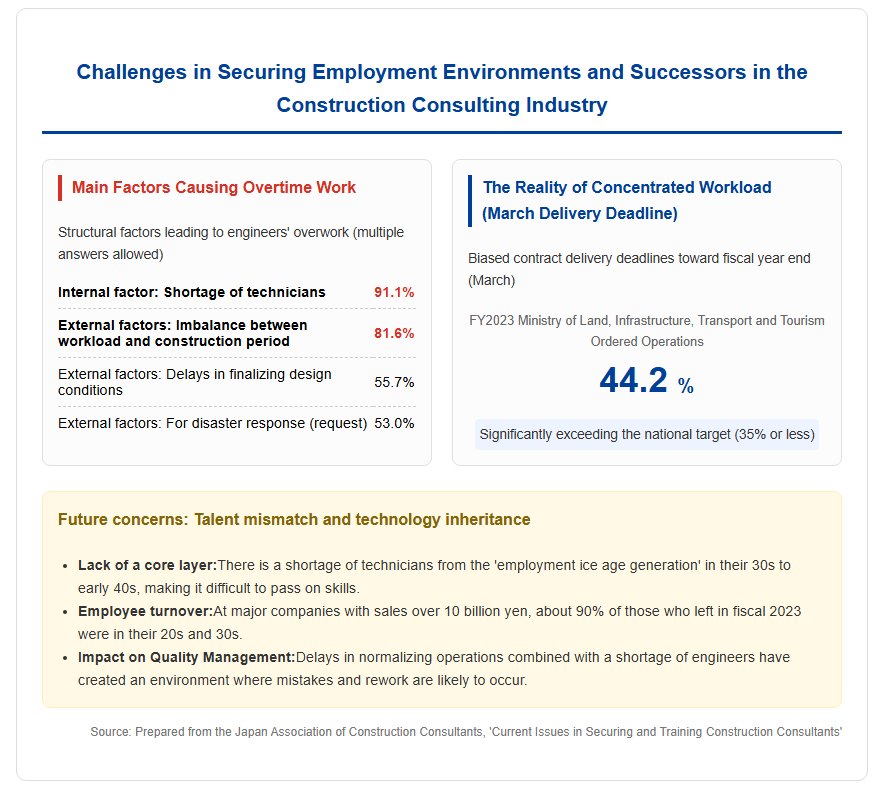
With the anticipated frequent occurrence of severe disasters due to climate change in the future, to prevent a recurrence of incidents like this, it is necessary not only to reform the government internally but also to address structural challenges across the construction industry, such as securing and training engineers to support infrastructure, and leveling out appropriate construction schedules and ordering. To maintain a sustainable society, it is essential to simultaneously promote the advancement of engineers and the creation of an environment where business can be conducted through proper processes.
[#広島県 #公共事業 #コンプライアンス #西日本豪雨 #行政の透明性 #災害復旧 #砂防工事 #広島県議会]


コメント